Industry
Part of Mansions: organizing public, private and service space in one plan
Agency prices compared with what an assessment file actually shows
Agency price figures sit next to assessment file numbers, and the two measure different things. Here is what each one is actually counting in the record.
An assessment file and an agency price sheet both carry a number for a house. They are not the same document, and the numbers are not the same number. Sotheby's International Realty and Compass typically quote 5% to 6% of sale price in total. In New York City, Class 1 homes are assessed at 6% of market value.
This page puts real agency pricing next to what an assessment file records, names the agencies, and shows where the two figures part company.
What to take away
- Full-service agencies such as Sotheby's and Christie's typically charge 5% to 6% of sale price in total, with the listing side usually 2.5% to 3%. The rate is negotiable and set in the listing agreement, not by law.
- An assessment file records a value for tax purposes, on a fixed date, for a whole class of property. It is not an appraisal and not a sale price. In New York City, Class 1 homes are assessed at 6% of market value.
- Flat-fee and limited-service listings move the commission off the sale price and onto a fixed charge. HomeLister packages typically run from about $399 to $999 as of 2026, and Redfin lists at 1.5% in many markets.
- The two numbers can differ by a wide margin and both can be correct. A $4,000,000 agency price can sit beside a $240,000 assessed value on a 6% assessment roll.
- Ask any agency for its fee schedule in writing before you sign a listing agreement.
What agencies actually charge
Commission is a percentage of the sale price, split between the listing side and the buyer side. The rate is negotiable. Nothing in federal law sets it. The figures below are published or commonly quoted structures as of 2026, not a quote for your house.
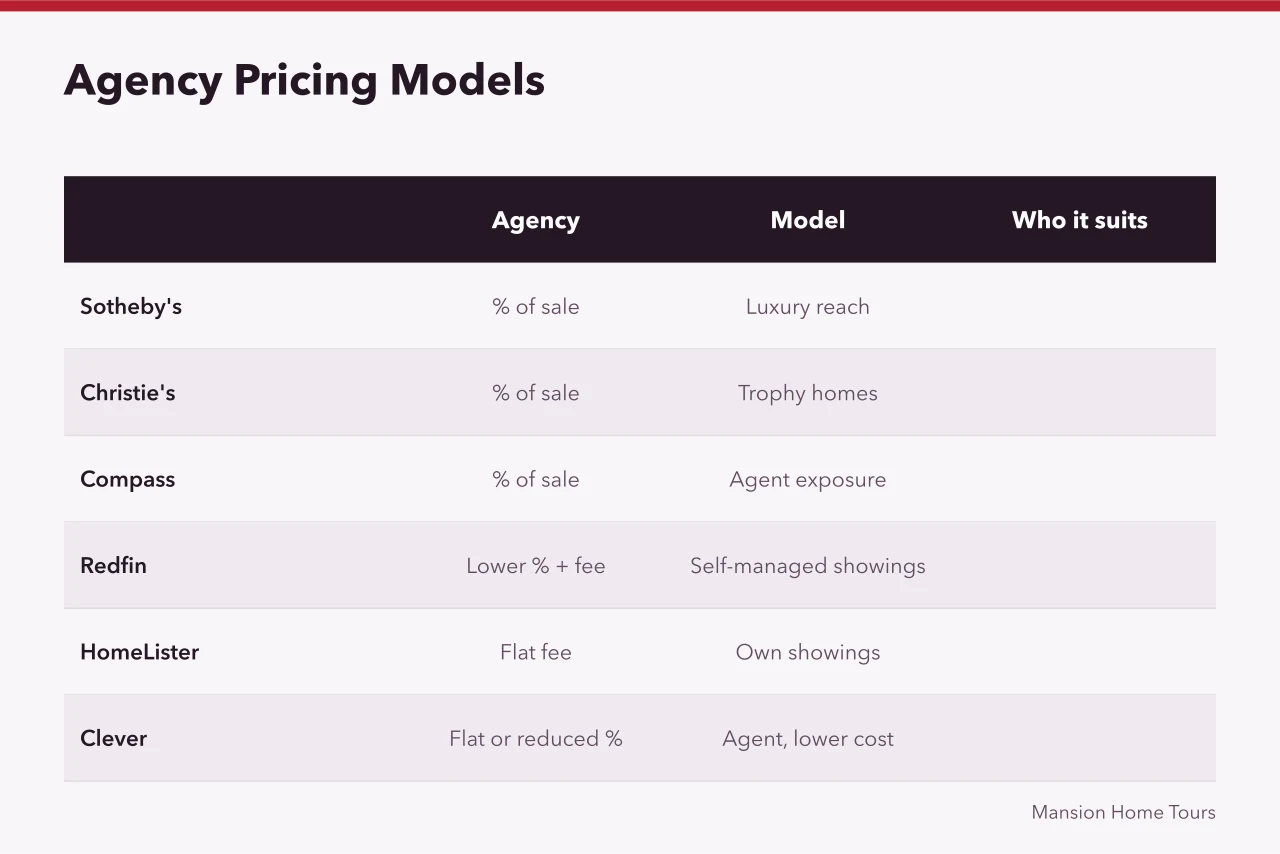
| Agency | Model | What it does | Who it suits |
|---|---|---|---|
| Sotheby's International Realty | Percentage of sale price, typically 5% to 6% total; listing side often 2.5% to 3% | Luxury marketing, international buyer network, private listings | High-value homes needing discreet, broad reach |
| Christie's International Real Estate | Percentage of sale price, typically 5% to 6% total; listing side often 2.5% to 3% | Art-world and collector network, luxury branding | Trophy and architecturally significant homes |
| Compass | Percentage of sale price, typically 5% to 6% total; listing side often 2.5% to 3% | Large in-house agent network, proprietary technology platform | Sellers wanting wide agent-to-agent exposure |
| Redfin | 1.5% listing fee in many markets, or 1% if you also buy through Redfin, with a minimum fee | Tech-led listing, limited in-person service | Sellers comfortable managing showings |
| HomeLister | Flat fee, packages typically $399 to $999 as of 2026; free option not on MLS | Seller lists on the MLS themselves, no listing agent | Sellers who will run their own showings |
| Clever Real Estate | 1.5% listing fee in many markets, with a $3,000 minimum in some | Matches sellers with local agents at a set rate | Sellers wanting an agent without a full commission |
The percentage itself is the variable that matters. If a home sells for P and the agreed rate is r, the listing-side fee is P x r.
At a rate of 2.5 percent on a P of 4,000,000, that is 100,000. A full 5% total commission would be 200,000. Substitute your own figures.
The rate is the thing to negotiate, and it is written into the listing agreement before the house goes on the market.
What the assessment file records
An assessment file is a form with fixed boxes, filled in so thousands of parcels can be compared quickly. It carries a parcel identifier, a land area, a building area, and a story count. It also carries a year built, room counts, a construction class, and a condition grade.
The file usually holds two figures: a market value and an assessed value. The assessed value is a percentage of market value set by state or local law. New York City assesses Class 1 homes at 6% of market value and Class 2 homes at 45%.
That value is set for tax purposes, on a stated date, under rules that apply to a whole class of property. It is not a sale price and not an appraisal. New York City's explanation of property assessments sets out the scope plainly, and the same reading applies wherever you are.
Where the two numbers part company
An agency price is a marketing opinion of what a buyer will pay, formed close to the sale and adjusted for condition, view and timing. An assessment value is an administrative figure, often set years earlier, tied to a roll that is updated on its own schedule.
A $4,000,000 agency price on a Class 1 New York City home can sit beside an assessed value near $240,000 in the file. The market value field may read $4,000,000, while the assessed value is 6% of that.
| Criterion | Agency price | Assessment file |
|---|---|---|
| What it measures | Likely sale price | Taxable value |
| Date | Close to sale | Stated roll date, often years earlier |
| Who sets it | Brokerage, by agreement | Assessor, by statute |
| Range driver | Marketing, condition, view, timing | Class ratio, exemptions, roll updates |
Neither corrects the other. A seller who treats a high assessment as proof of value, or a low one as a problem, is reading the wrong document.
Why agencies disagree with each other
Two agencies can quote different percentages for the same house. The rate reflects the marketing budget, the size of the agent network, and how much of the work the seller will do.
Sotheby's and Christie's carry photography, staging, international placement and a private listing option, and typically charge 5% to 6% total. HomeLister carries a listing on the MLS for a flat fee that typically runs from about $399 to $999.
Redfin lists at 1.5% in many markets, or 1% if you also buy through Redfin, with a minimum fee. Clever Real Estate charges 1.5% in many markets, with a $3,000 minimum in some. The gap in price is the gap in labor.
What the file cannot capture
| The record says | What it cannot capture |
|---|---|
| Building area | Whether the area is one usable plan or a collection of leftover rooms |
| Number of stories | Whether the levels connect sensibly |
| Year built | The later campaigns of work that produced most of what stands |
| Room counts | Whether a household and a guest can avoid each other |
| Construction class | The condition of the specific roof, gutters and sills |
| Quality grade | Whether the finish is original, a good replacement, or a bad one |
Year built is the most misread field. On a long-history house it is often the earliest known campaign, sometimes a permit date, occasionally a guess. To read a building from its mass and openings rather than its paperwork, see reading a house from the street.
How to use both documents honestly
Take the assessment fields as claims by an agency, dated. Write the date next to whatever you take from it. Do not derive layout from area, or section from a story count.
For the history of the fabric, the designation and survey material is where the method lives. the National Register database and research guidance explains how those files are structured and searched.
This site does not publish figures that would locate a private home. The reasoning is in privacy-safe maps. What a large house is, structurally and socially, sits in the mansion as a type, and how public records differ by city is in homes by city.
Common questions
Does an assessment file tell me what a house is worth?
No. It tells you what one office recorded for tax purposes, on a stated date, under rules that apply to a whole class of property. That is a different thing from a sale price or an appraisal. A $4,000,000 agency price can sit beside a $240,000 assessed value in a 6% class.
Why do two agencies quote different percentages?
Because the rate reflects what each one does. Sotheby's and Christie's carry marketing, staging and international placement at 5% to 6% total. HomeLister carries an MLS listing for a flat fee of about $399 to $999. The gap in price is the gap in labor.
Is the recorded building area often wrong?
It is often different, not wrong. Some systems measure to the outside face of the wall, some to the inside. Some count a finished attic, some do not. Two correct records of the same house can differ for that reason alone.
What is the best single public document about a building?
Where one exists, the designation or survey report, because it was written to explain a building rather than to classify a parcel, and it cites its sources. Where none exists, the permit history, read in order, is the next best thing.