Guides
Part of Mansions: organizing public, private and service space in one plan
What does a wide lens hide about mansions interiors in listing photos?
Mansions interiors in photographs: what a wide lens does to a room, what staging removes, and how to read the pictures as evidence rather than sales.
Nobody walks into a room and finds it matches the photograph. That is not dishonesty. A three-dimensional space with working ceiling height, a door you enter, and a radiator under the window becomes a rectangle. A lens chosen to make it look generous flattens it.
Once you know what the camera does, the pictures become evidence instead of an advertisement.
What to take away
- A wide lens does not simply fit more in. It stretches whatever is near the camera and pushes the far wall away, which is why rooms photograph larger than they are.
- Most interior images are taken from a corner, at a height no adult ever stands at, with the verticals corrected afterwards.
- The most informative thing about a set of interior photographs is which rooms are missing from it.
What the lens does
A wide angle lens increases the apparent distance between the front of the room and the back. Objects close to the camera grow, objects far away shrink, and the diagonal from the corner becomes the longest line available. Shoot from a corner with a wide lens and a room reads as roughly a third larger than it measures.
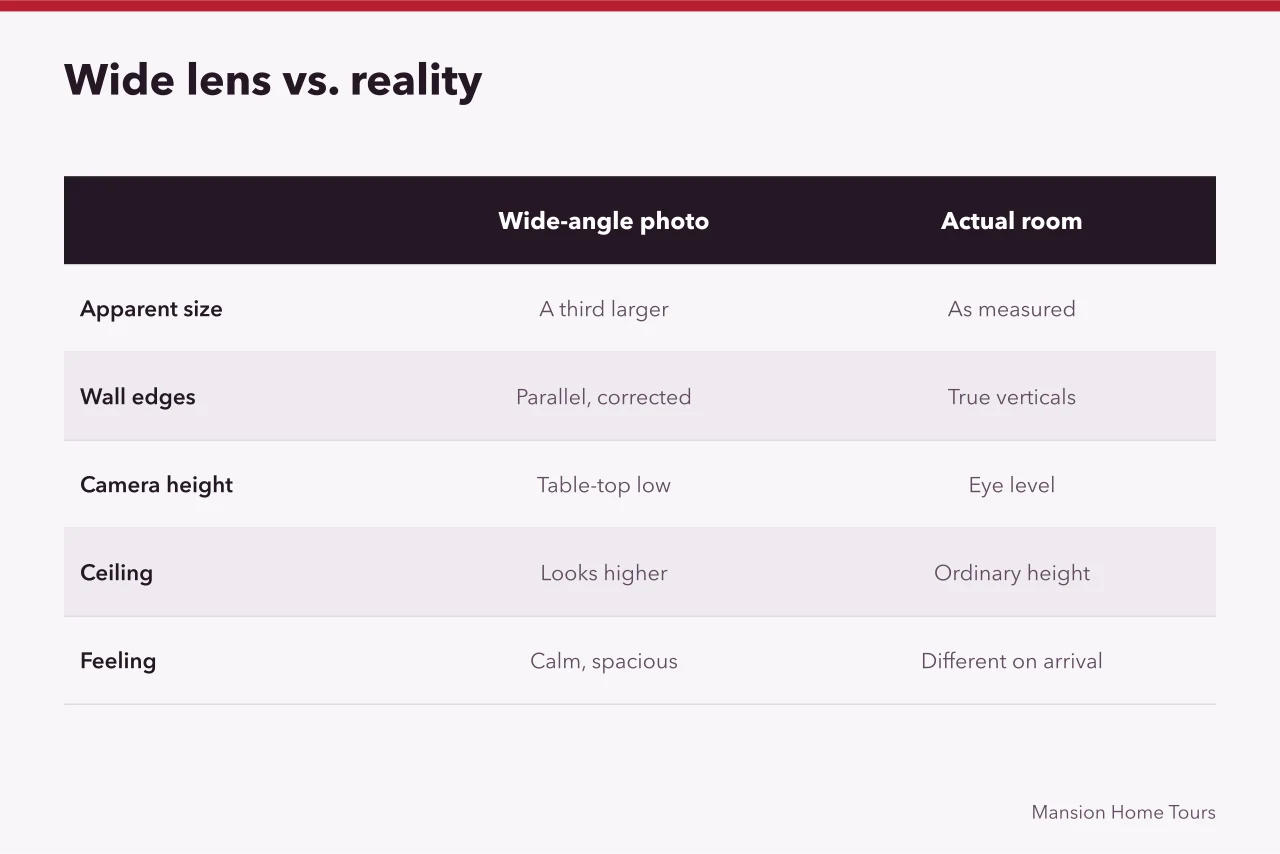
Verticals give it away. To make a room look square, the camera must be level, or the image corrected so wall edges run parallel.
Tilt the camera up in an uncorrected image and walls lean inward. Almost every published interior has that removed. The pictures look calm; the space feels different when you arrive.
Camera height matters as much as the lens. Interiors are usually shot lower than eye level, often around table top height.
A low camera makes ceilings look higher and keeps floor and furniture in proportion. It also hides an ordinary ceiling. If a photograph makes you feel small in the room, check where the camera was.
What is outside the frame
| What the picture is doing | What it usually leaves out | How to check |
|---|---|---|
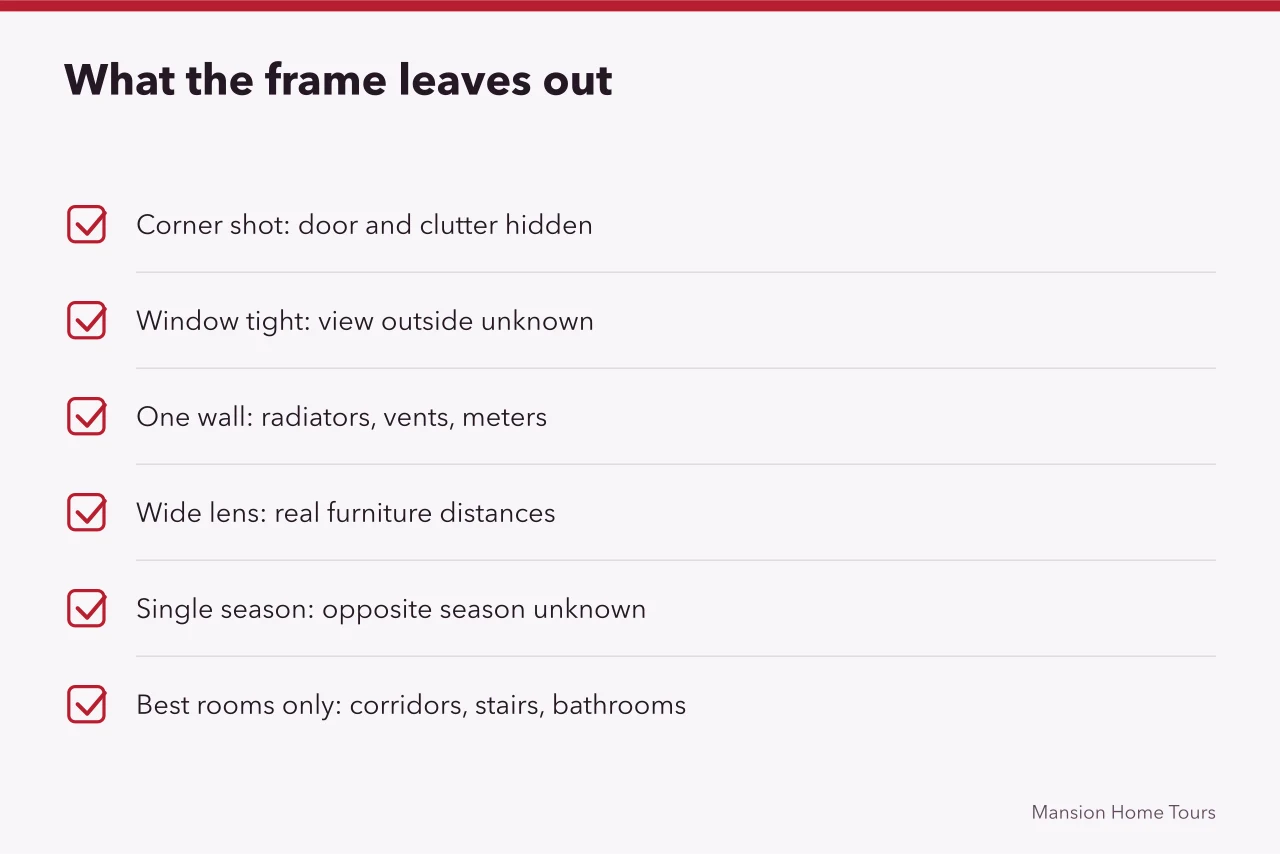
| Shooting from a corner | The corner the camera was standing in, which often holds the door and the clutter | Ask for a photo taken from the opposite direction |
| Framing tight on the window | What the window actually looks at | Ask for a shot from inside looking straight out |
| Composing around one wall | Radiators, vents, meters, switch banks and service risers | Look for a floor plan and match the walls |
| Using a wide lens in a small room | The real distance between furniture and walls | Ask for dimensions, or count floorboards or tiles |
| Photographing in a single season | How the room performs in the opposite one | Ask when the pictures were taken |
| Showing the best rooms | Corridors, stairs, bathrooms, utility spaces and anything unrestored | Note which rooms have no photograph at all |
The absent rooms are the strongest signal in any set. A house presented in twelve pictures with no corridor, no stair, no kitchen from a second angle and no bathroom is telling you where to look when you visit.
Staging, which is most of the effect
Furniture in a photographed room is frequently smaller than furniture people live with. Sofas are shallower, tables are narrower, beds are dressed to look larger while the room around them is emptied. Everything that signals daily life goes: cables, bins, drying racks, chargers, the second chair nobody wanted. What is left reads as calm, and calm reads as spacious.
Rugs organize the floor and stop the eye at a chosen point. Mirrors double a window or extend a wall. Doors open to make a room seem to continue.
Plants and flowers give scale and color at a known size. None of this deceives on its own; all of it shifts the picture away from how the room will feel.
Lighting is the last layer. Interiors are usually shot with lamps on and daylight balanced against them, often by combining several exposures so the window is not blown out and corners are not black.
Real rooms do not work that way. In a real room, the window is bright and the corner is dark. Your eye adjusts as you look around. The photograph shows a version with the contrast removed.
Reading pictures like evidence
The trick is to stop asking whether the room is attractive and start asking what the image proves. Ceiling height can be estimated from a standard door in the frame. Window proportion and reveal depth survive any amount of staging.
Floor material, cornice profile, skirting height and the position of doors are all difficult to fake and easy to compare against the plan. Measured drawings, which state the dimensions a lens distorts, are produced to a consistent standard by the Historic American Buildings Survey.
Use the pictures to build questions, not conclusions. How does that room connect to the one before it, where is the light coming from at that hour, and what is on the wall the camera stands against?
Then answer them on site. Apply the same discipline to the room studies in new york homes interiors and the tour method set out in mansions list.
Historic photographs are a useful corrective because they were taken to record rather than to sell. The interiors held in the Library of Congress photographic collections show rooms crowded with the textiles, screens and furniture that people actually used, which is a truer picture of how a large room was made habitable than a cleared one.
Common questions
Why do rooms feel smaller in person even when the dimensions are accurate?
Because a photograph removes the ceiling from your awareness and flattens the depth. You experience a room as a volume you move through, with a floor you cross and a height above you. A picture gives you a single fixed viewpoint with none of that.
Is there a lens that shows a room honestly?
Something close to normal focal length gives proportions nearest to how the room reads in person, but it fits far less in, so it is rarely used. If a set of images all look tight and slightly cramped, you may be looking at the more honest set.
What should I ask a photographer or agent for?
A floor plan with dimensions, a photograph of each room from two directions, one shot taken from the doorway you would actually enter by, and a view out of each main window. The absence of any of those is informative.
Does any of this apply to houses open to the public?
Yes, with a different motive. Museum photography is composed to present a restored scheme at its best, usually with the ropes, signs and lighting rig cropped out. Compare the published image with what you see on the day, and note what has been kept out of shot.
The wider vocabulary for that comparison is in architecture and interiors, and the reasons this site keeps private homes out of its imagery altogether are set out in privacy-safe celebrity maps. Style patterns across large houses are compared in mansions.