Guides
How Canadian buyers purchase a US celebrity home without tax surprises
A Canadian buying a US celebrity home faces FIRPTA withholding, Form 8288 filing, LLC registration and CRA reporting, all on separate clocks.
What to take away
- FIRPTA withholding is 15 percent of the gross sales price, not of profit, and it is withheld from the seller, not paid by the buyer.
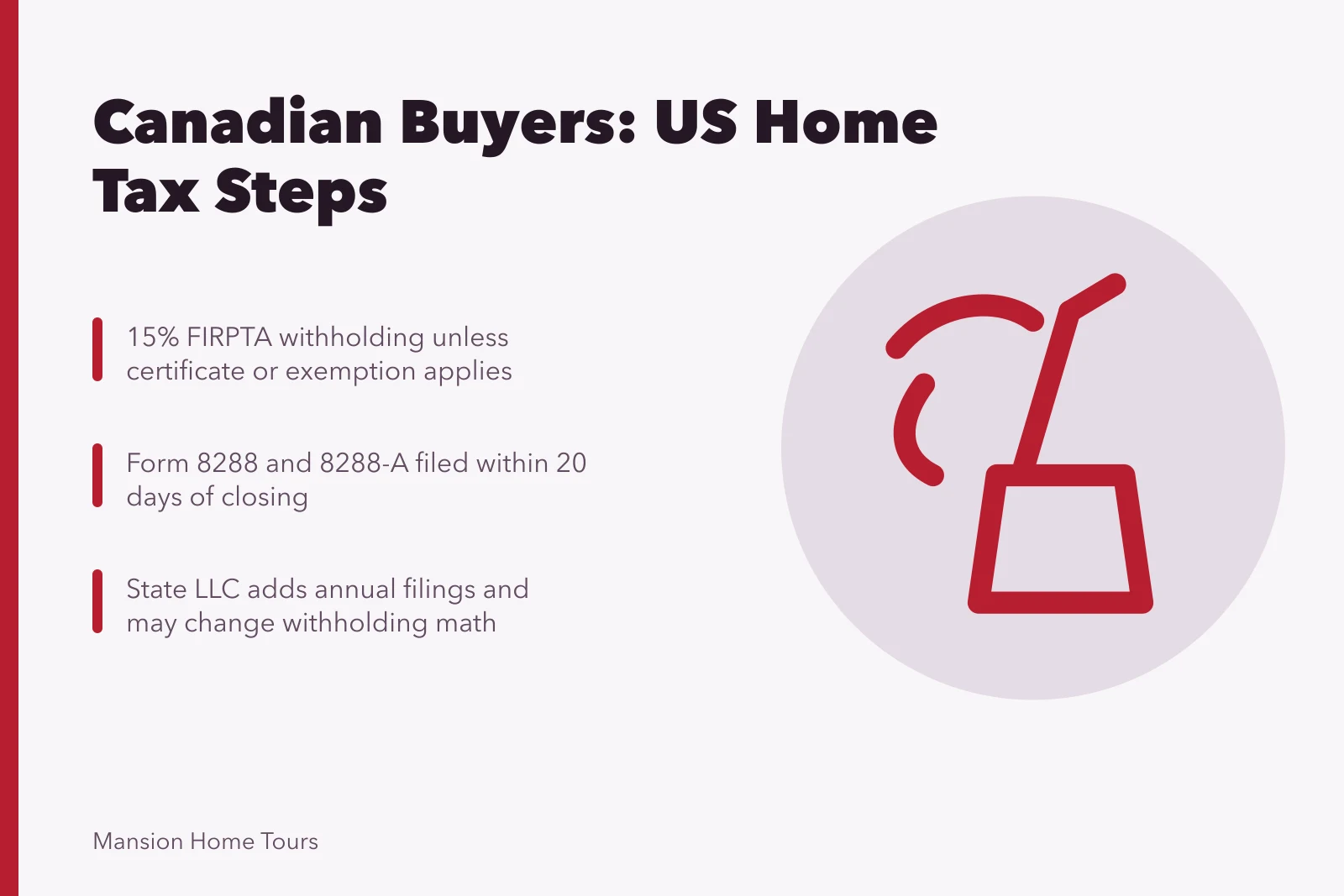
- The buyer or closing agent files Form 8288 and Form 8288-A within 20 days of the transfer; that clock starts at closing.
- A visa governs how long you stay, never whether FIRPTA applies. Keep the immigration file and the tax file apart.
- An LLC can keep a name off a public deed, but a foreign-owned single-member LLC still files Form 5472 and still counts as a foreign person.
- Canada taxes residents on worldwide income, so the US sale, the US rental income and Form T1135 all land on the Canadian return.
FIRPTA: who withholds, and from whose money
FIRPTA is the Foreign Investment in Real Property Tax Act. It applies when a foreign person sells a US real property interest. The buyer is the withholding agent, which means the buyer carries the liability if the money is not sent in.
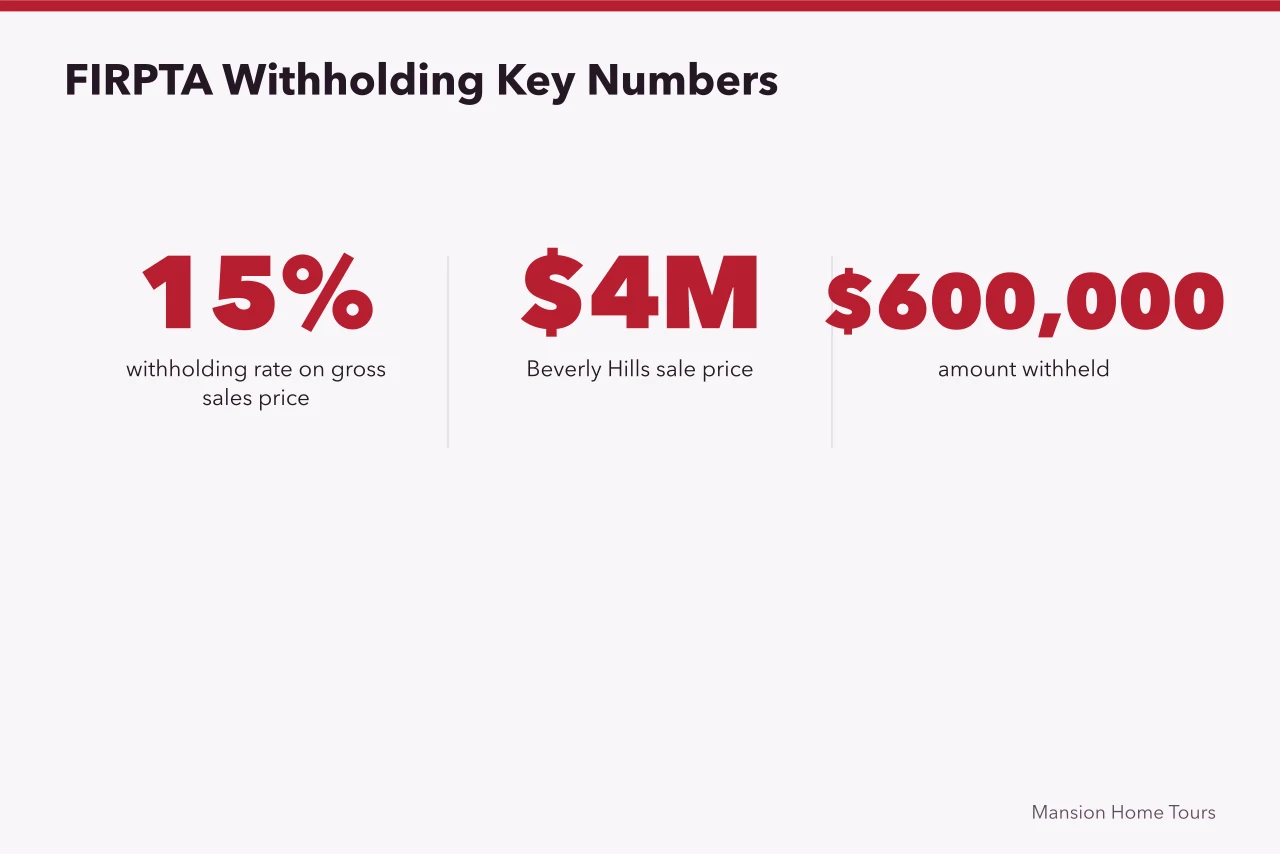
The rate is 15 percent of the gross sales price. Not of gain, not of net proceeds. A $4 million Beverly Hills sale therefore carries $600,000 withheld, and that money sits with the IRS until the seller files a US return and claims any excess back.
The FIRPTA withholding rules set out who counts as a foreign person and when withholding applies.
Two exemptions matter. A buyer who will live in the home and pays at or below the price threshold in the statute is exempt. A seller holding an IRS withholding certificate can reduce or eliminate the amount. A certificate takes weeks, so it belongs on the closing timeline, not in the final week.
The US-Canada treaty does not stop withholding at closing. It can lower the final US tax once a return is filed. Treat the withheld amount as a deposit and the return as the place the treaty rate is applied.
Withholding is computed on the gross price, including any mortgage the buyer assumes. It is not reduced by the seller's payoff, commissions or closing costs. Sellers who learn this at the table are the ones who did not read the settlement statement early.
If you buy from a Canadian seller, get the seller's status confirmed in writing. A non-foreign seller signs a non-foreign affidavit.
Keep it in your file; it is your answer if the IRS later asks why you did not withhold.
The same paperwork discipline runs through purchases and sales records, where a deed, a roll entry and a permit each prove a different fact.
Form 8288 and the 20-day clock
Form 8288 is the return the withholding agent files with the IRS. Form 8288-A reports the amount withheld for each transferor. The Instructions for Form 8288 give the deadline, the mailing address and the rules for both forms.
The deadline is 20 days after the transfer. That clock starts at closing, not at month end and not at tax time. Missing it exposes the buyer to penalties and interest.
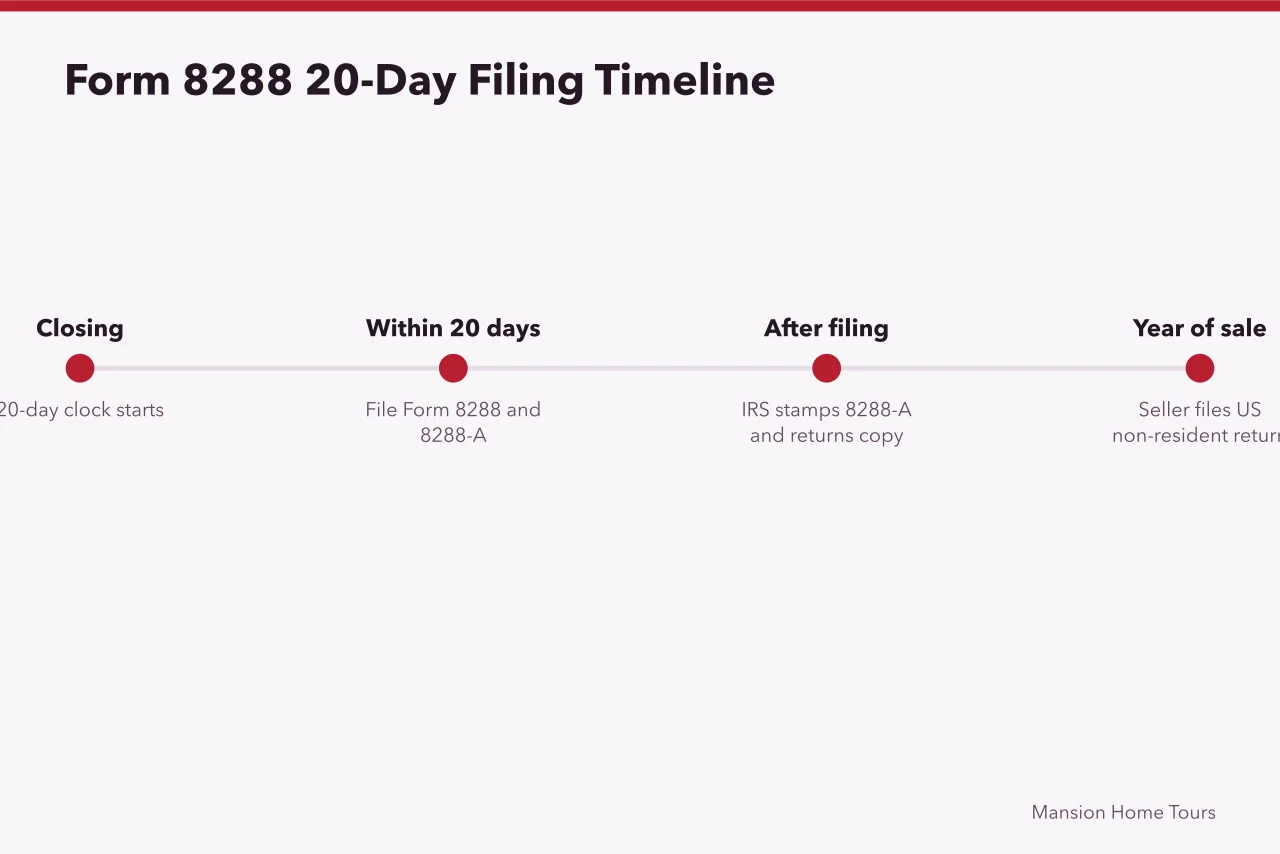
The stamped copy of Form 8288-A is the seller's proof of credit. If the closing agent does not send it, ask. A Canadian seller filing a US return should attach that copy.
Who pays? In law the buyer withholds from the seller's proceeds. In practice the closing agent runs the mechanics and the seller's net is reduced. The buyer's own funds are not the source unless the buyer fails to withhold and the IRS assesses the buyer later.
On a celebrity-priced home, a small error is expensive. Before signing, check the settlement statement line for withholding, confirm the gross price matches the contract, and confirm any certificate amount is applied correctly.
FIRPTA looks at the seller, not the buyer. A Canadian buying from a Canadian still triggers withholding. A Canadian buying from a US seller usually has no withholding duty on that purchase, and becomes a withholding agent on a later sale to a foreign buyer.
Visa status does not change the tax
Visa options govern how long you may stay, not whether FIRPTA applies. Canadian citizens generally enter as visitors for short stays, and B-1 or B-2 status covers business visits and tourism. Snowbird seasons in Florida, Arizona or California run on that visitor status.
Buying US real estate is not itself a visa event. You can own US property while living in Canada, and the purchase neither requires a visa nor grants one.
The International taxpayers guidance is the IRS starting point for the tax side of cross-border life. Count your days if you plan long stays. The substantial presence test can make you a US tax resident and pull worldwide income into US tax. Canadians often lean on the treaty tie-breaker, but that requires filing, not assuming.
If you want to work in the US, or run a business from the property, the visa question becomes real. Options include an E-2 treaty investor visa, an L-1 intracompany transfer and an O-1 for individuals with extraordinary ability.
Each has its own requirements, and none is a real estate product. Talk to an immigration lawyer before tying a purchase to a visa plan.
Rental income from US property is US-source income. It is taxable in the US, and a Canadian owner files a US return for it. Visitor status does not change that. On a visitor status, do not take a job or manage a US business from the home; that can put your status at risk.
Privacy planning sits on a different track from tax. Canadian owners who want a low profile should settle title holding before closing, not after. The rules that apply to Canadian celebrity properties are covered in canadian celebrity home privacy laws.
State LLC filing, step by step
Many Canadian buyers hold US real estate through a limited liability company, for liability, privacy and estate planning. The cost is extra filings, and the state of formation matters as much as the state where the property sits.
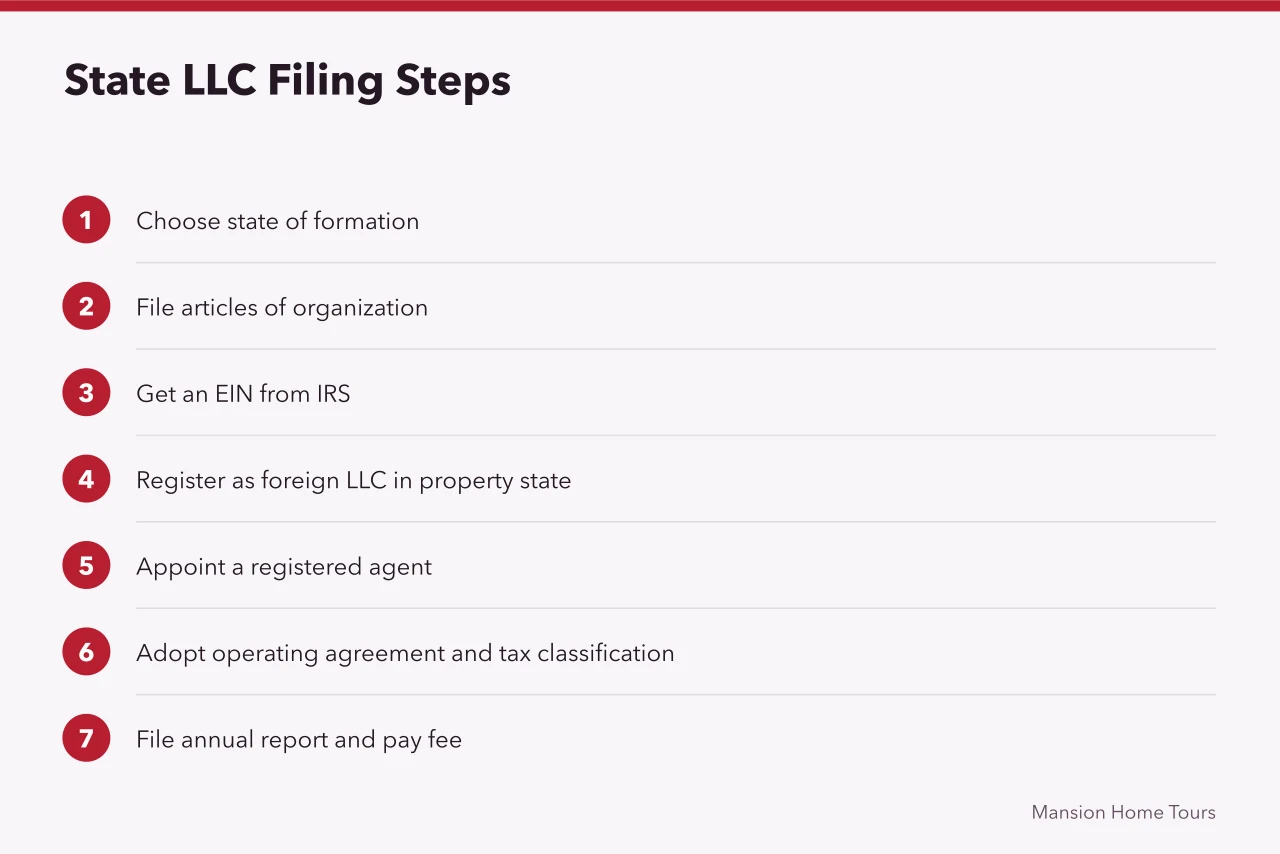
A foreign-owned single-member LLC files Form 5472 with a pro forma Form 1120. The penalty for not filing is severe, and it is not optional paperwork.
An LLC does not remove FIRPTA. A foreign-owned LLC is still a foreign person, so a later buyer still withholds. Certain distributions from the LLC can also carry a higher withholding rate. Plan the exit before the entry; the trade-offs are set out in celebrity home llc purchase.
An LLC can keep a name off a public deed in many states. It will not hide the property from the IRS or from the Canada Revenue Agency, because both countries have reporting rules that reach the owner.
County recorders and state real estate commissions each have their own habits. Some counties want the LLC's formation documents on record. Some lenders will not lend to an LLC without a personal guarantee. Confirm both before you take the buyer's name off the contract.
For a celebrity home, the seller may care who holds title. A seller who wants a quiet closing may prefer an LLC buyer; a seller who wants certainty may prefer a person.
That is a negotiation point as much as a tax one. Nothing here is legal or tax advice on vesting, and an LLC structure should be reviewed by a licensed attorney and a CPA in the relevant state.
The Canadian side: CRA reporting
Canada taxes residents on worldwide income. For a Canadian resident, buying US real estate is not a taxable event. The sale is. Any gain is a capital gain for Canadian purposes, reported in Canadian dollars.
Start with the exchange rate. You need the US dollar cost and the US dollar proceeds, converted at the rate for each date, and the gain is then computed in Canadian dollars. A falling Canadian dollar can turn a modest US gain into a larger Canadian one.
The International Non Residents page is the CRA entry point for cross-border filers, covering residency, foreign income and the forms that apply. The French counterpart, Impot International Non Residents, carries the same material for francophone filers.
Foreign property above the threshold is reported on Form T1135 with the Canadian return. US real estate can fall within that rule. The threshold and the categories are on the CRA site, and a missed T1135 can mean a penalty even when no tax is owed.
US rental income is reported in Canada too. Both countries tax it, and Canada gives a credit for the US tax paid, within limits. Keep the US return and the Canadian return in the same file.
On a sale, the US withholding is not the final US tax. You file a US return, claim the withholding as a credit and pay any balance. Then you report the same sale in Canada and claim a foreign tax credit for the US tax. US first, Canada second.
Canadians who become US residents face a different set of rules, including departure tax on the way out of Canada. If you are near the residency line, get advice before you buy. These are tax positions that vary by person and by province, so take them to a qualified cross-border tax adviser rather than applying them from a page.
Keep records of improvements, closing costs and currency conversions. They support the cost base on both returns. The same discipline applies to the inspection file, covered in beverly hills vs bel air homes.
A worked example, offer to closing
A Canadian couple buys a $5 million Miami home from a Canadian seller, planning to use it as a vacation home and rent it part of the year.
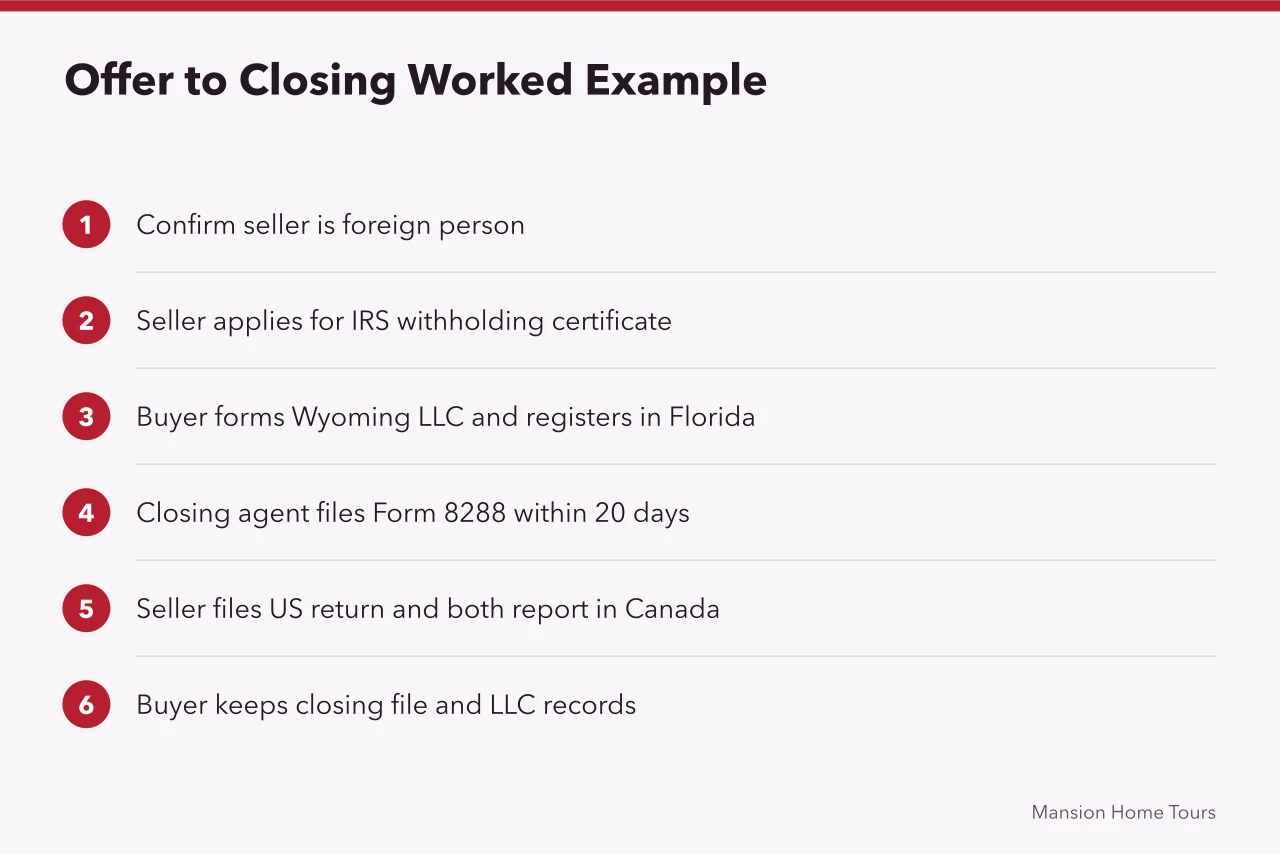
Step one: the buyer confirms the seller is a foreign person. FIRPTA applies, and the closing agent will withhold 15 percent of $5 million, or $750,000, from the seller's proceeds.
Step two: the seller applies for an IRS withholding certificate to reduce the withholding to the estimated tax. That takes weeks, so it starts before closing. If the certificate arrives, the withholding drops. If not, the full amount goes in.
Step three: the buyer forms a Wyoming LLC and registers it in Florida as a foreign LLC. The LLC takes title, the buyer obtains an EIN, and annual reports are filed in both states.
Step four: the closing agent files Form 8288 and Form 8288-A within 20 days of closing and sends the withheld funds to the IRS. The seller receives the stamped 8288-A copy.
Step five: the seller files a US non-resident return to claim any refund, and both spouses report the sale in Canada, claim the foreign tax credit and file Form T1135 for the year.
Step six: the buyer keeps the closing file, the LLC records and the inspection report. The rental income starts a new set of US and Canadian filings.
Use this checklist before removing conditions:
- Confirm the seller's foreign or non-foreign status in writing.
- Budget 15 percent of the gross price as a possible withholding.
- Decide whether to apply for an IRS withholding certificate.
- Confirm your visa or visitor status and count your US days.
- Choose the LLC state and register in the property state.
- Get an EIN and open the LLC bank account.
- Line up a US CPA and a Canadian accountant before closing.
The celebrity angle changes the privacy planning, not the tax rules: a high-profile seller may ask for a confidentiality agreement, and a buyer who wants a quiet deed may need an LLC.
The property state sets the property tax, the transfer tax and the recording rules, so those numbers come from the county, not from a national rule.
If the figures are large, get a written tax opinion before signing. The opinion costs little next to the withholding. A related look at the Canadian side of non-resident tax is in non-resident tax celebrity homes.
Common questions
Does FIRPTA apply when a Canadian buys from another Canadian?
Yes. FIRPTA looks at the seller's status, not the buyer's. If the seller is a foreign person, the buyer must withhold 15 percent of the gross sales price unless an exemption or an IRS withholding certificate applies.
Can a treaty claim remove the withholding at closing?
No. The US-Canada treaty can reduce the final US tax once the seller files a return. The withheld amount is a deposit, refunded if the return shows less tax is owed.
Is an LLC required to buy US real estate as a Canadian?
No. You can buy in your own name. An LLC is a choice for privacy, liability and estate planning, and it adds state filings plus Form 5472 for a foreign-owned single-member LLC.
What does a Canadian buyer report to the Canada Revenue Agency?
A Canadian resident reports worldwide income, including US rental income and any gain on a later sale. Foreign property above the threshold is reported on Form T1135 with the Canadian return.