Rules
Seattle waterfront mansion tours and Washington shoreline permits
This mansion guide covers Seattle waterfront tours under the Shoreline Management Act, city permit steps, critical areas rules and what sellers must disclose.
What to take away
- This mansion guide walks through the Washington rules that shape Seattle waterfront tours and waterfront sales.
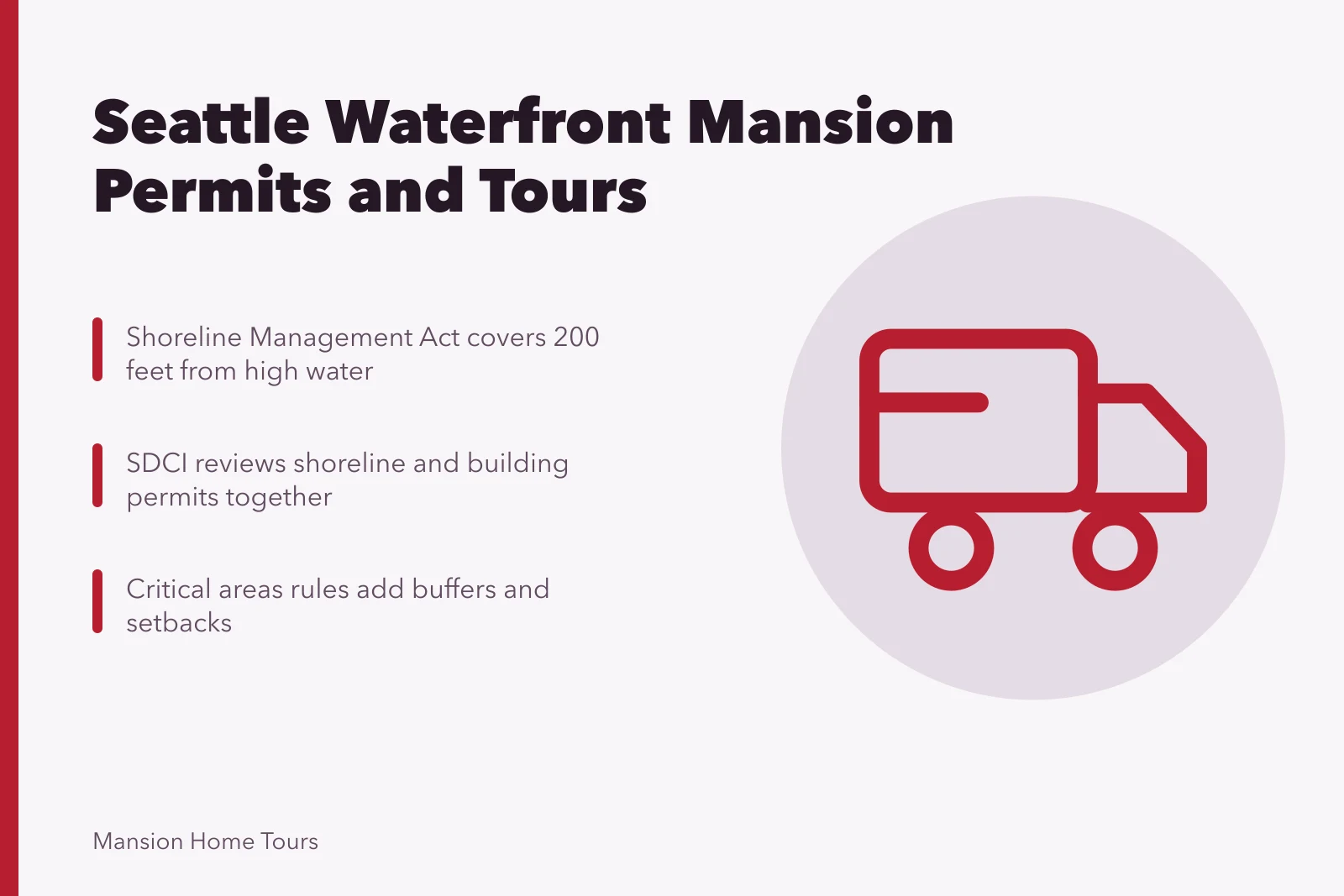
- The Shoreline Management Act governs most work and some uses within 200 feet of Puget Sound, Lake Washington, the Ship Canal and major rivers.
- The Seattle Department of Construction and Inspections issues the shoreline permits, and critical areas ordinances add buffers, setbacks and vegetation limits on top.
- A tour is a marketing event, not a permit, so sellers and agents should confirm what may be shown, docked or walked before buyers arrive.
- Disclosures on flood history, erosion and unpermitted dock or bulkhead work belong in the listing file before an offer.
The Shoreline Management Act and what it covers in Seattle
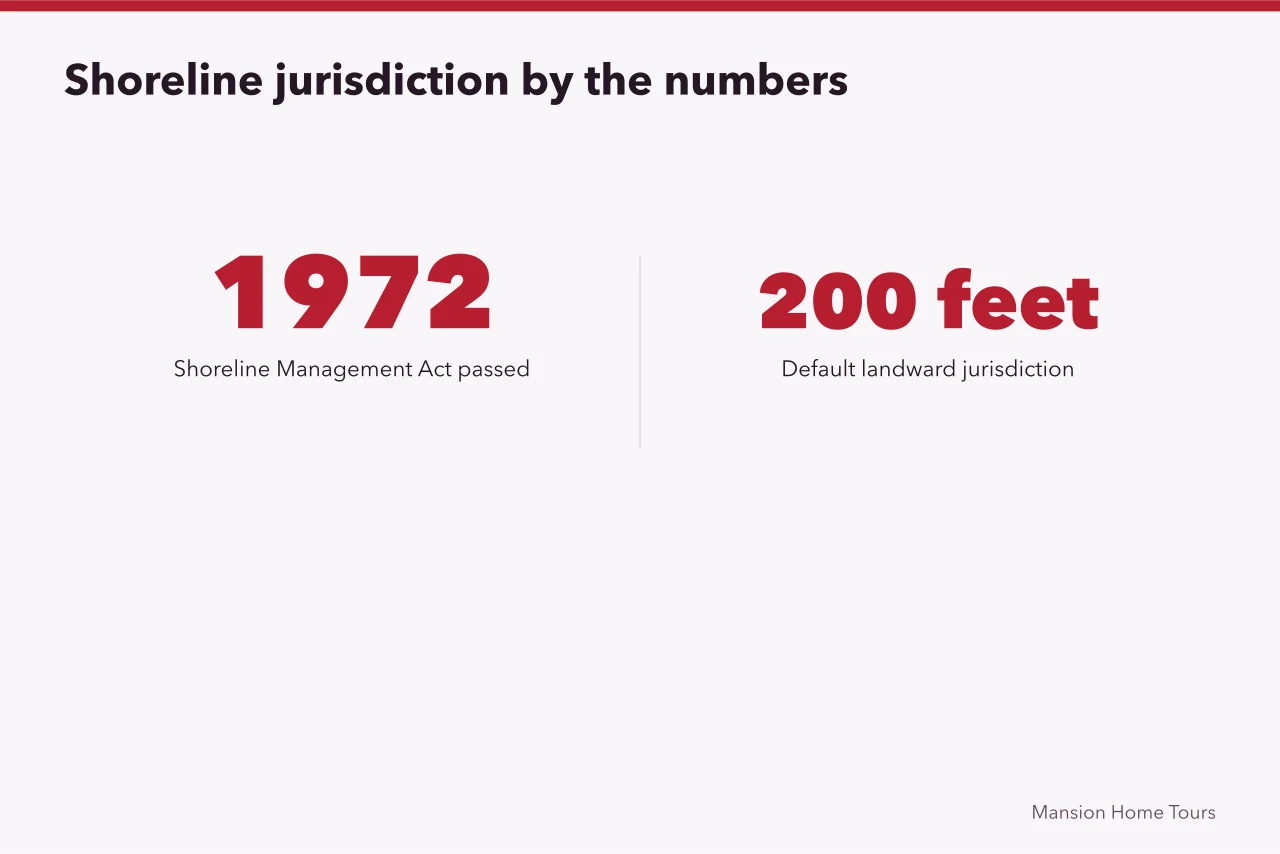
Washington voters passed the Shoreline Management Act in 1972 to keep the state's shorelines public in character while allowing reasonable private use. It reaches beyond the water line. The state sets a default shoreline jurisdiction of 200 feet landward from ordinary high water, plus wetlands and floodways tied to the shoreline.
In Seattle that means much of the city's most expensive residential acreage sits inside a regulated zone. Lake Washington, Lake Union, the Lake Washington Ship Canal, Puget Sound, the Duwamish Waterway and Green Lake all carry shoreline designations.
A mansion on any of them is not just waterfront property. It is shoreline property, and the rules follow the land, not the owner.
The Act splits authority. The state Department of Ecology approves each city's shoreline program, and Seattle implements its own version through the municipal code. Permits come from the city, but the state can review some decisions. For a buyer, the practical question is simple: what did the current owner build, and was it permitted?
Shoreline permits come in a few tiers. Substantial development permits cover larger projects. Conditional use permits cover things like some docks, piers and over-water structures. Variance permits cover requests to depart from the dimensional standards. A new bulkhead or a rebuilt dock usually triggers one of these.
Ordinary maintenance is treated differently from expansion, and that line matters at resale. Replacing decking on an existing pier is not the same as lengthening it. If you are preparing to tour a celebrity mansion on the water, ask which structures have current permits and which predate the code.
Seattle Department of Construction and Inspections permit steps
The Seattle Department of Construction and Inspections, usually shortened to SDCI, is the agency that reviews shoreline and building permits inside city limits. It also handles land use approvals, inspections and code complaints. A shoreline project typically needs both a shoreline permit and a building permit, and they are reviewed together.
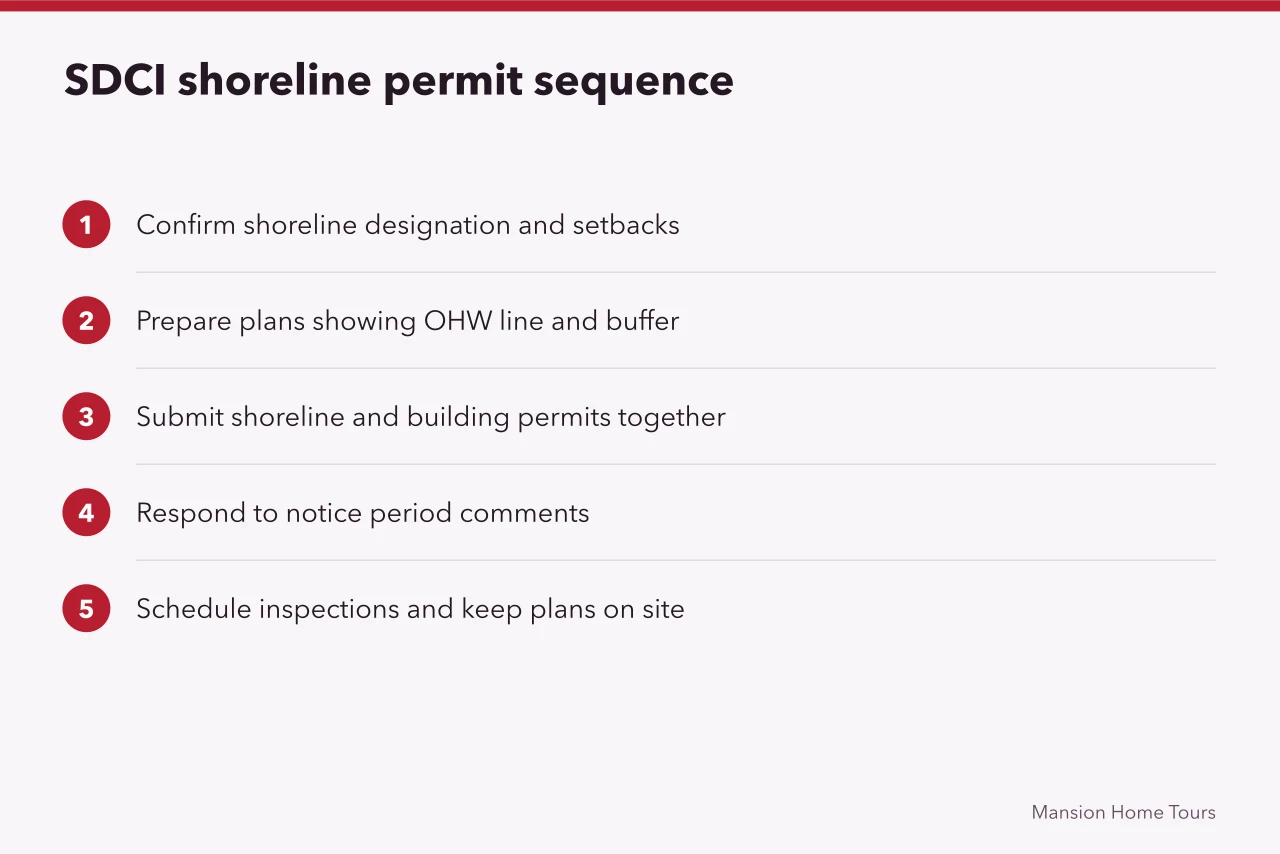
Timelines stretch. A dock replacement may move in months, while a new over-water structure can take longer because of the comment period and state review. Buyers who assume a quick approval often lose contingencies.
SDCI also fields complaints about unpermitted work, and those complaints travel with the property. A code violation on a bulkhead or an unapproved stair to the beach can stall a closing or shift repair costs to the seller. Agents should pull the permit history early, not the week before closing.
If you are comparing formats for showing the property, the difference between a mansion home tour vs private showing is mostly about who is present and what gets documented, but the permit records are the same either way.
Critical areas ordinances along the waterfront
Critical areas ordinances are the city's rules for land that is environmentally sensitive: steep slopes, wetlands, fish and wildlife habitat, flood hazard areas and shorelines. In Seattle they sit alongside the shoreline program and often apply to the same parcel at the same time.
The most common constraint on a waterfront mansion is the steep slope. Many Puget Sound and Lake Washington properties drop sharply to the water, and the code limits clearing, grading and new impervious surface on those slopes.
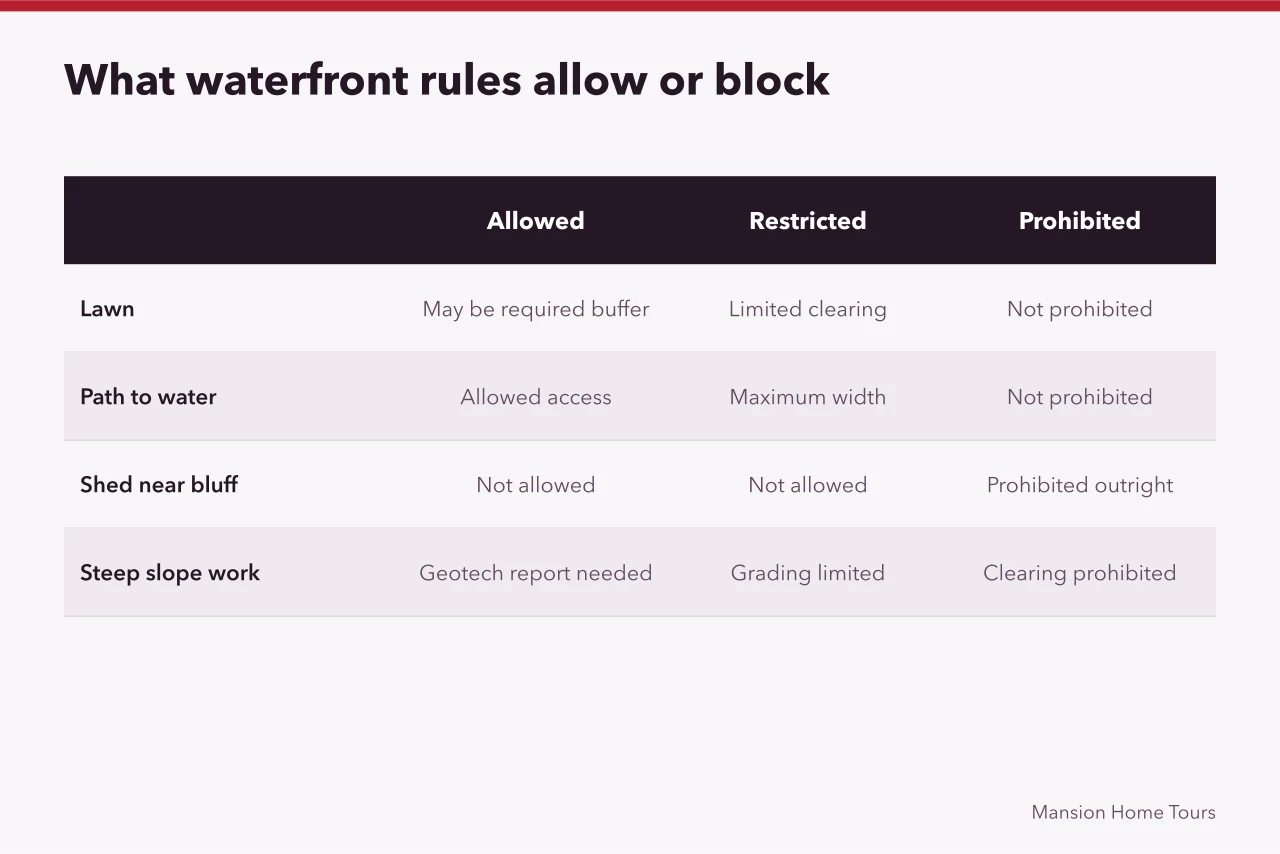
Vegetation buffers along the water are also protected, which is why some estates keep a band of native plantings between the lawn and the beach.
These rules affect what a buyer can change. A lawn that looks like a simple landscaping choice may be a required buffer. A path to the water may be an allowed access corridor with a maximum width. A shed near the bluff may be prohibited outright.
Geotechnical review is routine. The city often asks for a report from a licensed engineer before approving work on a steep slope or near a marine bluff, and that report becomes part of the record. Erosion control during construction is enforced, not advisory.
Because the layers stack, a single parcel can carry shoreline jurisdiction, a critical area designation and a flood zone. Zoning maps that show one layer at a time, like a US homes by city map, help buyers see how much of a neighborhood sits inside an overlay before they fall for a view.
EPA water and regulatory guidance that shapes shoreline work
The federal layer does not replace the state and city rules, but it shapes them. The Environmental Protection Agency publishes the water topics that frame shoreline and permit-related environmental rules, including wetlands, watersheds and water quality standards that states use when they write their own programs.
You can read the agency's overview at Water Topics | US EPA.
Permit applicants and their consultants also lean on the agency's topic-by-topic regulatory material. It explains how federal statutes and guidance translate into the reviews that touch docks, fill and stormwater. That reference lives at Regulatory and Guidance Information By Topic | US EPA.
The underlying statutes are collected in one place as well. Clean Water Act provisions on dredge and fill, and the rules that follow from them, are the reason a new pier or a bulkhead repair can require federal review in addition to city approval.
The agency's index of those authorities is at Laws & Regulations | US EPA.
For a buyer, the takeaway is that shoreline work has three gates: city, state and, in some cases, federal. A seller who says the dock is permitted should be able to show which gate it passed.
What a waterfront tour must disclose before a sale
Washington is a seller disclosure state. The residential seller disclosure statement asks about flooding, drainage, erosion, shoreline location and any known permit problems. Those answers are not marketing copy. They are part of the transaction record.
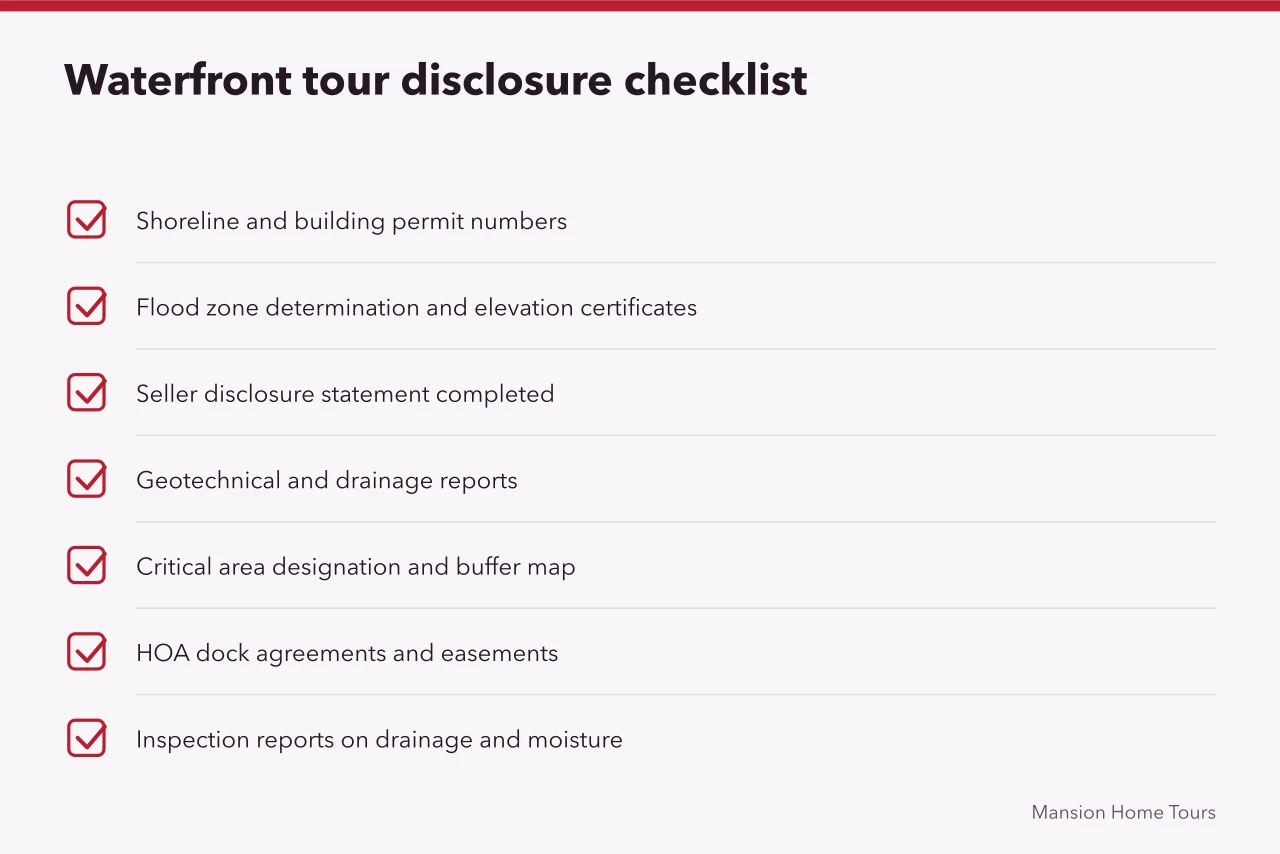
A waterfront tour should be built around that record. Before buyers walk the property, the listing file should hold the permit history for every structure at or near the water, the current flood zone determination, any geotechnical reports, and documentation of past repairs to bulkheads, docks or seawalls.
Use this checklist when preparing a tour or reviewing one as a buyer.
The National Association of Realtors publishes consumer guidance on inspections that is useful when you set expectations for out-of-state buyers. It covers what a general inspection does and does not include, which matters when the real risks are below the lawn. See Home Inspections.
Financing adds another layer. Lenders treat shoreline and flood-zone homes differently, and insurance quotes can change the math on a listing. Agents working the 2027 pipeline should track how new york homes sales 2027 may shift with updated flood and fire mapping, because waterfront pricing in Seattle is sensitive to both.
None of this is a reason to avoid the water. It is a reason to read the file first. A clean permit history and a complete disclosure package make a waterfront mansion easier to show, easier to finance and easier to sell.
Common questions
Does the Shoreline Management Act apply to a house that is not directly on the water? Yes, if the parcel falls inside the shoreline jurisdiction, which generally extends 200 feet landward from ordinary high water. Distance from the beach is not the test.
Who issues a dock permit on Lake Washington? The Seattle Department of Construction and Inspections issues the shoreline and building permits, with state oversight through the Department of Ecology's approved shoreline program.
Are critical areas ordinances separate from shoreline rules? They are separate codes that often apply to the same parcel. A steep slope or wetland designation can add buffers and review requirements on top of shoreline jurisdiction.
What happens if a bulkhead was built without a permit? It becomes a disclosure item and a possible code violation. Buyers should price the risk of repair or removal, and sellers should resolve it before listing where possible.
Do federal rules ever apply to a residential dock? Sometimes. Dredge and fill activity in regulated waters can trigger federal review under the Clean Water Act, in addition to city and state approvals.