Features
Mansion Home Tour vs Private Showing: What Changes for a Buyer?
Mansion Home Tour vs Private Showing changes what a buyer sees, who can attend, and what gets answered. Here is the practical US luxury buyer criteria table.
What to take away
- A mansion open house is a public viewing window with no appointment; a private showing is an appointment for you and your agent.
- The seller and listing agent choose which format to offer, and many US luxury listings never hold a public open house.
- A private showing usually gives you more direct access to the listing agent and a clearer read on condition and disclosures.
- Local MLS rules can limit open house advertising or require proof of funds before a private showing.
- No single format is always better; compare them on access, information, agent access, and privacy.
The basic difference in a luxury market
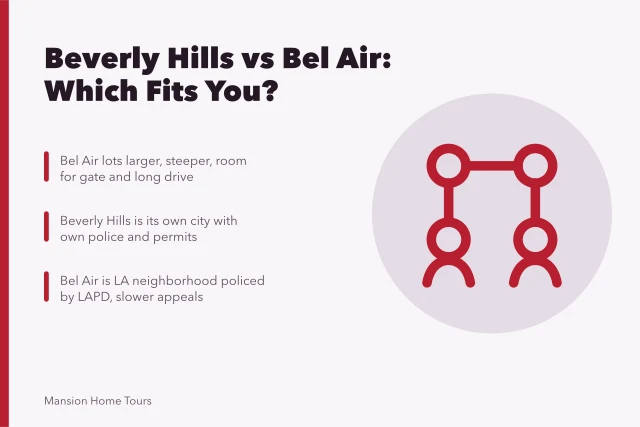
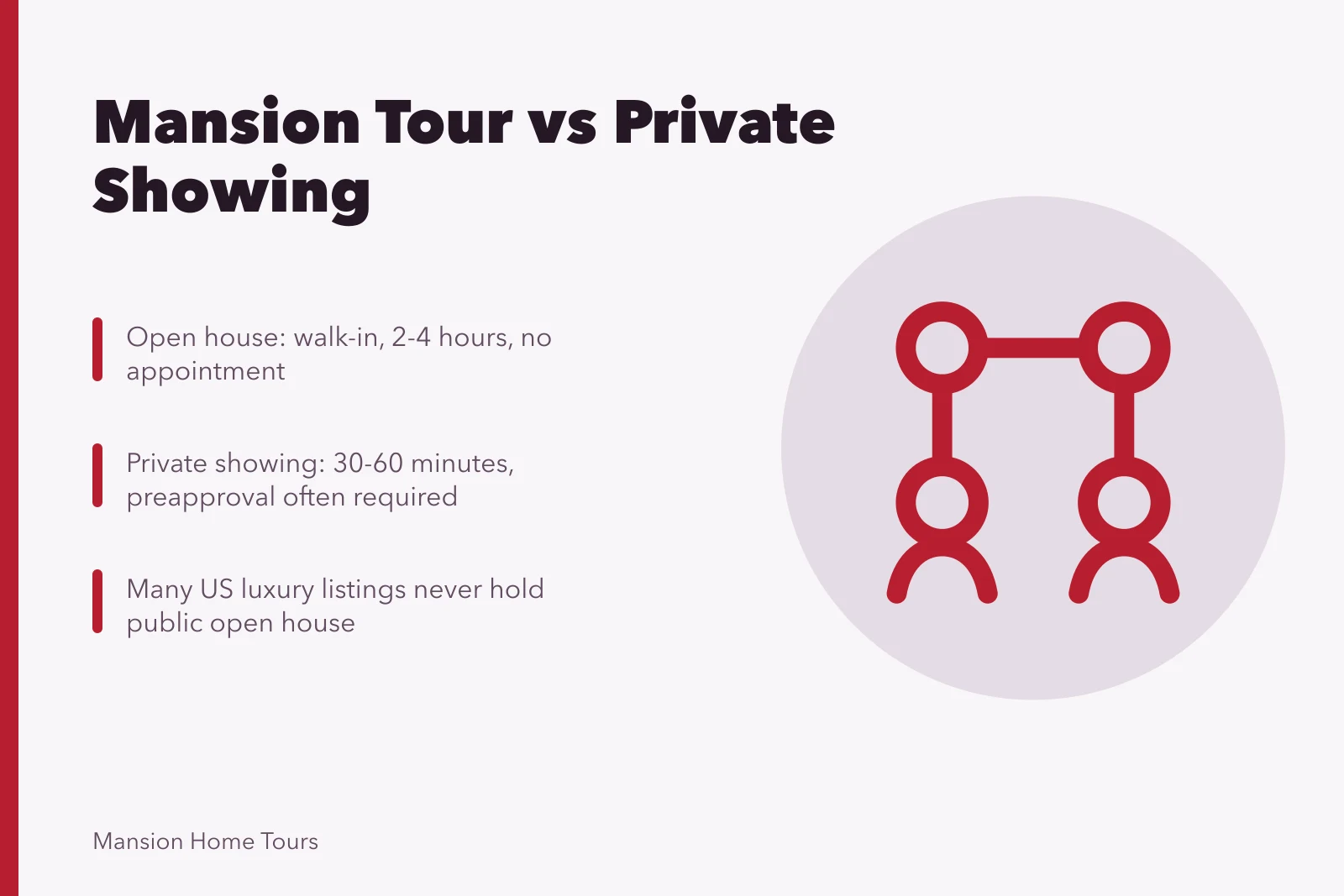
A mansion open house is a scheduled window, often two to four hours on a weekend, when anyone who arrives can walk through the rooms. A private showing is an appointment, usually 30 to 60 minutes, arranged through your buyer's agent with the listing agent. The two formats serve different purposes and give a buyer different types of information. In US high-end markets, the open house is not a universal step. Many listings above a few million dollars never open to the public. A seller who values privacy will skip the open house and allow only one-on-one showings after a buyer's agent submits a preapproval letter or proof of funds. This pattern is common in gated communities, where entry is controlled and the open house would require staff at the gate. You can read a practical comparison of two famous luxury pockets in Beverly Hills vs Bel Air, which covers setting, rules, and buyer expectations.
What a listing agent controls
A listing agent cannot invent local MLS rules, but the agent can shape the showing format. The seller often tells the agent whether an open house is acceptable. In a gated community, an open house means giving the gate code to dozens of strangers over a three-hour period. That risk alone leads many sellers to choose private showings only. A listing agent may also require a buyer's agent to accompany every showing, which filters out unrepresented curiosity seekers. The same agent can limit the number of private showings per week to reduce wear on a staged home. This is not a legal restriction; it is a seller preference written into the showing instructions. You can read more about how those instructions appear in a Celebrity Home's Sales History without reading too much into a single entry.
Criteria that change between the formats
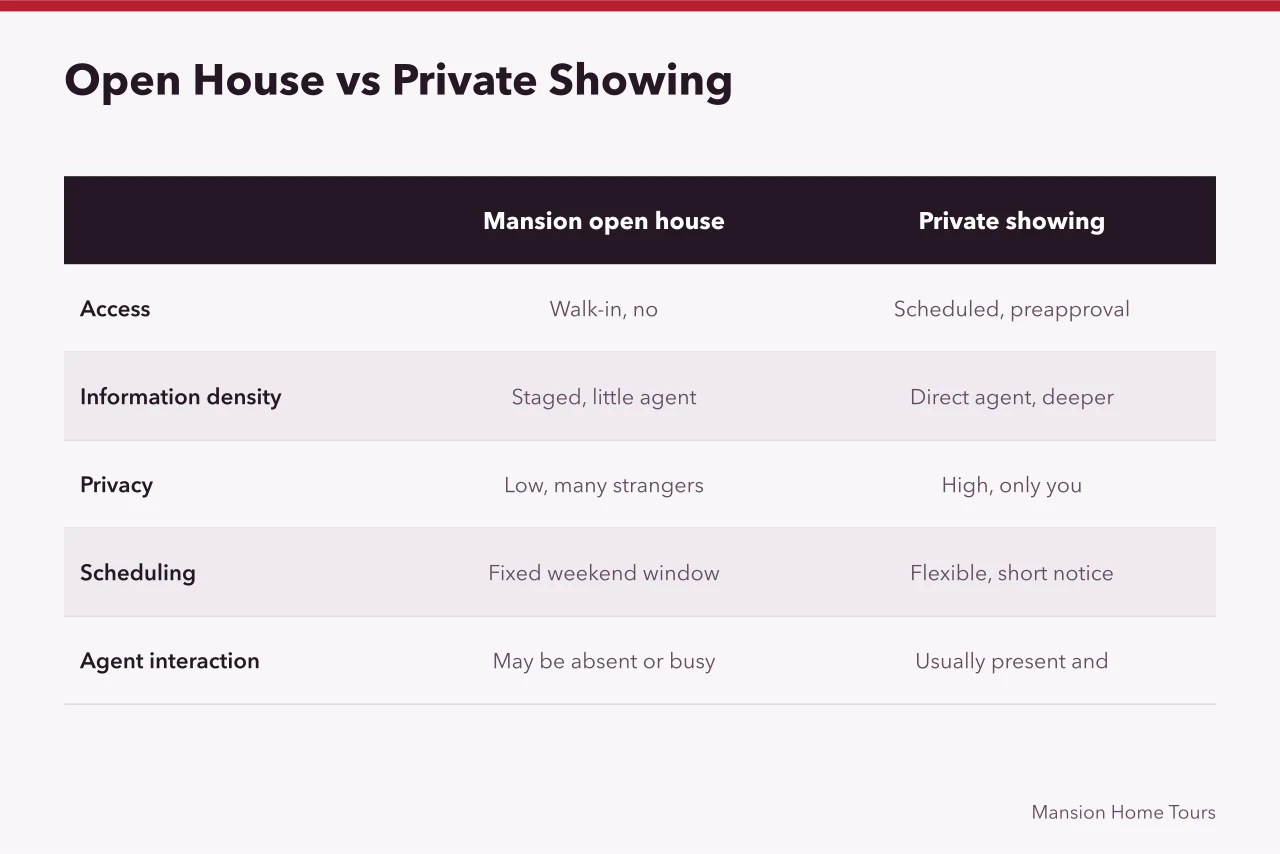
The table below compares the two formats on the factors that matter most to a serious buyer.
Three buyer checks that work in either format
No matter which format you choose, these three checks give you better information than the staging and the agent's summary.
- Ask for the full disclosure package. In many US states, sellers must provide known material defects. A private showing lets you ask follow-up questions on the spot.
- Verify the HOA or community rules if the home is in a managed development. HUD homebuying resources explain the documents you should request, including covenants and fees.
- Compare the Agency prices compared against the assessor's file to see what the assessment file actually shows. A large gap needs an explanation before you make an offer.
Example of a listing with no public open
Consider a Bel Air estate listed at $14 million. The seller's instructions say no open house. A buyer's agent requests a private showing and sends a proof of funds letter from a US bank. The listing agent confirms a 45-minute appointment for Tuesday at 10 a.m. The buyer arrives with their agent, sees the un-staged service areas, and asks the listing agent about the roof age and the last major renovation. The same questions would be harder to answer in a crowded open house. Bel Air is known for this type of controlled viewing, partly because many homes sit behind gates and long driveways.
Which format yields better information
The answer depends on what you need. An open house gives you a fast scan of layout, light, and scale. A private showing gives you time to test faucets, open closets, and ask about disclosures. For a buyer who is not yet preapproved, the open house may be the only option. For a buyer who is ready to write an offer, the private showing is almost always more efficient. If you plan to hold the title in an entity, you should also read Buy a Celebrity Home Through an LLC before scheduling the showing, because some sellers will not consider offers from a trust without proper documentation.
Common questions
Is a private showing always better than an open house?
No. An open house is useful for an early scan without committing to an appointment, but a private showing gives more focused information.
Do luxury sellers ever refuse all showings except to prequalified buyers?
Yes. Many sellers in gated communities or celebrity-heavy areas will only allow a showing after receiving a proof of funds or a lender preapproval letter.
Can an open house happen in a gated community?
Yes, but it is less common because of security and access control at the gate. The HOA may also set rules for visitor entry.
What should I bring to a private showing?
Bring your preapproval letter or proof of funds, a list of questions, and a notebook. Do not bring children or extra guests unless the listing agent approves them.