Guides
Why Buy a Celebrity Home Through an LLC? A Practical Walkthrough
A celebrity home LLC purchase hides the buyer's name on the deed, but only as far as state law allows. Delaware, California and Wyoming differ.
What to take away
- An LLC keeps your name off the county deed, which is the record most people search. It does not hide the purchase from lenders, the IRS or a determined reporter.
- The state you form in matters less than the state where the property sits. California and New York expose more than Delaware or Wyoming.
- A single-member LLC is taxed like a sole proprietorship by default, so the privacy gain is real but the tax gain is usually zero.
- Expect formation costs of roughly $50 to $500 plus annual fees that range from $0 in some states to $800 in California, figures that change and should be checked against the state's own fee schedule.
- If you need a mortgage, the lender will want a personal guarantee, and that guarantee is a public court record the moment anything goes wrong.
Why a deed is a public document
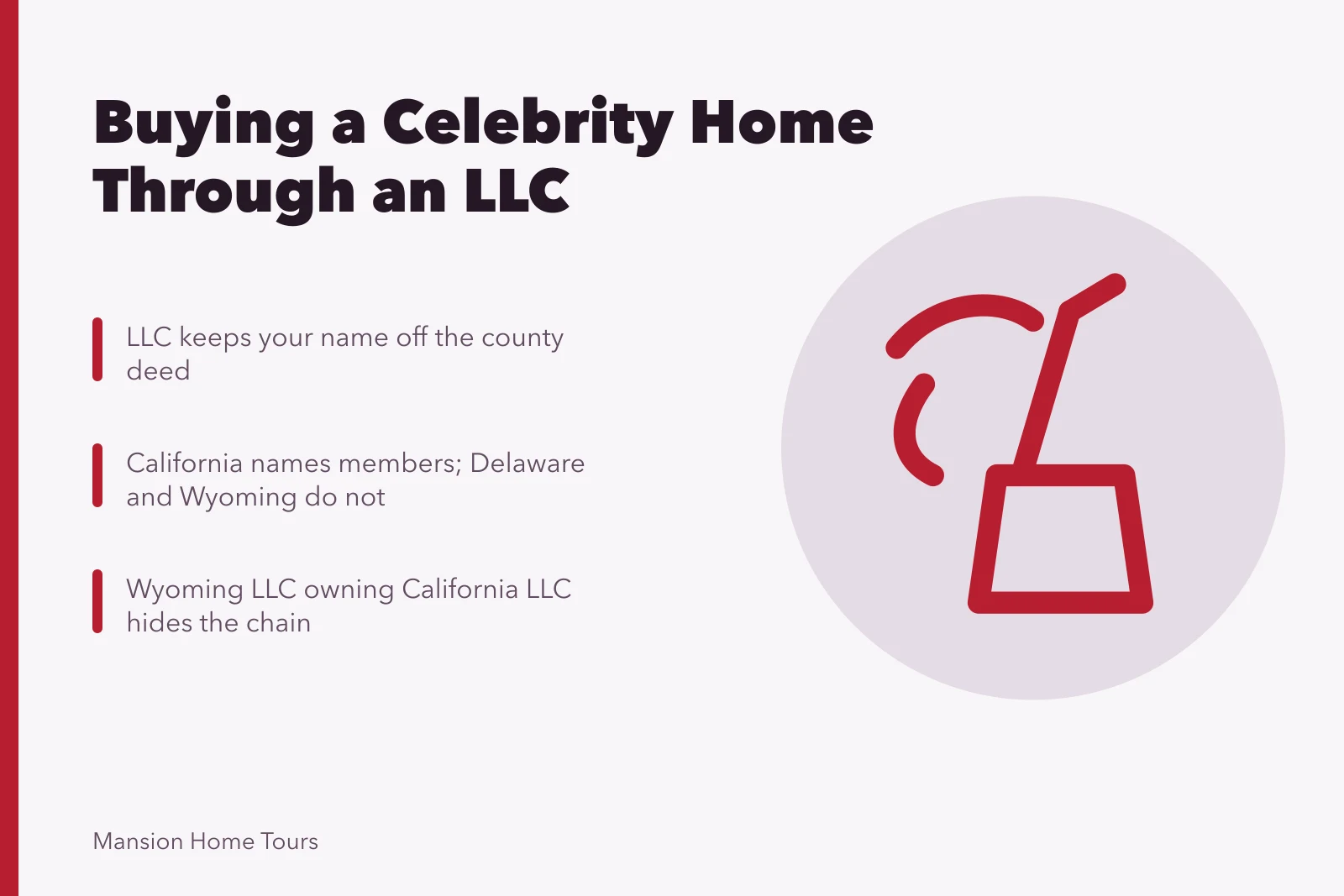
County recorder offices exist so that anyone can trace who owns what. That is the point of a land records system, and it is why a search of your name returns your house. An LLC interrupts that search.
The buyer of record becomes a company name. A reader who wants the human behind it has to work through state business filings, registered agent records and sometimes a lawsuit.
The IRS treats an LLC as a pass-through by default, which is why the structure is common for rentals and small holdings. The SBA guide to business structures lays out how the entity types differ.
Delaware, California, Wyoming and New York compared
Delaware does not publish member names in its public business search. California requires a statement of information that names managers and members, and the franchise tax starts at $800 a year. Wyoming allows nominee arrangements and charges a lower annual fee. New York requires publication of the formation in two newspapers, which is the opposite of quiet.
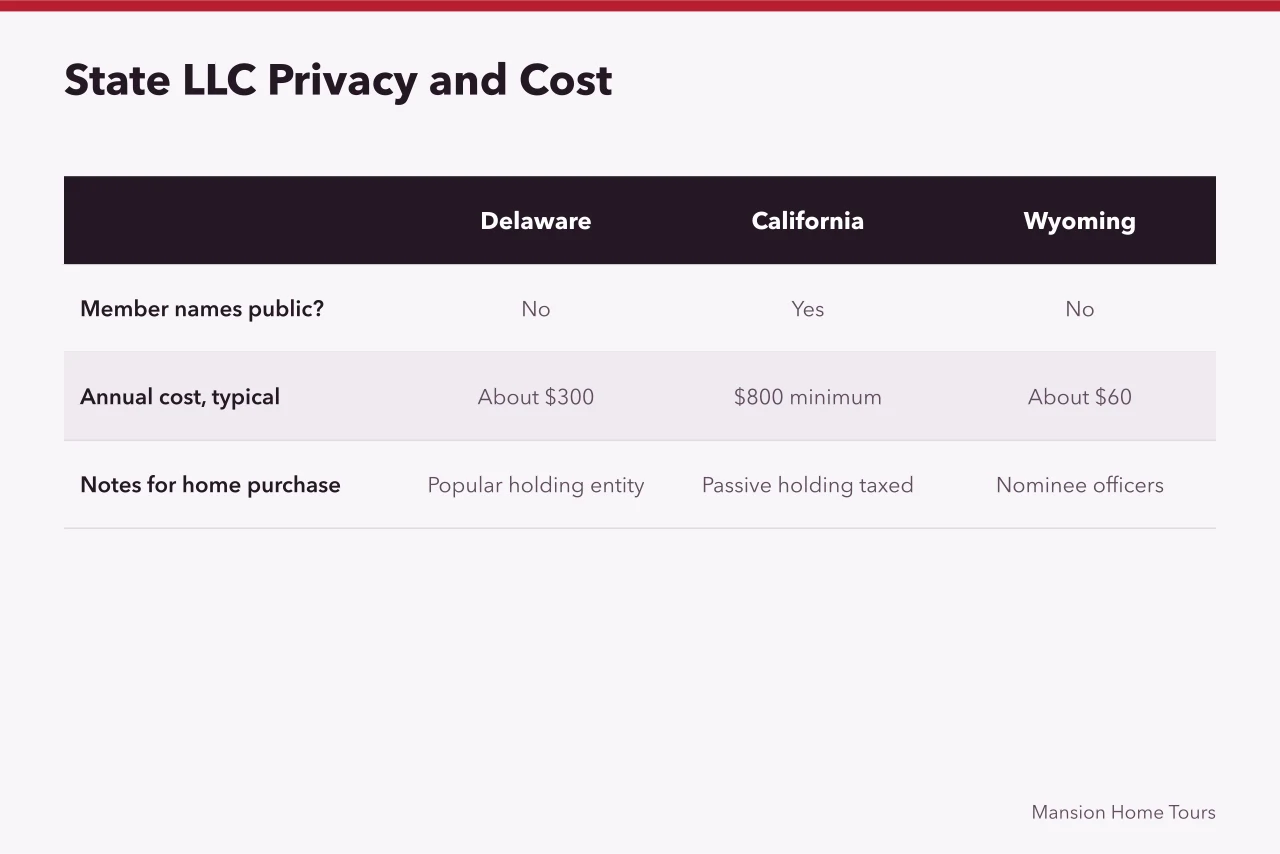
| State | Member names public? | Annual cost, typical | Notes for a home purchase |
|---|---|---|---|
| Delaware | No, not in the entity search | About $300 franchise tax | Popular for holding entities, no property needed |
| California | Yes, on the statement of information | $800 minimum franchise tax | You will pay this even for a passive holding |
| Wyoming | No, and nominee officers allowed | About $60 annual report | Strong privacy, weak local court familiarity |
| New York | Yes, plus newspaper publication | Varies by county | Publication can run into hundreds of dollars |
Forming in Delaware while the house sits in California does not exempt you from California law. The state where the property is located controls title, transfer tax and disclosure.
Example: the Bel Air purchase that stayed quiet
A buyer forms a Wyoming LLC, then a second LLC in California that the Wyoming entity owns. The California LLC takes title. The county deed shows the California company. The state filing shows the Wyoming company as manager. The Wyoming filing shows a registered agent, not a person.
That chain costs money to maintain and buys time, not secrecy. A journalist with a tip can unwind it in an afternoon. A neighbor with a grudge can too, if the registered agent is careless.
For contrast, look at how ownership records surface in Los Angeles homes, where lot splits and trust transfers already muddy the paper trail.
The steps, in order
- Decide whether you need a mortgage. If yes, ask the lender in writing whether it will lend to the LLC or require a personal guarantee.
- Choose the state of formation based on where the property sits and how much you are willing to pay each year.
- File the articles of organization and appoint a registered agent with a real street address.
- Open a bank account in the LLC name and pay the closing funds from it, so the chain of funds matches the chain of title.
- Check the local disclosure rules before closing. Some counties and HOAs require the names of principals regardless of the deed.
- Confirm the county recorder's public search actually hides your name
- Confirm the state filing does not list you as a member or manager
- Confirm the registered agent will forward service of process promptly
- Confirm your insurer will write the policy in the LLC name
Where the structure fails
A homeowners association can demand ownership details in its own records. So can a lender during underwriting, and so can a court during litigation. The HUD homebuying pages note that association rules bind the owner regardless of the entity on the deed.
Foreclosure is the other leak. A default filing names the borrower, and the borrower is often a person who signed a guarantee. The CFPB explains how that process works and why it becomes public.
Insurance is a quieter problem. Some carriers will not write a standard homeowner policy for an LLC, and a vacant or rarely used house pushes the premium up further.
If the property is a rental, the LLC makes ordinary sense for liability. If it is a primary residence, the privacy benefit shrinks and the paperwork grows.
Common questions
Does an LLC make me anonymous to the county? Yes, on the deed itself. The county records the company name, not yours. Everything downstream depends on how the state filing is written.
Can I buy with a mortgage inside an LLC? Sometimes. Most lenders want a personal guarantee, which puts your name back into the file and into any later court record. Ask before you form anything.
Is Delaware always the best state? No. Delaware is convenient for entities, but the property state still governs title and transfer tax. A Wyoming or local LLC is often cheaper to run.
Will this stop a reporter? Usually not. Public filings, permits and lawsuits leave traces. Treat the LLC as a speed bump rather than a wall.