
Guides
How to read a celebrity home's MLS listing in California without guessing
A California Regional MLS record is a form, and the fields agents skip, like year built and lot size, say more about a house than the photos do.
What to take away
- The sale history and the county tax roll are generated by transactions; square footage and bedroom counts are generated by description.
- A transfer disclosure statement, a natural hazard report and the residential earthquake guide carry more weight than any line of marketing.
- Agent remarks are unverified free text. "Sold as is", "trust sale" and "probate" are the three phrases that change what you are buying.
- Days on market resets when a listing is re-entered. Compare the original list date and the MLS number, not the counter.
- Missing fields cluster: no HOA dues, no permit history, no roof photo. Ask why in writing before you schedule the showing.
The MLS fields that carry the most weight
A California Regional MLS record is a form, and forms reward whatever gets filled in. The National Association of Realtors explains how MLSs are organized and what data they hold, which is the right frame for reading one listing (MLS Policy).
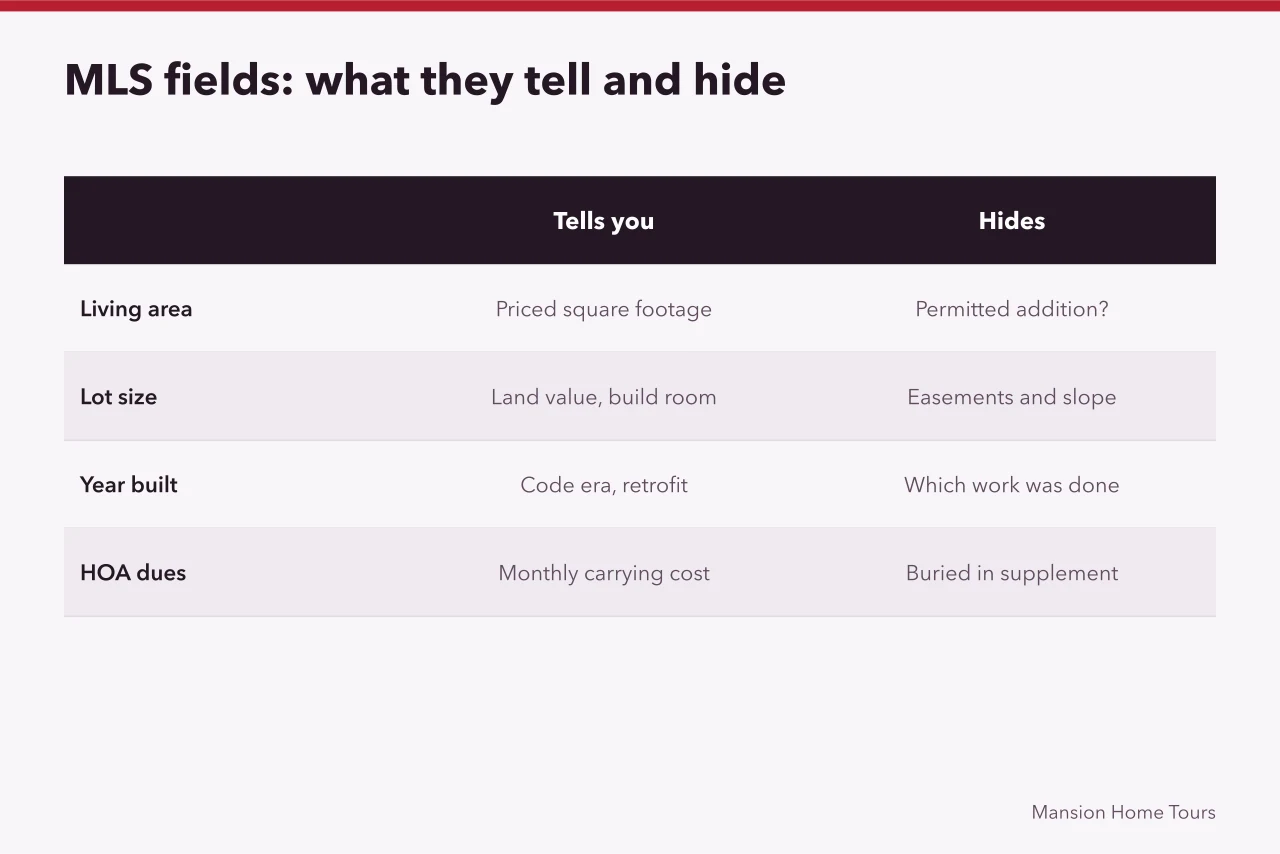
Living area and lot size drive price per square foot, and in Los Angeles County that number moves fast. Judge one house against current los angeles homes prices, never against a national average.
Bedroom and bathroom counts are the next trap. California agents sometimes count a permitted conversion, a guest unit or a finished basement as a bedroom. The public record may disagree, and the difference is a price difference.
Year built matters more here than in most states because of seismic code. A 1926 Beverly Hills house and a 1998 one face different retrofit questions, and the listing rarely says which work was done.
HOA dues deserve their own line. In gated California communities, monthly dues can run into four figures, and a listing may bury that in a supplement rather than the main field.
| MLS field | What it tells you | What it hides |
|---|---|---|
| Living area | Priced square footage | Whether the addition was permitted |
| Lot size | Land value and build room | Easements and slope |
| Year built | Code era and retrofit needs | Renovation date and scope |
| HOA dues | Monthly carrying cost | Special assessments |
| Days on market | Negotiating room | Relistings under a new number |
| Price history | Seller expectations | Why prior deals fell through |
Days on market is softer than it looks. A house can be re-entered to reset the counter, so a 12 day listing may be a 200 day problem. Compare the MLS number and the original list date instead.
Disclosure forms a mansion listing must attach in California
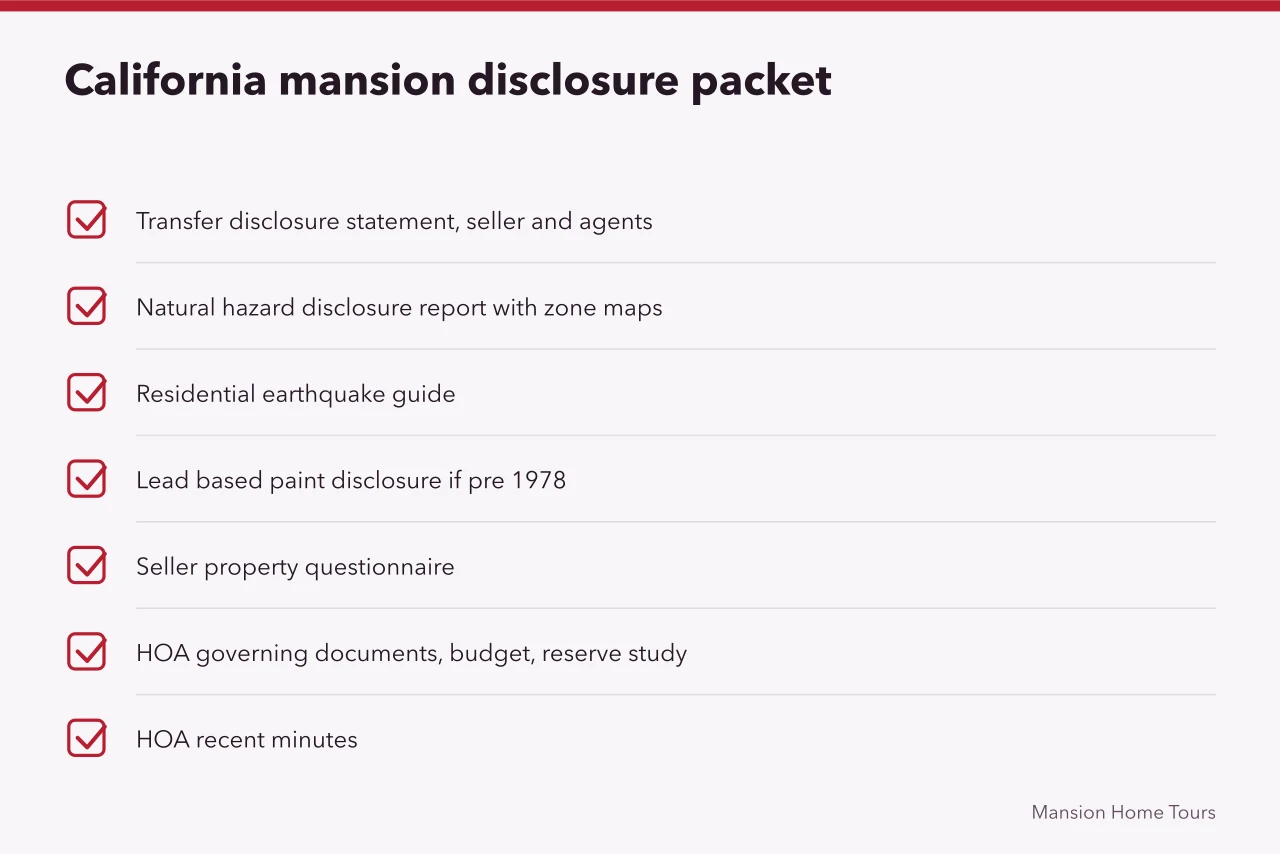
California is a disclosure state, and the paperwork is where a luxury listing stops being marketing. The transfer disclosure statement is the core document: the seller lists known defects, and each agent signs a separate section.
The natural hazard disclosure report flags flood, fire, seismic and landslide zones. In the hills above Los Angeles, that report is often the most useful page in the packet.
The residential earthquake guide covers retrofit and insurance questions. Sellers must deliver it, and buyers should read it before the inspection contingency window closes.
Other forms in the packet include the Megan's Law notice, the lead based paint disclosure for pre 1978 homes, and the seller property questionnaire. The questionnaire is not required in every deal, but when it exists it is candid.
HOA documents arrive separately: governing documents, budget, reserve study and recent minutes. Minutes are where a pending special assessment or a lawsuit shows up first.
For what California licensees must publish, the DRE's own Publications and Reports page is the shelf to start from (Publications and Reports).
If a form is missing, ask why in writing. A missing natural hazard report is not a paperwork slip, it is a question about the property.
Agent remarks: what they say and what they leave out
Agent remarks are the free text box in the MLS, and they are the least regulated part of the record. They are written to sell, and nobody verifies them.
The NAR's policy on what may appear in those remarks is worth knowing before you read them as fact (NAR policy on listing and display rules).
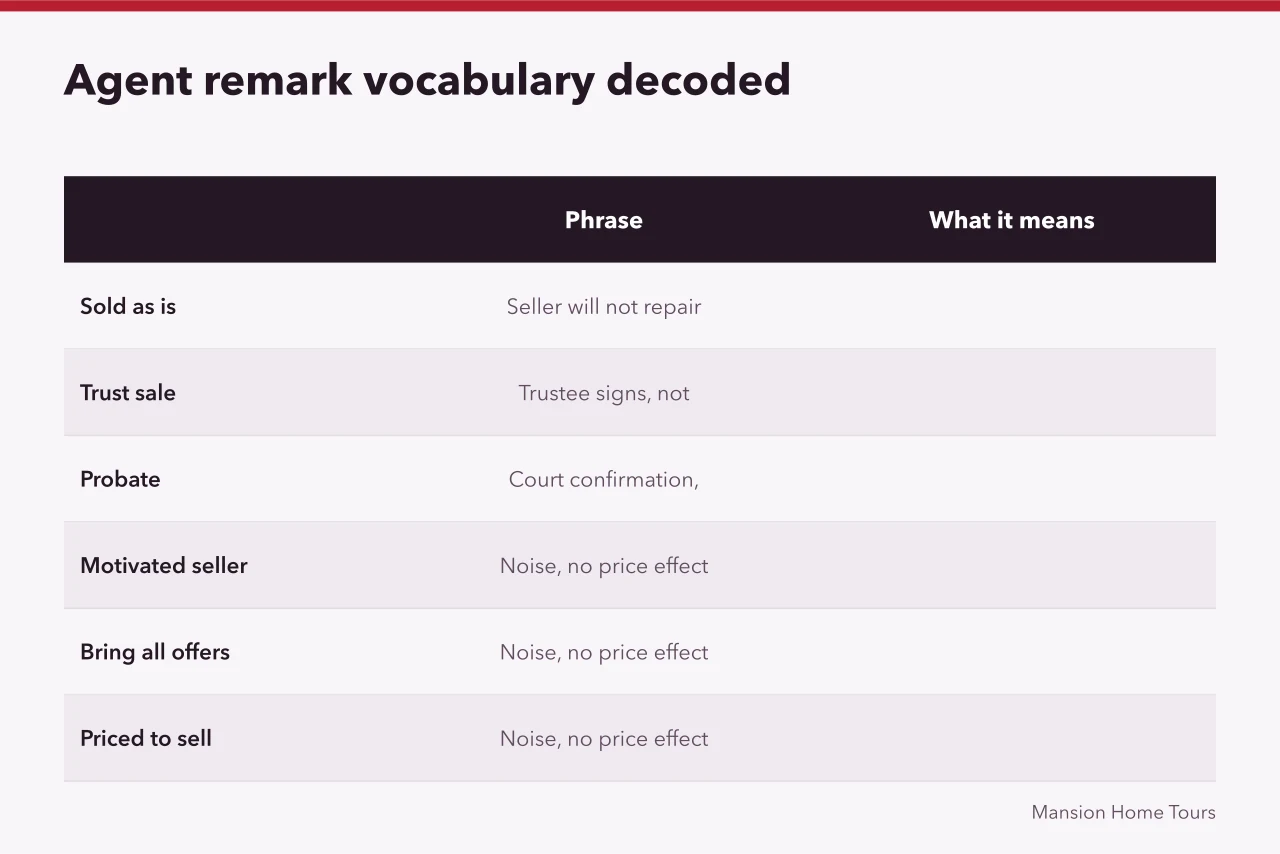
Learn the vocabulary. "Sold as is" means the seller will not repair. "Trust sale" means a trustee, not an owner, is signing. "Probate" means court confirmation and a possible overbid.
"Motivated seller" is noise. "Bring all offers" is noise. "Priced to sell" is noise. None of it moves the price, and none of it appears in the disclosure packet.
What remarks omit is more useful. A house with no mention of the roof, the foundation or the sewer line is a house where those items have not been discussed.
Remarks also carry the showing instructions and the offer deadline. Read those literally, because agents enforce them literally.
Records and remarks diverge over time. Our piece on celebrity home sales history shows one property described three ways in three years.
Reading sale history against the current asking price
Sale history is the MLS's own audit trail, and it is harder to spin than a description. It shows every list price, every price change, every pending status and every closing.
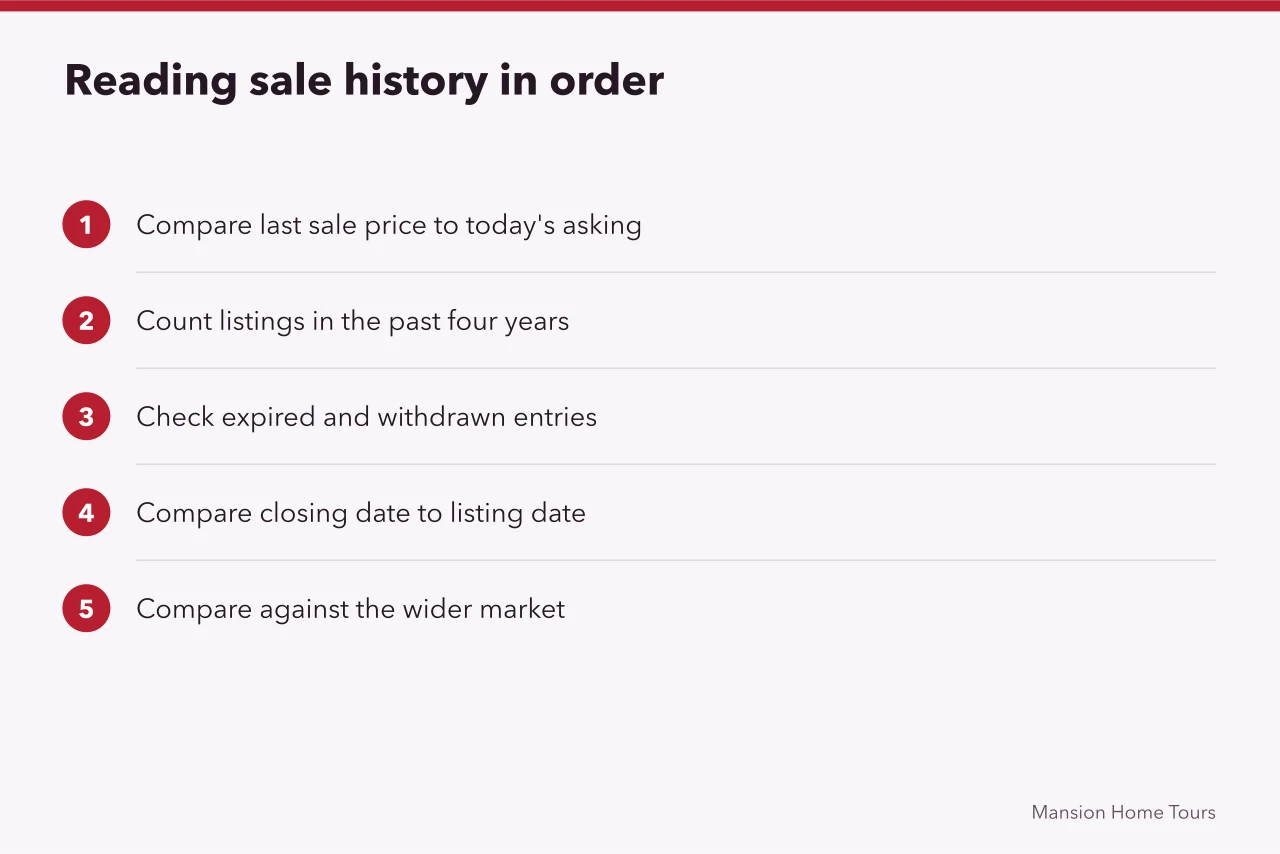
Start with the gap between the last sale price and today's asking price. A jump that outruns the neighborhood needs an explanation: a renovation, a subdivision, or optimism.
Our guide to purchases and sales records explains how a deed, a tax roll entry and a building permit can tell three different stories about the same house.
Count the listings next. Three listings in four years suggests a house that does not satisfy its owners, or a price that does not satisfy the market.
Then look at expired and withdrawn entries. An expired listing is a seller who wanted more than buyers would pay, and that history is bargaining room.
Finally, check the closing date against the listing date. A house that closed in 30 days sold to a motivated buyer. A house that took 300 days tells you what the market thought.
When a sale history looks unusual, compare it with the wider market before drawing a conclusion. A mansion guide is only as good as the records behind it.
Where the California DRE fits into a buyer's reading
The California Department of Real Estate licenses agents and brokers, and it publishes consumer guidance on what those licensees owe you. Its Homebuyers and Borrowers page is the plain starting point (Homebuyers/Borrowers - DRE).
The DRE does not review listing prose. It does not approve agent remarks, and it does not verify square footage. That is the MLS's job and, ultimately, yours.
What the DRE does provide is a complaint path. If an agent misstates a material fact, a license can be at risk.
It also publishes recovery account information for consumers who win judgments against licensees. That is a backstop, not a plan.
DRE guidance tells you what to expect from the professionals in the deal. It does not replace your own reading of the MLS record.
For buyers comparing two high end neighborhoods, the DRE material is neutral. The choice between beverly hills vs bel air is a lifestyle and price question, not a regulatory one.
Spotting omissions before you schedule a showing
Omissions are rarely accidental. They are the fields a seller's agent chose not to fill, and they cluster in predictable places.
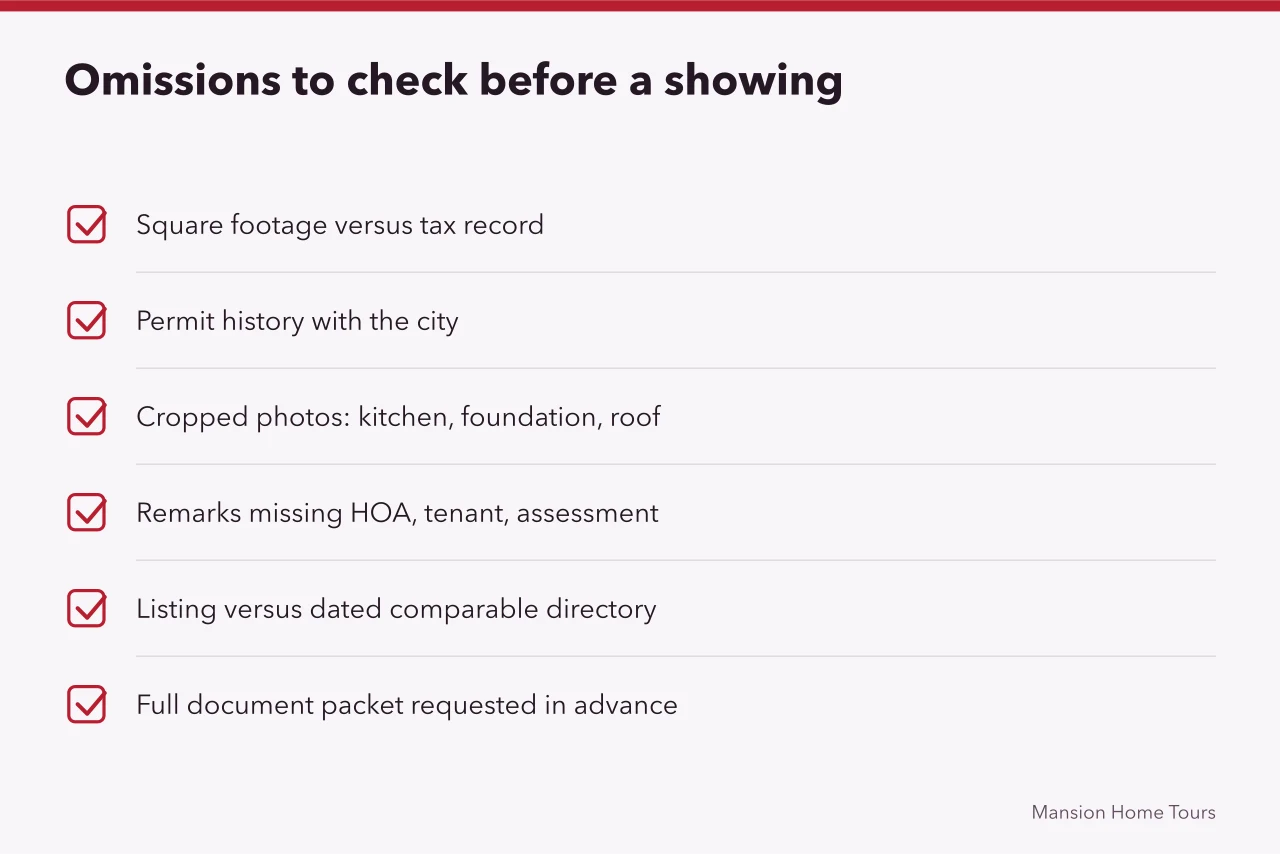
Start with square footage. If the MLS shows a number and the tax record shows a smaller one, the difference is unpermitted space until proven otherwise.
Then check permit history with the city. A 6,000 square foot house with no permits since 1970 has either been untouched or unpermitted, and only the building department can tell you which.
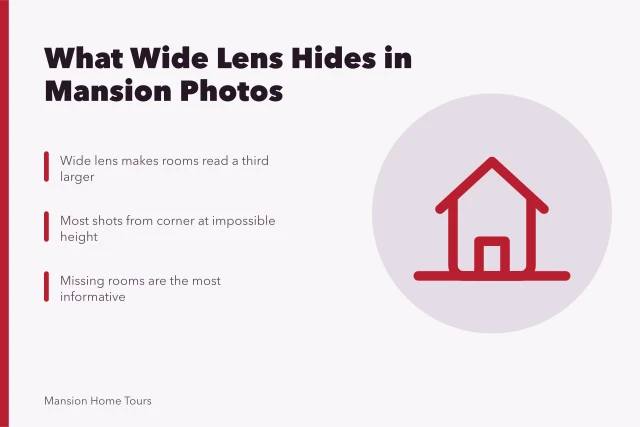
Look at the photos for what is cropped. A missing kitchen photo, a missing foundation line, a missing roof shot: each one is a question.
Read the remarks for what is absent. No mention of the HOA, no mention of a tenant, no mention of a pending assessment.
Compare the listing against a dated directory of comparable properties. A mansions list with sources and dates gives you a baseline the listing alone cannot.
Ask your agent for the full document packet before the showing, not after. The NAR's material on MLS and online listing practices explains why the public listing is a summary, not the file (MLS & Online Listings).
If the seller will not release documents before a showing, that is itself information. Treat it as one more line in the record.
Common questions
What is the most reliable field in a California MLS listing?
The sale history and the county tax record, because transactions generate both rather than a description. Square footage and bedroom counts are the fields most likely to be inflated, and the tax roll is where you check them.
Do agent remarks have any legal weight?
They are marketing text, not disclosures. A false and material statement in remarks can still support a misrepresentation claim, but it is not a substitute for the transfer disclosure statement.
Which disclosure form matters most in a hillside mansion purchase?
The natural hazard disclosure report, because it maps fire, flood, seismic and landslide zones. Read it alongside the residential earthquake guide before you release contingencies, and take any zone question to your insurance broker.
Can I rely on the DRE to verify a listing?
The DRE licenses agents and publishes consumer guidance, but it does not verify listings. Use its Homebuyers and Borrowers page to learn what your agent owes you, then verify the property yourself through the county and the city building department.