Guides
Reading a Celebrity Home's Sales History Without Assumptions
Reading a celebrity home sales history means pulling county recorder deeds, checking LLC and trust filings, and knowing what online portals omit.
What to take away
- Celebrity home sales history lives in county recorder and assessor files, not on listing portals.
- The deed names the buyer and often the consideration, but an LLC or trust can hide the person.
- Most county websites show deed images only for the last 25 to 30 years, which rules out online tracing of older transfers.
- A quitclaim deed between family members or into a trust is not a market sale even if a price appears.
- Compare the recorder's deed with the assessor's parcel history before saying a sale happened.
Begin with the county recorder's index, because that is where a transfer becomes a public record. Most real estate portals pull from Multiple Listing Service feeds that agents control. Those feeds can omit the final recorded price, list the wrong buyer, or leave a celebrity sale off entirely. County data is messier but more complete for the physical parcel.
Start at the county recorder, not the MLS
A recorder's office files the actual instruments: deeds, mortgages, liens, and notices of default. The grantor-grantee index is searchable by name, but a celebrity buyer who uses a limited liability company will not appear under their own name. The parcel number is more reliable. Search the parcel, not the name, to follow the property across owners. Some counties call this the recorder, others the register of deeds. The differences matter less than the document images.
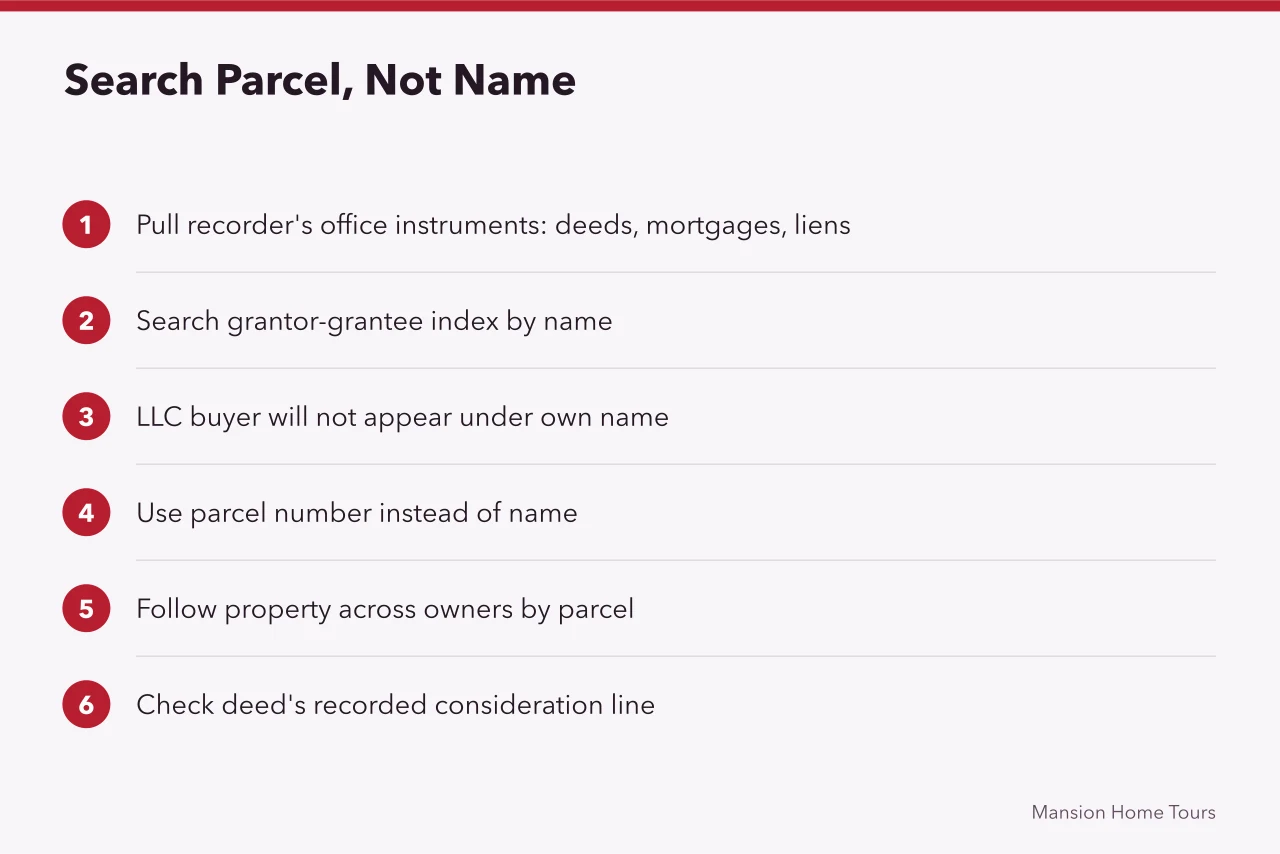
Before accepting a portal's sale price, look at the Agency prices compared line in the deed. Recorded consideration is often lower than the listing price because buyers and sellers can exclude personal property or use a credit.
Read the deed, then the assessor card
The deed states the buyer, seller, legal description, and often the consideration. A grant deed usually warrants that the seller has not already conveyed the title. A quitclaim deed transfers whatever interest the grantor has, with no warranty. Celebrities sometimes use quitclaims to move a house into a trust or between spouses. That is not an arm's length sale, even if a price appears. The assessor card adds the parcel number, square footage, bed and bath count, and the assessed value. Assessed value can lag a sale by a year or more because valuation rolls are annual.
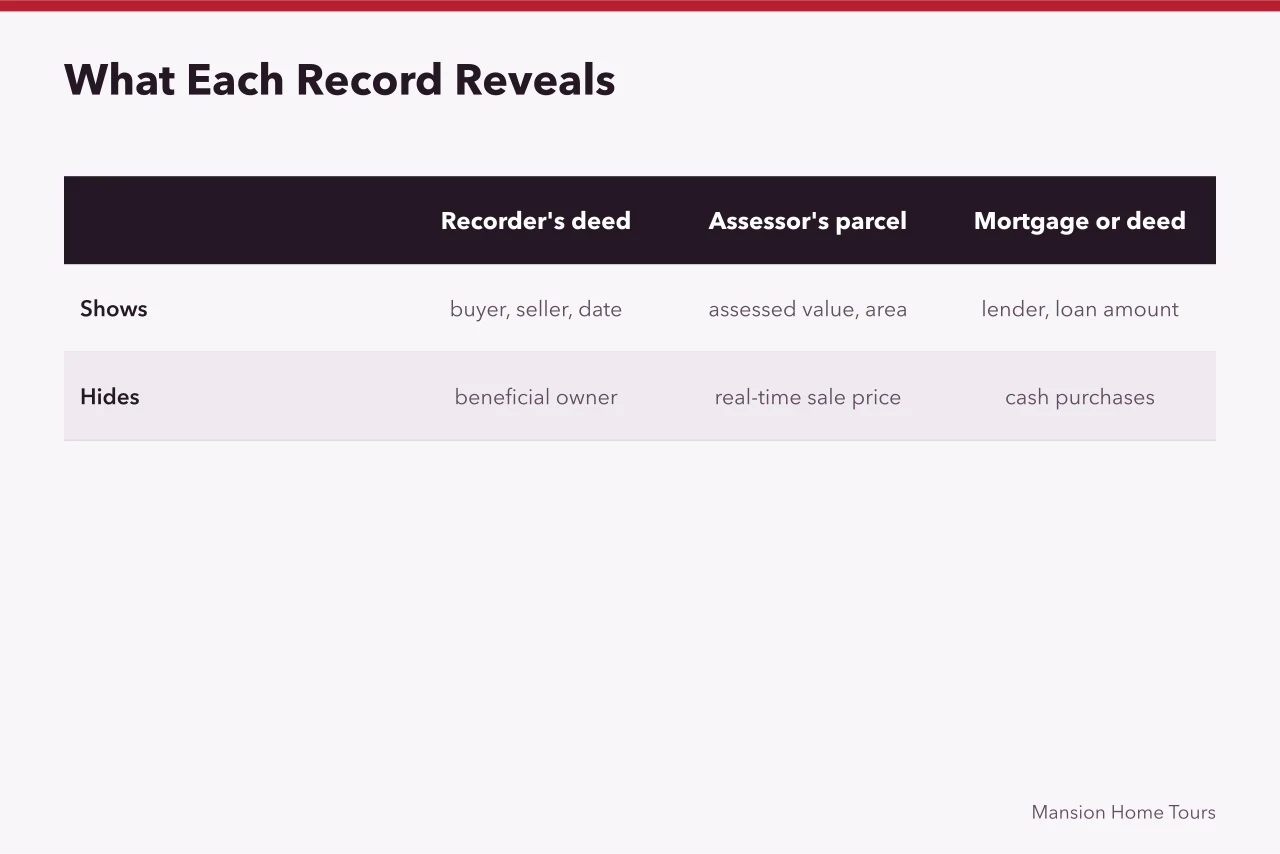
A limited liability company can hold title in its own name, so the beneficial owner never appears on the deed.
| Record | What it shows | What it does not show |
|---|---|---|
| Recorder's deed | buyer, seller, date, consideration | beneficial owner behind an LLC |
| Assessor's parcel | assessed value, land and building area | the negotiated sale price in real time |
| Mortgage or deed of trust | lender, loan amount, recording date | cash purchases |
| Notice of default or trustee's sale | foreclosure status and auction date | private pre-foreclosure workout |
The mortgage document is often missing from a celebrity story because the sale may be all cash. No mortgage means no lender name, and no deed of trust to search. That absence is itself a signal, not proof of anything.
The LLC and trust problem
A celebrity often buys through a limited liability company to keep a name off public indexes. The LLC appears as the grantee on the deed. The county recorder does not require a list of members. You can search the state's secretary of state database for the LLC's registered agent, but that agent is often a lawyer or service company. A trust can be even more opaque because the trust name may be something like Smith Family Trust with no beneficiary listed. This is normal, not fraud.
The IRS treats the LLC as a pass-through entity by default, but the entity itself is the legal owner on the deed, per the IRS LLC page. This matters because the pass-through tax treatment does not create a public record of the member.
Trace the chain of title in four steps
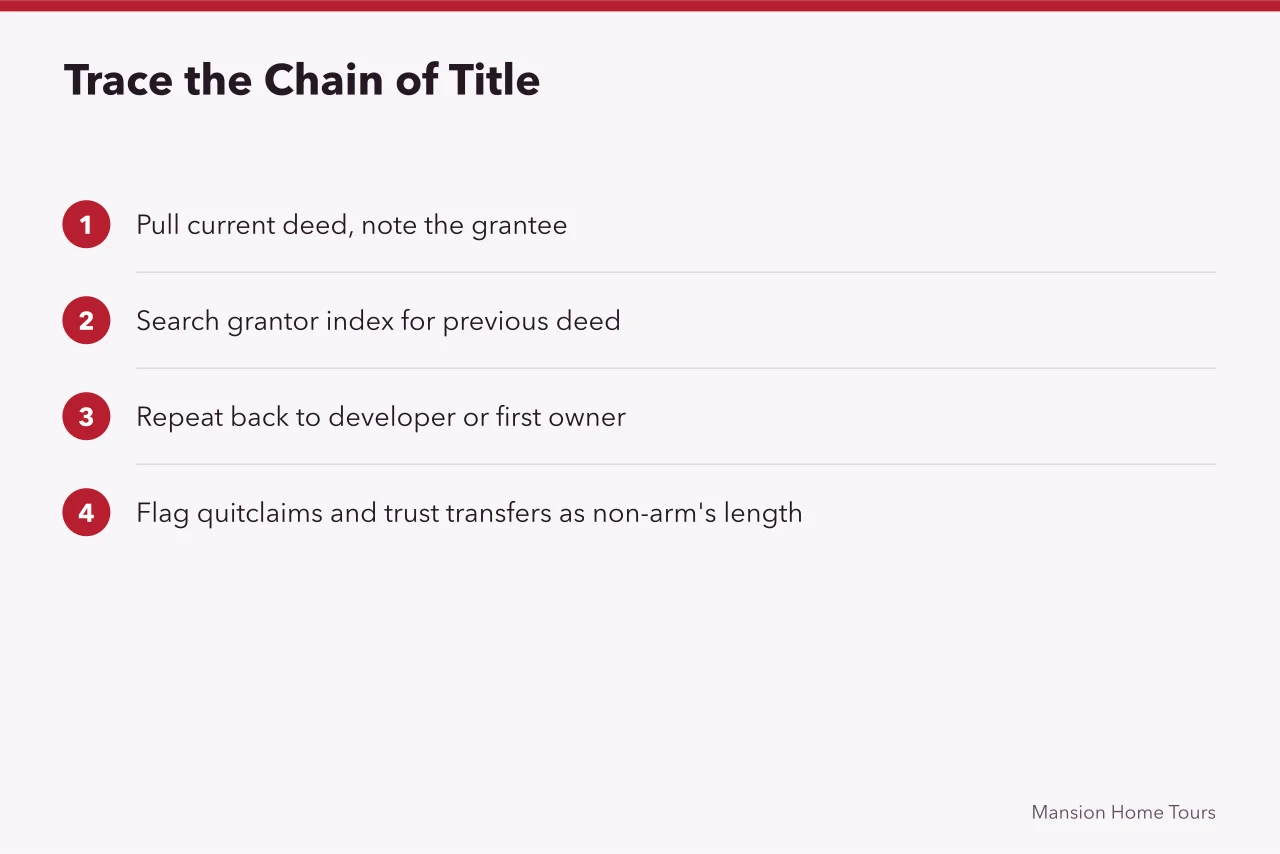
- Pull the current deed image from the recorder and note the grantee.
- Find the previous deed by searching the grantor's name in the grantor index.
- Repeat back through each transfer until you reach the developer or the first private owner.
- Mark any quitclaim deed or transfer to a trust as a non-arm's length move, not a market sale.
If an earlier deed lists an LLC as grantee, the next step is to read Celebrity Home Through an LLC about what that entity changes in title and lending. A trustee's deed also changes the reading because it often comes after a foreclosure.
The online record limit and what it rules out
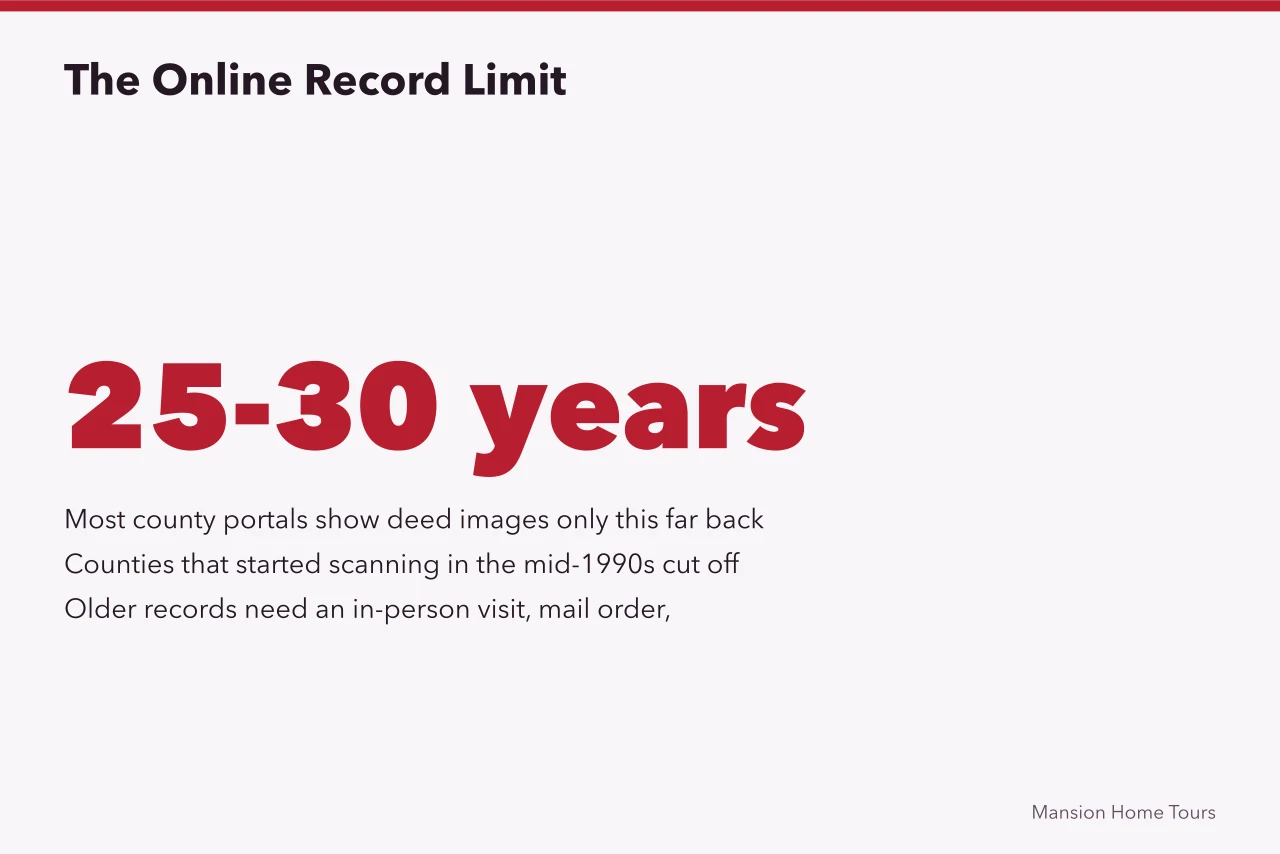
Most US county portals show deed images only for the last 25 to 30 years. Some counties started scanning in the mid-1990s. If the previous sale was in 1988, the scanned image may not be online. That rules out tracing the full chain from a laptop. You would need to visit the recorder's office in person or order a copy by mail. This is a real constraint, not a website bug. County staff can pull older records from microfilm or paper books, but that takes time and often a fee.
Foreign registries have similar digitization gaps, so International homes sales can show how to read those records without assuming a clean title.
What the portals do not show
Many portals do not show the document type clearly, or omit the consideration if the deed says for good and valuable consideration. Some states require a transfer tax affidavit that can be separate. The assessor's map may not match the legal description. Also note that a celebrity sale may appear as a change in ownership with no price if a documentary transfer tax exemption applies, such as a transfer into a trust. That means the sale price field is blank. You must read the deed itself.
If the chain shows a trustee's deed, read Celebrity Home Foreclosure before assuming the price reflects market value.
Common questions
Can I find a celebrity's name in the county recorder index? Only if the celebrity bought in their own name. Many use an LLC or trust, so search by parcel number instead. Does a quitclaim deed mean the house sold for the stated amount? No. A quitclaim often transfers title without a market sale, such as into a trust or between spouses. Why is the sale price blank on some deeds? The consideration may be omitted or a transfer tax exemption applies, especially for trust transfers or intra-family moves.