Costs
Part of A buyer's guide to judging international homes by fit and quality
International homes sales for the careful reader
Buying and selling homes abroad runs on registry files, tax rules and designation status, and each one changes what a careful buyer pays at closing.
International homes sales for the careful reader start with three records, not one: the land registry, the cadastre or tax roll, and the heritage designation file. Each is set by the country, and sometimes by the region inside it.
This guide covers cross-border sale mechanics, designation rules, and named places where international homes trade.
What to take away
- The land registry, the cadastre and the tax roll are three separate records. They can disagree, and the disagreement follows the property. In Spain, ask for the Registro de la Propiedad extract and the Catastro parcel number.
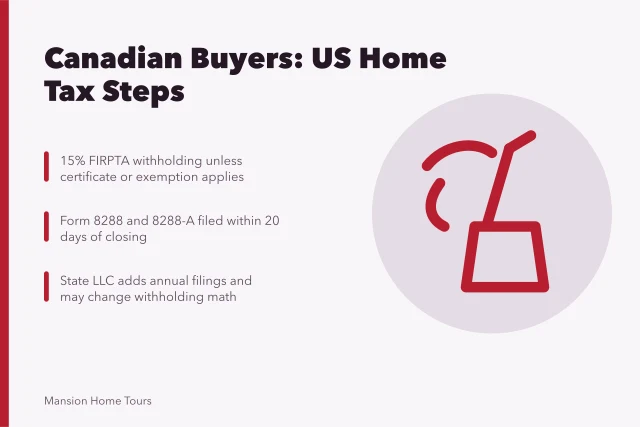
- A non-resident seller often faces a withholding tax at closing. Spain requires the buyer to withhold 3% and file Modelo 211. Mexico uses a 25% gross-sale withholding on many non-resident sales. Rates and refund processes are set by the destination country's revenue authority.
- Historic designation restricts alteration, not ownership or access. France's monument historique, Italy's vincolo, and Spain's Bien de Interés Cultural each run through a consent process. It changes what a buyer can do, not who may visit.
- Transfer tax, agent commission and currency movement are three separate costs. Budget them as three lines, not one.
- Every figure below belongs to a jurisdiction. Confirm yours with a licensed attorney or CPA before you sign.
What the buyer is actually buying
Ownership abroad is proved by a registry entry, not by a deed in a drawer. In Spain the Registro de la Propiedad records title while the Catastro maps the parcel for tax. In Italy the conservatoria records ownership and the catasto maps the parcel. The two can drift apart after an unrecorded inheritance or a boundary dispute.
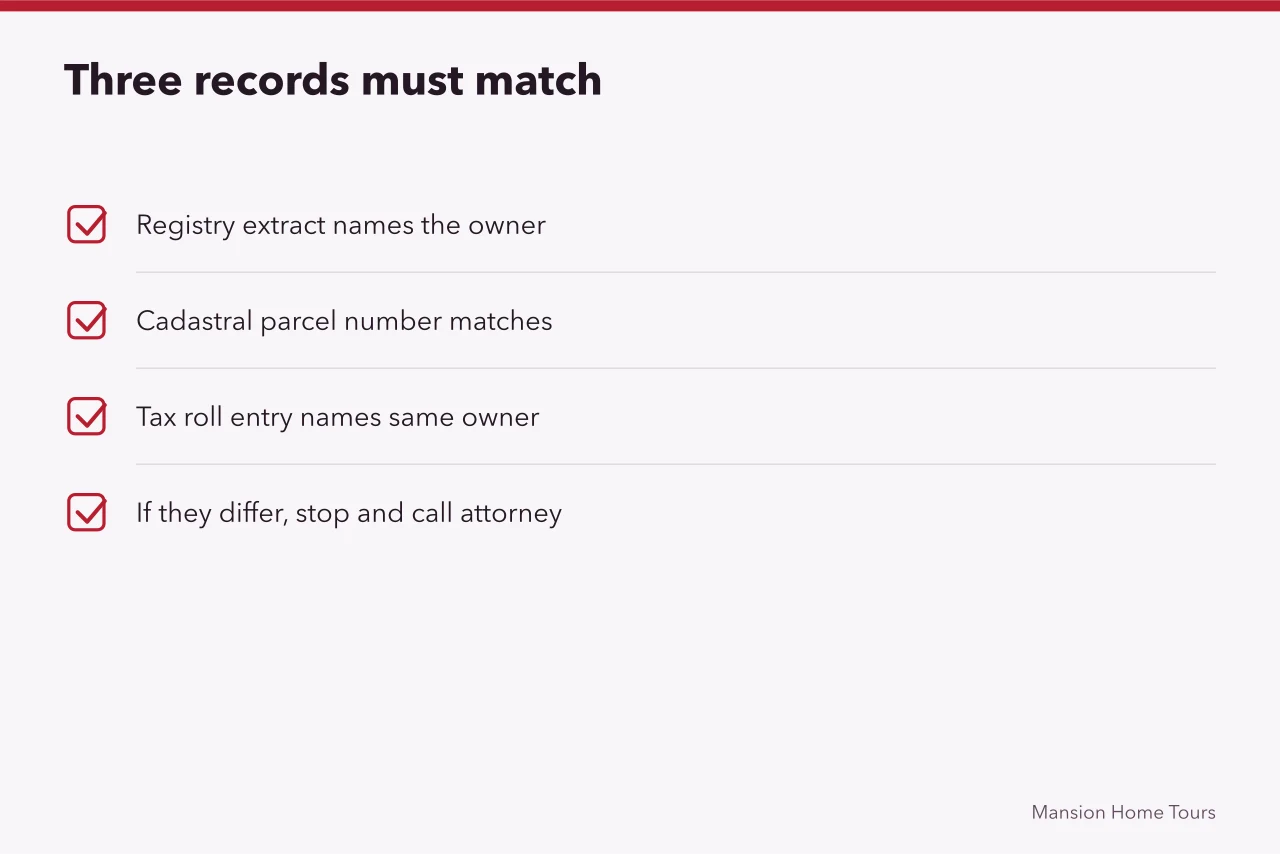
Ask for the registry extract, the cadastral parcel number, and the tax roll entry. If the three do not name the same owner, stop and get a local attorney to explain why. This is the single most common failure in cross-border purchases.
In France, the notaire pulls the état hypothécaire and the cadastral matrix before closing.
Costs, taxes, and named markets with typical prices
| Cost | Who pays it | Where the figure lives |
|---|---|---|
| Transfer tax or stamp duty | Buyer, usually | National or regional revenue office |
| Agent commission | Seller, sometimes buyer | The listing agreement |
| Non-resident withholding | Seller, withheld at closing | Destination country's tax authority |
| Currency conversion | Whoever moves the money | Your bank's published spread |
| Spain non-resident withholding | Buyer withholds 3% and files Modelo 211 | Agencia Tributaria |
| Mexico non-resident withholding | Buyer withholds 25% of gross price, or seller elects net-gain tax | SAT |
| France non-resident capital gains | Seller, paid through the notaire | French tax authority, 19% plus 17.2% social contributions, with possible EU/EEA relief |
| Portugal non-resident capital gains | Seller | Portuguese Tax Authority, flat 28% in many cases |
| Greece non-resident capital gains | Seller | Greek tax authority, 15% in many cases |
The withholding is the one buyers miss. Many countries require the buyer's side to withhold a percentage of the price and remit it, then the seller reclaims the difference after filing. The percentage varies by country and by treaty. Your CPA, not this page, tells you the number.
Spain's 3% withholding and Mexico's 25% withholding are advance payments, not final taxes. Portugal and Greece collect from the seller after the sale.
Portals such as Idealista, SeLoger, Immobiliare.it, Rightmove Overseas, and Christie's International Real Estate group listings by region. Knight Frank, Savills, and Berkshire Hathaway HomeServices also list heritage homes. Their filters show asking prices, not closing prices. These are typical asking ranges as of 2026.
| Market | Example place | Typical asking price | What drives the range |
|---|---|---|---|
| Algarve, Portugal | Quinta do Lago and Vilamoura | €500,000 to €2.5 million | Beach proximity, golf, and short-term rental rules |
| Tuscany, Italy | Val d'Orcia and Chianti | €800,000 to €4 million | UNESCO towns, land, and restoration permits |
| Provence, France | Luberon and Aix-en-Provence | €1 million to €6 million | Wine-growing land, proximity to Avignon, and monument historique status |
| Costa del Sol, Spain | Marbella and Sotogrande | €300,000 to €2 million | Coastal frontage, golf, and short-term rental rules |
| San Miguel de Allende, Mexico | Jardín Principal and Atotonilco | $400,000 to $2 million | UNESCO center status, INAH permits, and dollar demand |
| Athens Riviera, Greece | Glyfada and Vouliagmeni | €400,000 to €2.5 million | Sea view, Ellinikon development, and short-term rental limits |
What designation does to the deal
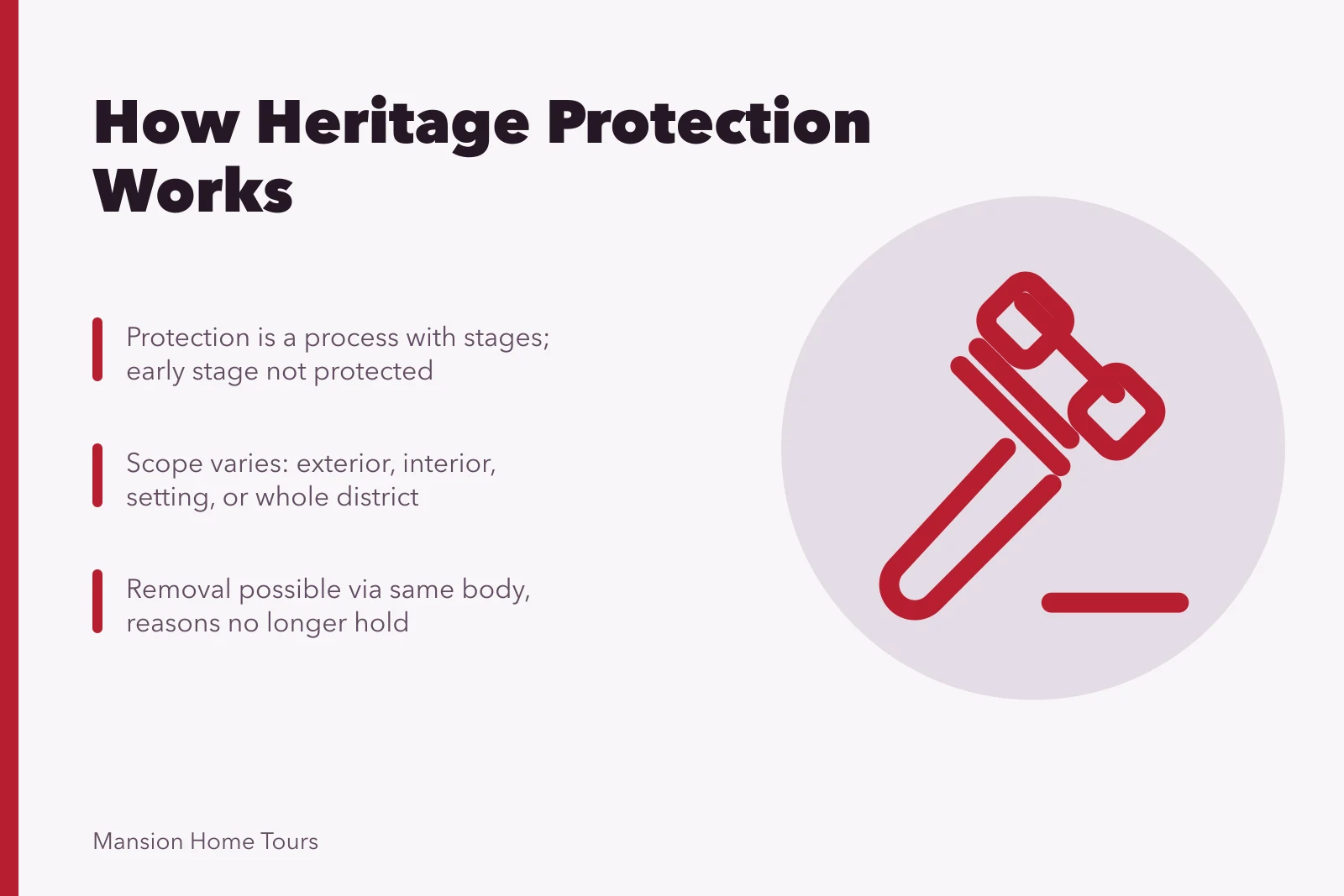
A listed building is not frozen. It is subject to a consent process, and the consent test usually turns on the features that made it significant. The exterior may be controlled while the interior is not, or the setting may be the most restrictive part.
France's monument historique, Italy's vincolo, and Spain's Bien de Interés Cultural each set scope property by property.
The published explanation of one national system's criteria is what the National Register is and what listing means, and the procedural side is at how a property is listed. The maintained file of what has been listed and removed is at the National Register database and how to search it.
None of those three links tells you what a French monument historique or an Italian vincolo restricts. That is set property by property, in the designating body's own document. Read that document, not a summary of it.
Comparing systems without translating them
The vocabulary problem is real. The same word means different things in different countries, and different words mean the same thing. A safe method:
- Find the actual designating body, not a secondary description of it.
- Find the actual document for the actual property, because scope is set property by property.
- Establish what the status restricts, what consent process it creates, and who administers it.
- Do not translate a status into another country's term. Report it in its own words.
Spain's Bien de Interés Cultural, Portugal's Imóvel de Interesse Público, and Greece's listed-building status do not map one to one.
Why record systems generally fail to translate across borders is in comparing property records across countries. How imported building traditions become local hybrids that these systems then have to evaluate is in what a region does to an imported style.
The general question of judging a house in an unfamiliar tradition is in international homes. How to read the stack of alterations that a long-protected building accumulates is in former lives of buildings.
Where to stop
Title, vesting, tax residency and contract terms are legal questions. Name the jurisdiction and hire a licensed attorney there. Tax treatment of a cross-border sale belongs to a CPA who files in both countries.
Structural questions about a load-bearing wall or a foundation belong to a licensed structural engineer or building inspector, not to a listing agent and not to this page. Access to a private property belongs to local trespass law, the HOA rules and the listing agent.
Common questions
Does buying a listed building mean the public can visit?
No. Protection and access are separate. A protected building may be entirely private, and this site treats a private protected building as a private home.
Does designation prevent an owner from changing anything?
No. It generally means certain changes need consent, and the consent test usually turns on the features for which the building was significant. Routine maintenance is normally outside it.
Is a building on a survey list protected?
Usually not. A survey identifies and records; designation protects. Confusing the two is common, and it matters because a surveyed building may carry no protection at all.
Who decides what counts as significant?
A named body, applying published criteria, on a documented record. In France the DRAC, in Italy the Soprintendenza, and in Spain the regional culture ministry apply those criteria. That is why the evaluation document is worth reading: it shows the reasoning, and it can be argued with.