Maintenance
Part of A buyer's guide to judging international homes by fit and quality
International homes prices: land registry versus cadastre versus tax roll
International homes records: how a land registry, a cadastre and a tax roll differ, and why floor area figures do not survive a border crossing.
International home prices look comparable on paper until you ask which record produced the number. A land registry records title. A cadastre maps parcels. A tax roll carries the fiscal value a local authority charges on. A country may run one, two, or all three, and each answers a different question.
Comparing those records across borders is where confident research goes wrong. The documents look equivalent. They are not. This page names public systems, published fee schedules and public price indexes. It identifies no private property and quotes no individual transaction.
What to take away
- A registry of title and a cadastre of parcels are different systems with different guarantees, and many countries have both. Germany runs a Grundbuch for title and a Katasteramt for the parcel map. The Netherlands merged both into the Kadaster.
- Floor area is defined differently almost everywhere, so an area figure is not comparable across borders without knowing the measurement standard.
- Tax rolls lag the market by design. France builds the taxe fonciere base from 1970 notional rents, and England's Council Tax bands use 1 April 1991 values.
- Public sale price registers exist. Ireland's Residential Property Price Register lists the price paid for every home sold since 2010.
- The safe method is to establish what a document guarantees before reading anything out of it.
Three institutions, three questions
A land registry records legal interests: who holds what right in a defined piece of land. In a title registration system the register itself is the title, and the state stands behind it. HM Land Registry, which covers England and Wales, insures the titles it registers and pays compensation when an entry is wrong.
An official copy of a register entry and the title plan costs typically £3 each through the Land Registry's online service. The fee is rarely what limits a comparison. The guarantee behind the entry is.
Not every country registers title. Most US counties run a recording office instead. A deed is filed as a document and the county promises nothing about it. Los Angeles County records deeds, deeds of trust and liens, and buyers rely on title insurance rather than a state guarantee.
Recording fees in US counties are typically under $100 per document. The tax roll sits with a different office, the county assessor.
Germany splits the work. The Grundbuch at the local Amtsgericht holds title. The Katasteramt holds the parcel map under the ALKIS system. Buyers pay real estate transfer tax of 3.5 percent in Bavaria and Saxony. The rate reaches 6.5 percent in North Rhine-Westphalia, Brandenburg, Saarland, Thuringia and Schleswig-Holstein.
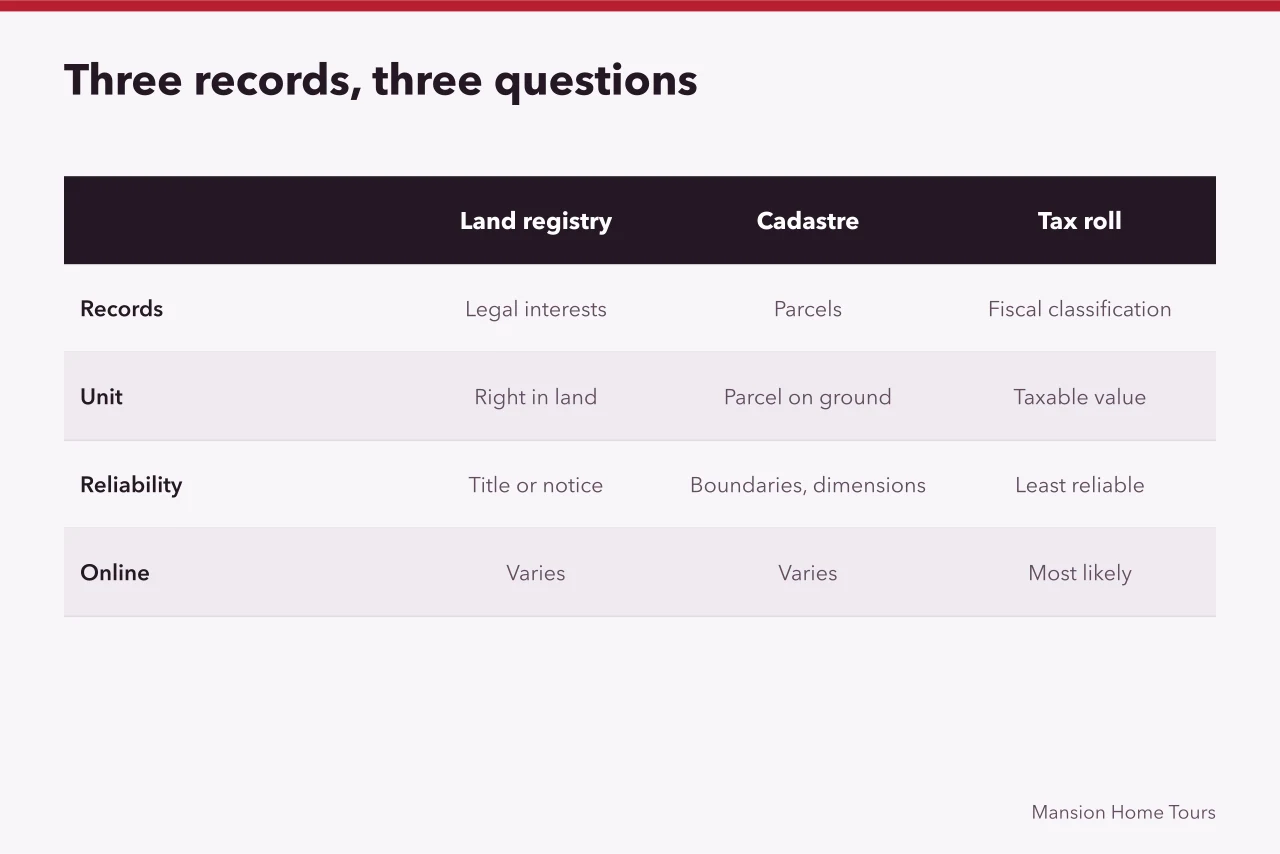
A cadastre records parcels: boundaries, dimensions, and sometimes buildings and their footprints. Cadastral systems grew out of taxation and mapping, so the parcel on the ground, not the right in it, is the unit of interest. France publishes parcel maps free at cadastre.gouv.fr, and a boundary line there proves nothing about ownership.
Spain keeps title at the Registro de la Propiedad, run by the Colegio de Registradores. A nota simple extract costs typically about €9 to €12 online. The Netherlands merged title and parcel data into one body, the Kadaster.
A tax or assessment roll records what a fiscal authority needs to classify and charge. It is the least reliable source about a building and the most likely to be online. A US county assessor's roll is free to search. New York City assesses Class 1 homes at 6 percent of estimated market value.
Lag is built in. Dutch municipalities publish a WOZ value with a reference date of 1 January of the previous year. England's Council Tax bands still rest on 1 April 1991 values, and Wales rebanded on 1 April 2003.
France builds the taxe fonciere base from 1970 notional rental values, adjusted by coefficients, so the bill and the market price part company. A typical French apartment's annual taxe fonciere runs to several hundred euros, and in Paris often above €1,000.
| System | Named example | What it records | What it guarantees | Money attached |
|---|---|---|---|---|
| Title registry | HM Land Registry (England and Wales) | Registered title, not the deed | State-backed title, with compensation for error | Register copy typically £3 |
| Deeds recording | Los Angeles County Registrar-Recorder (US) | Filed deeds, liens, deeds of trust | Nothing; buyers use title insurance | Recording typically under $100 |
| Cadastre | Cadastre run by the DGFiP (France) | Parcel boundaries and dimensions | Nothing about ownership | Parcel maps free at cadastre.gouv.fr |
| Merged registry and cadastre | Kadaster (Netherlands) | Title and parcel in one body | State-backed title | Fees published in the Kadaster tariff |
| Tax roll | County assessor (US) and WOZ (Netherlands) | Fiscal value for charging | A valuation, not a title | New York City Class 1 assessed at 6 percent of market value |
| Sale price register | Residential Property Price Register (Ireland) | Prices actually paid | Nothing; a record of completed sales | Every residential sale since 2010 |
Where a country has separate registry and cadastral bodies, the two can disagree. The way that disagreement is resolved is itself a matter of national law. Assuming the two describe the same object in the same terms is the standard error.
Why area figures do not travel
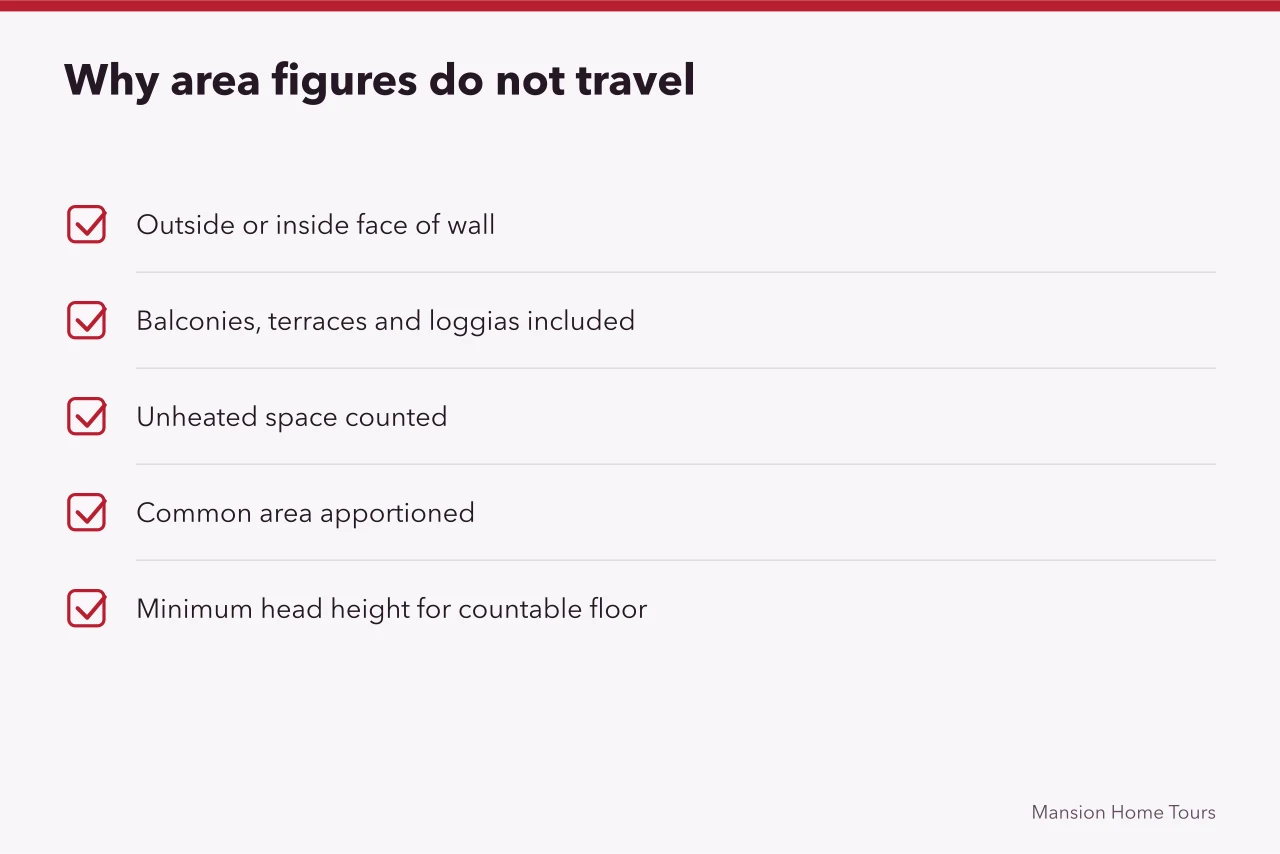
An area figure attached to a building means nothing without its measurement standard. The United States uses ANSI Z765 for single-family square footage. Germany uses DIN 277. Office measurement in many markets follows the RICS Code of Measuring Practice or the IPMS standards from the International Property Measurement Standards Coalition.
| Measurement question | Why it changes the number |
|---|---|
| Measured to the outside or inside face of the wall | Thick walls make the two diverge substantially |
| Are balconies, terraces and loggias included | Some standards include them whole, some at a fraction, some not at all |
| Is unheated space counted | Garages, cellars and attics are treated differently everywhere |
| Is common area apportioned | In apartment buildings this can change a figure dramatically |
| Minimum head height for countable floor | Attic space counts fully, partly, or not at all depending on the rule |
| Which published standard is quoted (ANSI Z765, DIN 277, IPMS, RICS) | The same room yields different numbers under each |
None of these is a mistake. Each is a defensible convention. A building described under one standard and compared under another produces a false result, and the mistake is invisible because both numbers are correct in their own system.
Public price indexes carry their own normalization rules. HM Land Registry publishes the UK House Price Index each month from completed sales.
In the United States, S&P CoreLogic Case-Shiller tracks repeat sales. The FHFA House Price Index covers mortgages bought by Fannie Mae and Freddie Mac. Eurostat covers the EU, and the Dallas Fed's International House Price Database sets its own terms.
Protection status does not travel either
A building may be listed, classified, registered, scheduled or inventoried. A general planning provision may protect it too. England grades listed buildings I, II star and II. France separates monument historique classe from inscrit. The US National Register of Historic Places carries its own consequences.
Each word means something specific in one system and nothing in another. What a status obliges an owner to do, what it prevents, and whether it attaches to the building, the interior, the setting or a district all vary.
The safest approach is the one preservation practice already uses: read the actual designation document for the actual property, in the actual jurisdiction.
For the reasoning that a well-developed system applies to what may be changed in a protected building, the Secretary of the Interior's Standards for Rehabilitation is a clear published example, and comparable documents exist in other systems under other names. The international conservation literature that discusses these differences across traditions is collected by the Getty Conservation Institute's publications.
A method for comparing honestly
- Identify which institution produced the document and what that institution guarantees.
- Find the measurement or classification standard the document uses, and record it beside anything you take.
- Do not convert between systems. Report each in its own terms and say they differ.
- Treat any aggregated cross-country comparison you did not build yourself as unverified until you can see its normalization rules.
Judging a house by the standards of your own country goes wrong in the first place. That problem is the subject of international homes, and comparing plans across building cultures is in reading plans side by side.
The American version of this record problem, fragmented in its own way, is in finding the right office. What any record can honestly support about a building is in how property records work.
Common questions
Is a foreign land registry entry a reliable statement of ownership?
It depends entirely on the system. In a title registration system the entry is close to conclusive. In a deeds recording system it is evidence within a chain. The two look similar and are not. A German Grundbuch entry and a Los Angeles County recorded deed sit at opposite ends of that range.
Why do the same building's areas differ between two documents?
Almost always because the two used different measurement conventions. Check the standard before assuming an error.
Does this site publish property figures from any country?
No. It publishes no prices, no transactions and nothing that would locate a private home, in any jurisdiction. The fee schedules and index figures above are public rates and public aggregates.
What is the one question to ask about any foreign property document?
What does this document guarantee, and to whom. Everything else follows from the answer.