Rules
Celebrity Home Tours in Canada: Rules, Taxes and What Buyers Can See
Canadian celebrity home tours face municipal licensing and parking rules; buying one means registry searches, foreign buyer taxes and section 116 withholding.
What to take away
- Provincial land registries let anyone search most Canadian homes for a fee, so a celebrity address is usually public even when the street is gated.
- Municipal licensing and parking bylaws, not privacy law, decide whether a paid tour bus can sit outside a Toronto mansion.
- Foreign buyers face the federal purchase ban to January 1, 2027, Ontario's 25 percent non-resident speculation tax and British Columbia's 20 percent transfer tax.
- A non-resident seller triggers 25 percent withholding of gross proceeds under section 116 of the Income Tax Act unless a compliance certificate is issued first.
How Canadian celebrity home tours are licensed
Toronto licenses commercial activity under Municipal Code Chapter 545. A paid bus or walking tour of celebrity homes in the city needs a municipal business licence, and a coach operator needs separate vehicle approvals.
A tour that keeps a list of private home addresses is handling personal information. Canada's federal private-sector privacy law applies to commercial activity, so an operator must limit what it collects and cannot publish a client's address without consent.
A tour licence is not a right of entry:
How tours are licensed
- No entry to private property, a gated lane or a condo lobby.
- No photographing through windows or onto a balcony.
- No exemption from parking, idling or noise bylaws.
- No access to a residents-only street without the owner's permission.
Provincial trespass law lets an occupier order anyone off the property, so most Toronto tours stay on public roads and stop at the driveway.
Provincial land registry lookups: what buyers can actually see
Each province runs its own registry, and most allow a title search by address. A search shows the registered owner, the parcel description, registered charges such as mortgages and liens, and the date of the last transfer.
Provincial land registry lookups
| Province | Registry | What a search shows |
|---|---|---|
| Ontario | OnLand and Teranet | Owner, parcel, charges, transfer date |
| British Columbia | LTSA through MyLTSA | Title, charges, transfer date |
| Quebec | Registre foncier du Quebec | Owner, registered rights, history |
| Alberta | SPIN2 | Title and encumbrances |
Sale prices are the uneven part. Some registries and commercial services expose the price paid; others do not. In Ontario, the Municipal Property Assessment Corporation publishes assessed values, which are not sale prices.
Municipal files are a second route. A request for a record naming a homeowner can be refused as personal information under Ontario's Municipal Freedom of Information and Protection of Privacy Act.
Foreign buyer rules, surtaxes and the tax treaty
The federal Prohibition on the Purchase of Residential Property by Non-Canadians Act blocks most foreign purchases of residential property. It began January 1, 2023 and applies to January 1, 2027.
Ontario adds a 25 percent non-resident speculation tax on the value of the consideration for residential property. British Columbia's additional property transfer tax is 20 percent in specified regions.
Steps for a US buyer before making an offer:
Foreign buyer rules
- Confirm the property counts as residential under the federal ban.
- Check provincial surtax exposure and any rebate tied to permit status.
- Choose how you will hold title, knowing a US LLC does not remove Canadian tax duties.
- Plan for the withholding that applies when you sell.
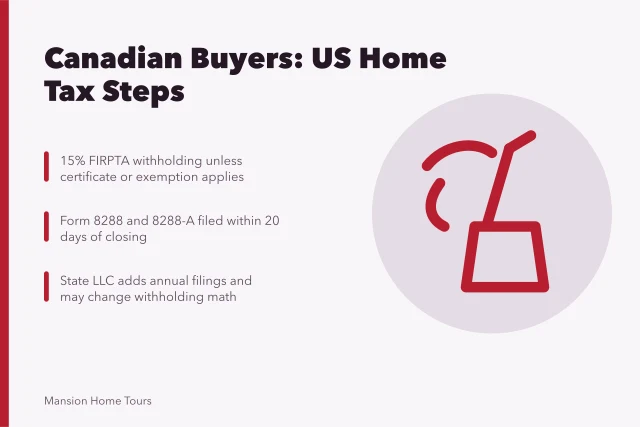
Withholding is the part US guides skip. When a non-resident sells taxable Canadian property, the buyer must withhold 25 percent of the gross proceeds unless the seller first obtains a certificate of compliance under section 116 of the Income Tax Act. The buyer can be assessed for the shortfall.
Example: a Toronto offer from a US buyer
Take a buyer from Michigan who offers on a house in Toronto. The seller moved abroad five years ago. On closing, the buyer's lawyer holds back 25 percent of the gross proceeds until the Canada Revenue Agency issues a certificate of compliance.
Title insurance does not cover that gap. Miss the step and the buyer can end up paying the tax.
Property tax, vacancy levies and carrying costs
Canadian property tax is municipal and school board tax based on assessed value. Ontario assessments come from the Municipal Property Assessment Corporation. A US owner gets no homestead exemption and no deduction for mortgage interest.
Vacancy levies add up. Toronto's Vacant Home Tax and Vancouver's Empty Homes Tax apply to homes left empty, and the federal Underused Housing Tax targets certain non-resident owners of vacant or underused property.
Renovation budgets behave differently, because envelope rules, mechanical plant and ground floor accessibility now shape what a large house can become. Those are the trends that still matter next year.
For a Canada and US cost comparison on one house, Mansion Home Tours keeps the numbers on the listing itself.
What a tour never shows about a mansion's future
Listings end, households move, and the building keeps a record. Mansions after the household leaves resolve into conversion, institutional occupation or loss, and each outcome leaves different evidence in the fabric.
Reading that evidence before an offer costs less than discovering it after closing. The starting point is Mansions sales with the guesswork removed, which begins with the fabric rather than the photographs.