Rules
Fair Housing Act rules for touring United States celebrity homes
Celebrity homes and real estate tours follow Fair Housing Act rules, HUD guidance, NAR conduct rules and state commission limits on what a tour may ask and show.
What to take away
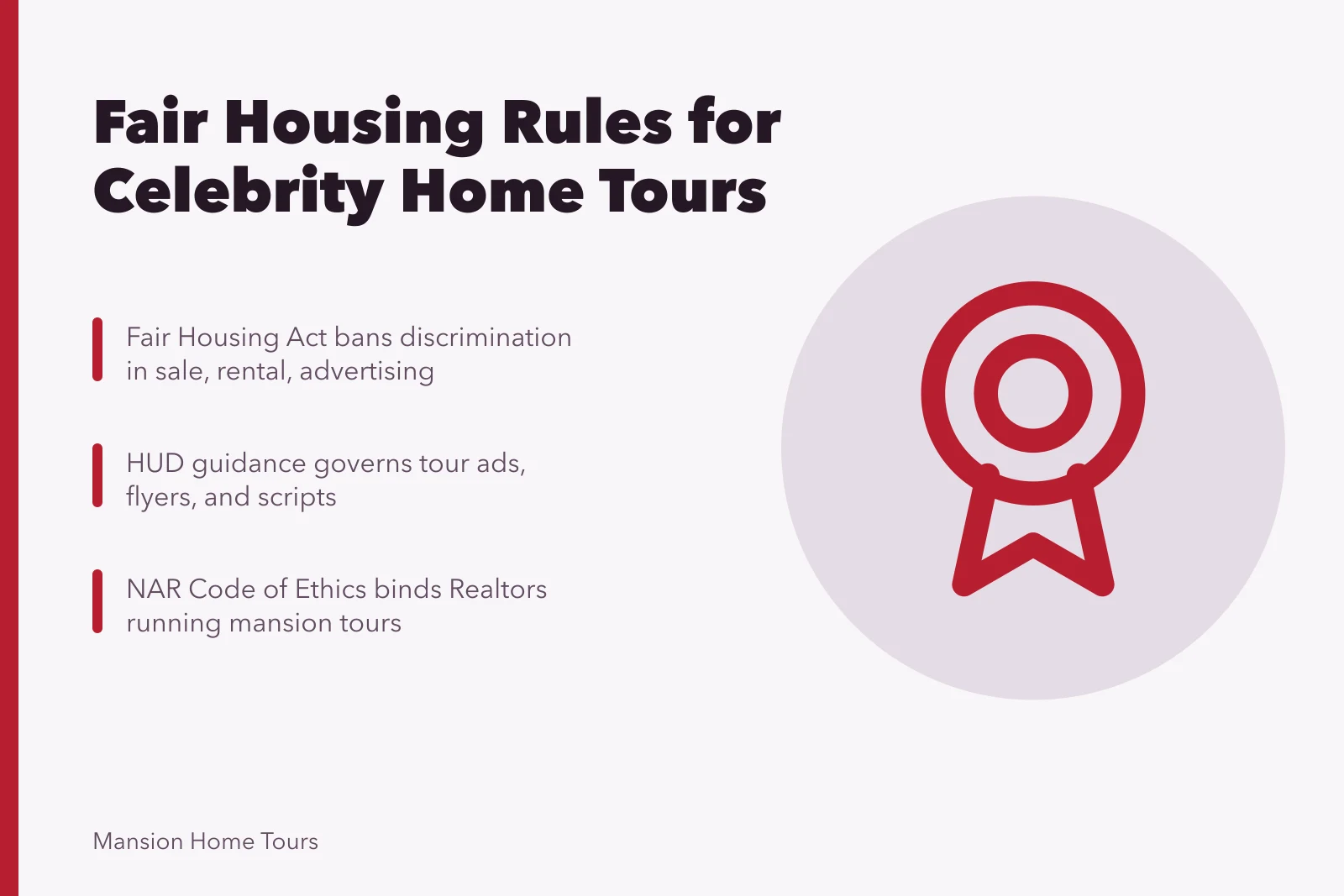
- Celebrity homes and real estate tours are covered by the Fair Housing Act the moment a listing is advertised, shown or discussed with a buyer.
- HUD guidance governs the words in tour ads, flyers and scripts, not just the showing itself.
- NAR conduct rules bind Realtors who run mansion tours, and state real estate commission limits add local layers on top.
- What a tour may ask is narrow: questions tied to price, financing, timing and property condition, never to a buyer's protected class.
- What a tour may show is limited by seller instructions, HOA rules and the property's actual status, not by the buyer's background.
- Document the tour, keep the listing file, and never record protected-class data.
What the Fair Housing Act actually prohibits on a celebrity home tour
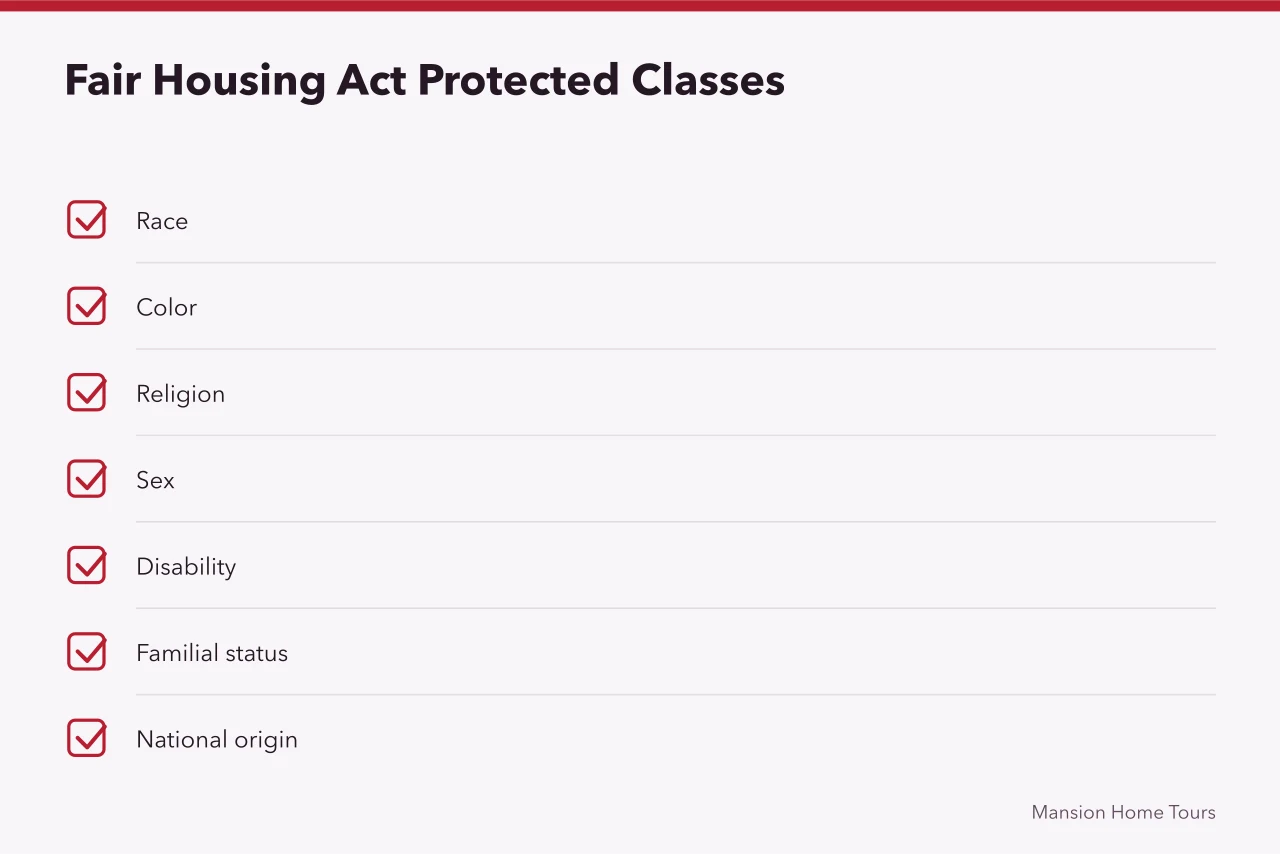
The Fair Housing Act bans discrimination in the sale, rental and advertising of housing. It protects buyers by race, color, religion or sex. Disability, familial status and national origin are protected too. That list comes straight from the statute and applies to a Beverly Hills estate tour the same way it applies to a walk-up in the Bronx.
The statute lives in Title 42 of the U.S. Code, and the full text is public. Reading the statutory language is the fastest way to see that the Act covers advertising, brokerage services, terms and conditions, and the showing itself.
A celebrity home tour is a housing transaction event. The moment a licensed agent opens the door, answers questions or hands over a fact sheet, fair housing duties attach. There is no celebrity exemption and no tourist exemption.
The Department of Justice enforces the Act through pattern-or-practice cases and individual suits. The Civil Rights Division publishes the statutory text and enforcement context, including cases against agents and brokers.
Three tour behaviors get operators in trouble most often. Steering a buyer toward or away from a neighborhood based on who lives there. Quoting different terms to different buyers. And answering demographic questions that the operator should decline.
Disability rules matter on mansion tours because many estates are older and not accessible. A tour operator cannot refuse a reasonable accommodation request, such as a slower pace or a written description of rooms, because the house is a celebrity property.
Familial status protects buyers with children under 18, pregnant buyers and anyone in the process of adopting. A tour that discourages a family from a five-bedroom estate because of the pool or the stairs is a violation, not a courtesy.
A private showing and a group tour carry the same obligations. Mansion home tour vs private showing changes the logistics, the insurance and the crowd size, not the legal standard.
Sellers can set lawful limits: no photography, no shoes, no access to a wing. They cannot set limits that screen buyers by protected class, and an agent who relays such an instruction becomes part of the problem.
How HUD guidance shapes tour advertising and showing language
HUD writes the rules that turn the Act into everyday practice. Its Fair Housing Act overview explains the prohibitions and the complaint process in plain terms, and it is the reference most state investigators cite first.
Start with HUD's Fair Housing Act overview when you draft a tour ad. It spells out that discriminatory advertising is itself a violation, separate from any refusal to show.
HUD's Office of Fair Housing and Equal Opportunity handles complaints and publishes guidance on advertising. The FHEO program page is where tour operators find the current rules on how listings and tours may be marketed.
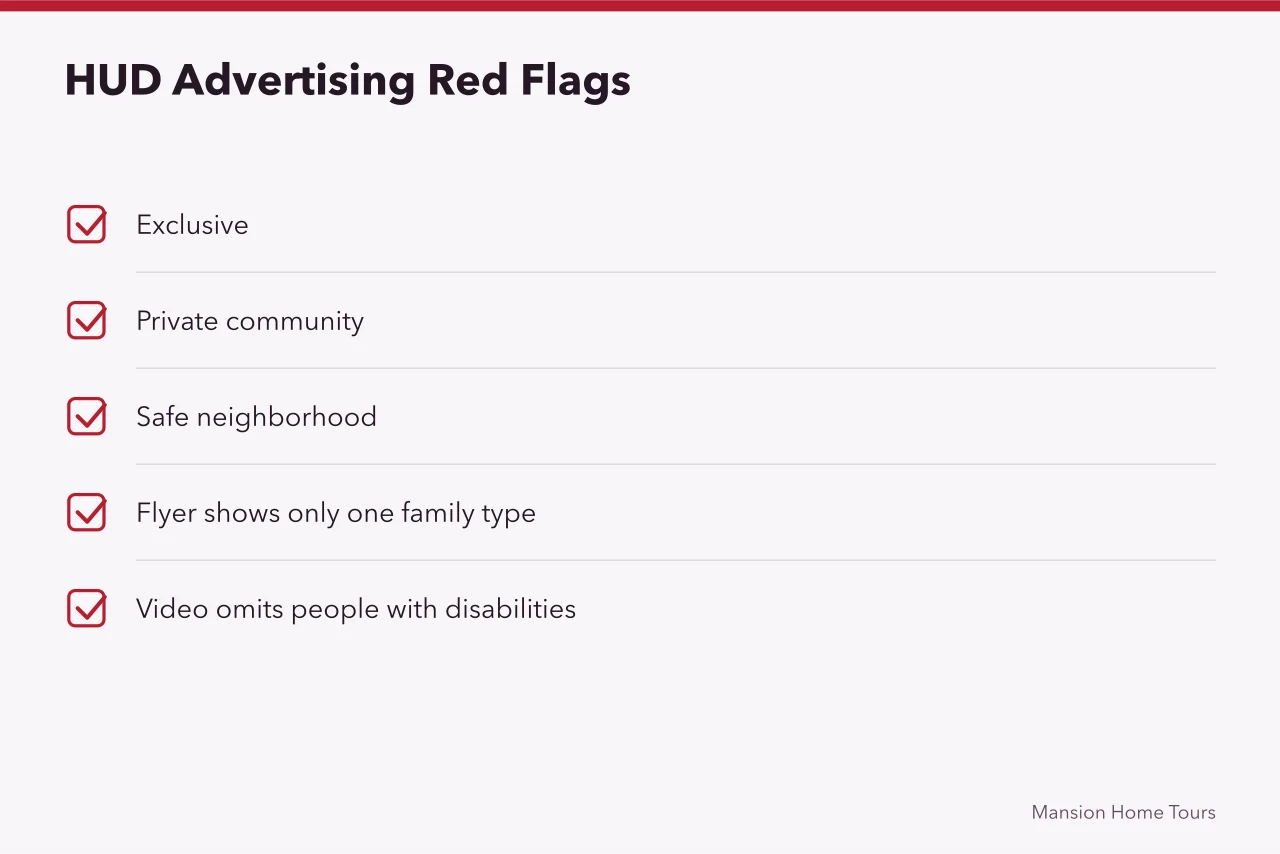
Advertising language is where celebrity tours slip. Words like exclusive, private community or safe neighborhood can signal a preference when paired with demographic cues, and HUD examiners read them in context.
HUD treats words and images together. A flyer that shows only one kind of family, or a video that never includes a person with a disability, can support a discriminatory advertising claim even if no buyer was turned away.
HUD guidance also covers reasonable accommodations and modifications. On a mansion tour, that can mean a ramp at the service entrance, a printed floor plan, or extra time for a buyer who uses a wheelchair.
The practical rule for scripts: describe the property, not the people. Square footage, school district boundaries, commute times and HOA dues are safe. Who lives next door is not.
HUD does not require a tour operator to answer every question. It requires that refusals be based on lawful reasons, such as seller instructions or safety, and applied evenly to every visitor.
Keep the ad file. If a complaint arrives, the flyer, the script and the social posts are the first documents an investigator requests, and HUD can act on advertising alone.
NAR conduct rules that bind Realtors running mansion tours
The National Association of Realtors imposes duties beyond the statute on its members. A Realtor who runs a celebrity estate tour is bound by the Code of Ethics and by NAR's fair housing policy.
NAR's fair housing page lays out the policy and the obligations members carry during property tours, including the duty to refuse discriminatory instructions from a client.
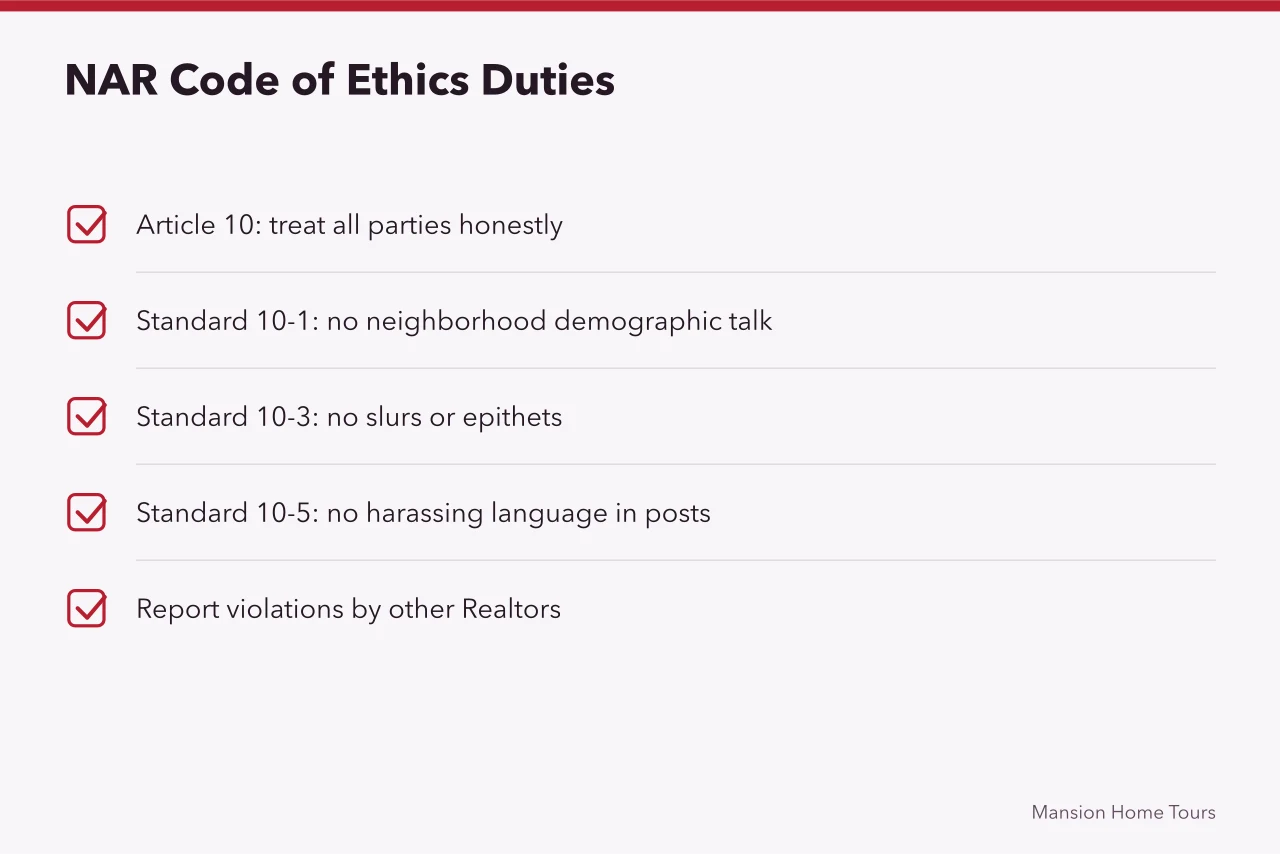
Article 10 of the Code of Ethics requires Realtors to treat all parties honestly and to refuse to deny equal professional services for discriminatory reasons. That duty runs to buyers, sellers and tenants alike.
Standard of Practice 10-1 bars a Realtor from volunteering information about a neighborhood's racial, religious or ethnic composition. On a Bel Air tour, that means no commentary on who the neighbors are.
Standard of Practice 10-3 addresses harassment and hate speech. A Realtor cannot use slurs or epithets in any professional setting, including a private tour with a single client.
Standard of Practice 10-5 requires Realtors to refrain from using harassing language based on protected characteristics. It applies to texts, emails and social posts promoting the tour, not just spoken words.
NAR also expects members to report fair housing violations by other Realtors. A tour operator who hears a colleague steer a buyer can face an ethics complaint for staying silent.
Ethics complaints go to local boards and can result in fines, education requirements or membership suspension. That runs parallel to any HUD or state enforcement, not instead of it.
A Realtor can decline a seller's instruction that would break the law. The Code permits withdrawal from a listing or a tour arrangement rather than passing a discriminatory instruction down to a buyer.
Where state real estate commissions draw the line on tour questions
State real estate commissions license agents and investigate complaints. Their limits sit on top of federal law, and some states add protected classes the Fair Housing Act does not name.
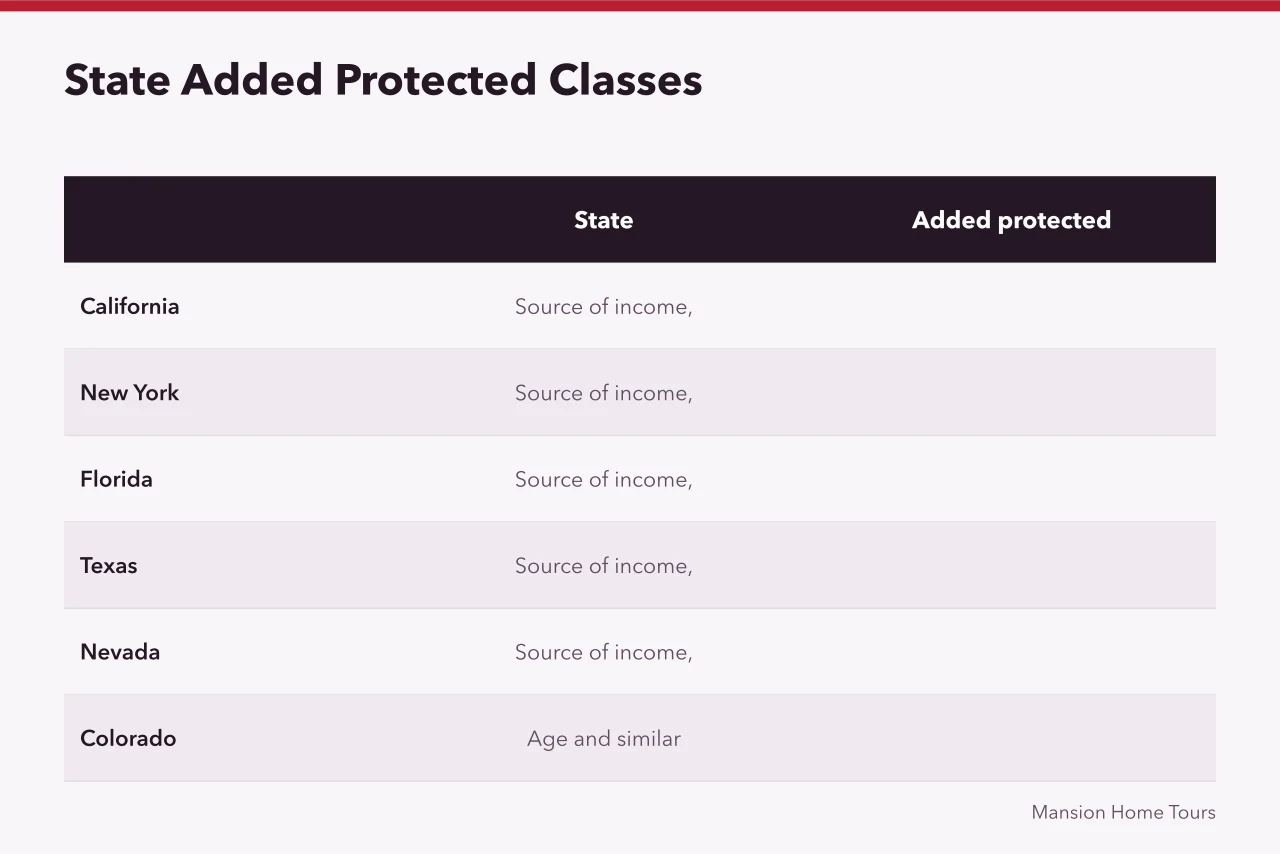
California, New York, Florida, Texas and Nevada all add categories such as source of income, marital status, sexual orientation and gender identity. Colorado, Georgia and Washington add age and similar protections. A tour script that is lawful in one state can fail in another.
California's Department of Real Estate and New York's Division of Licensing Services both publish advertising rules. Those rules reach tour flyers, open house signs and social media promotions for a celebrity estate.
Texas and Florida commissions handle high complaint volumes and require license holders to complete fair housing education. A tour operator working both states should assume the stricter rule applies.
Those states also add their own advertising and disclosure requirements. Colorado and Washington, for example, treat source of income discrimination as a violation in most housing transactions.
State commissions also police unlicensed tour activity. Charging admission to see a celebrity home, or acting as a tour guide for compensation in a real estate context, can draw an unlicensed activity complaint.
That is separate from trespass and privacy exposure. How to tour a celebrity mansion without trespassing covers the property-law side that commissions do not handle.
Penalties range from letters of reprimand to license suspension and revocation, plus civil fines. Commissions can act on a single complaint without a federal case ever being filed.
State investigators often begin with the listing and the ad copy. If a tour operator cannot produce the file, the commission may treat the missing documentation as an aggravating factor.
Reading a listing for fair housing risk before you book a tour
A listing is an advertisement, and a Multiple Listing Service entry is a public one. Read it before you book, because the language tells you how the tour will be run.
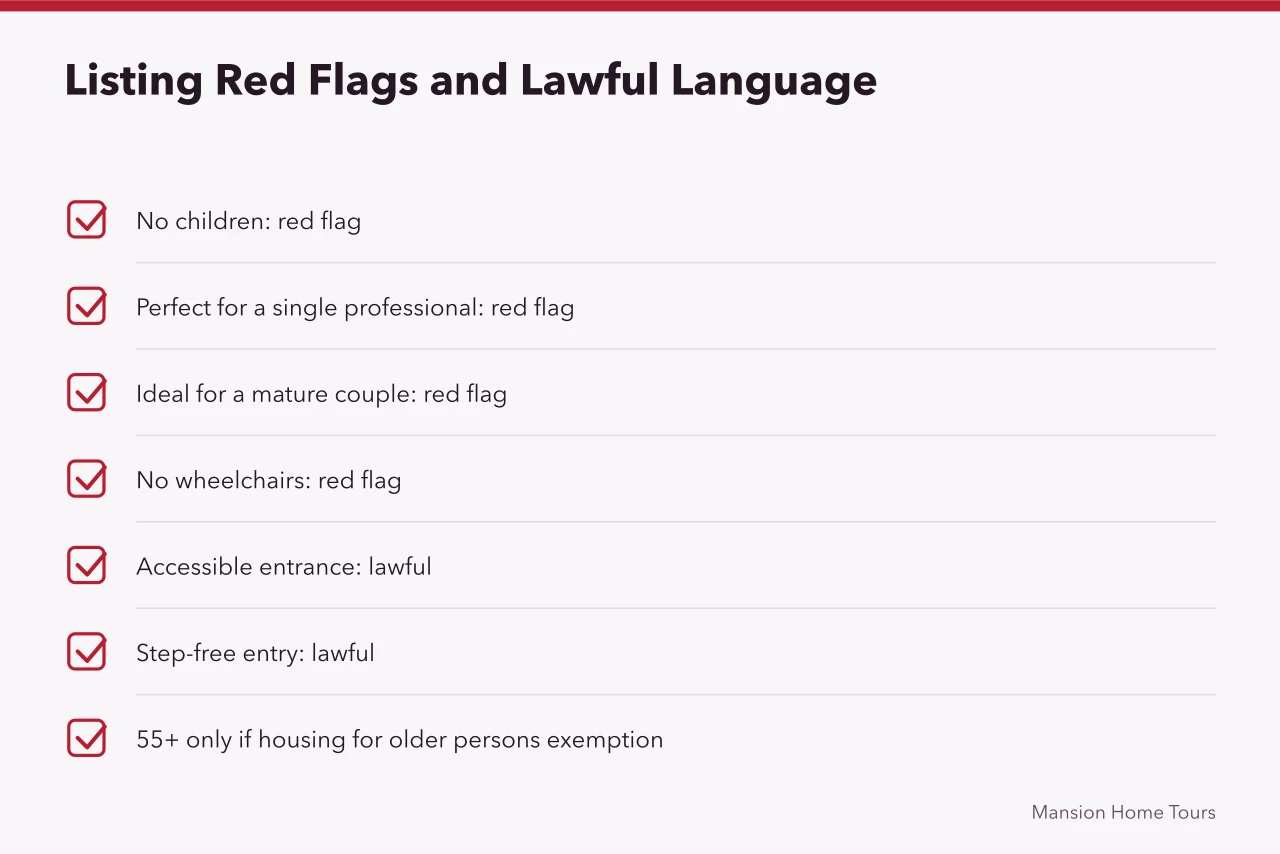
Religious and ethnic cues are the clearest violations. A listing that mentions a nearby church as a selling point, or names a neighborhood's dominant ethnicity, invites a complaint under the advertising rules.
Check the sales history for context, but do not read motive into it. Celebrity home sales history explains how to read prior transfers without assuming why a seller left.
HOA rules add a layer. Many celebrity gated communities restrict signs, tours, photography and short-term access, and those rules shape what a tour may show. Review them before booking, using a celebrity gated community checklist.
Price and address gaps are common on celebrity listings. For a closer look at how location shapes a purchase, see beverly hills vs bel air homes, and remember that a missing figure is not a fair housing issue.
When a listing looks risky, ask the agent in writing which protected classes the state adds and how the tour handles accommodation requests. A written answer creates a record.
Worked example: a Bel Air tour script that passes
A buyer asks whether the neighborhood is good for a young family. The scripted answer: the property sits in the Warner Avenue Elementary attendance area, the HOA allows strollers on the main path, and the pool has a removable safety fence. No comment on who lives nearby.
A buyer asks whether the seller would prefer a cash offer from a particular kind of buyer. The scripted answer: the seller will review all offers on the stated date and terms are in the MLS. No speculation about the seller's preferences.
A buyer asks for an accommodation and needs a step-free route. The scripted answer: the service entrance has a ramp and a printed floor plan is available. The request is logged in the tour file.
Documenting a tour: what to keep and what never to ask
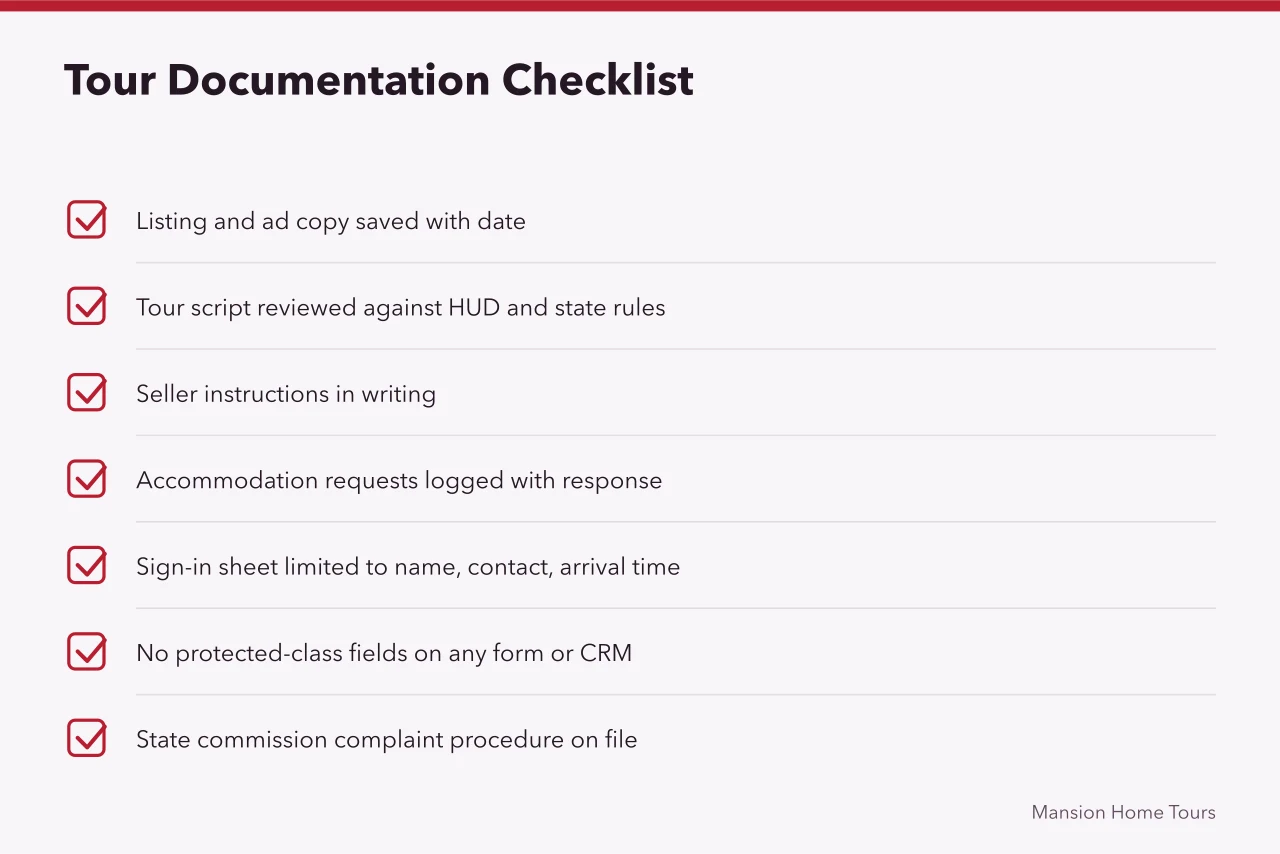
Documentation protects the operator and the buyer. Keep the ad copy, the tour script, the accommodation log and the showing record for the period your state requires.
Keep the listing as published, including any amendments. Keep written seller instructions, and keep a note of any instruction you declined and why.
Keep accommodation requests and your response. Keep the sign-in sheet, but limit it to name, contact information and time of arrival.
Never keep protected-class data. Do not record race, religion, national origin or sex. Do not record disability, familial status or any state-added category on a tour form or CRM note.
What a tour may ask is a short list. Ask about budget, financing status, timeline, representation and property condition. Accommodation needs are a fair question too.
What a tour may show is also bounded. Show the listed spaces, the disclosed defects and the amenities the seller authorized. Do not show a neighbor's lot, a security layout or an unlisted wing.
Never ask about nationality, birthplace, accent or religion. Never ask about marital status, children, pregnancy, disability or sexual orientation. Never ask why a buyer wants a particular neighborhood if the answer would reveal a protected class.
If a buyer volunteers protected-class information, do not write it down and do not repeat it. Acknowledge, move on, and keep the tour focused on the property.
Set the sequence before the tour starts. Confirm identity and representation, confirm the accommodation plan, walk the authorized spaces, then answer questions from the script.
- Confirm the buyer's agent and representation status in writing.
- Confirm any accommodation request and the plan to meet it.
- Distribute the property fact sheet with no demographic content.
- Walk only the spaces the seller authorized.
- Answer questions from the script and decline the rest.
- Log the showing, the accommodation and any declined instruction.
A tour operator who follows those steps has a defensible file. The file matters more than the tour, because complaints are decided on documents.
Common questions
Does the Fair Housing Act apply to a celebrity home tour? Yes. Any showing tied to the sale or rental of housing is covered, and the celebrity status of the seller changes nothing about the legal duties.
Can a tour operator ask whether I have children? No. Familial status is protected, and a question about children can support a discrimination claim even if the tour proceeds.
What can a tour operator legally ask me? Budget, financing, timeline, representation and condition concerns. Accommodation needs are fair game too.
Do NAR conduct rules apply to non-Realtors? No. The Code of Ethics binds NAR members, but state licensing laws and the Fair Housing Act apply to any licensed agent running a tour.
What should I do if a tour ad uses discriminatory language? Save a copy, note the date and file a complaint with HUD or your state real estate commission. Advertising alone can be a violation.
How long should a tour operator keep records? Follow your state commission's retention rule, which is often three to five years. When in doubt, keep the file longer than the minimum.