Features
Why New York penthouses cost more per square foot than Los Angeles mansions
Celebrity homes and real estate in New York cost more per square foot than Los Angeles mansions because of coop board rules, condo charges and land value.
What to take away
- In celebrity homes and real estate, the gap is legal and structural, not cosmetic: Manhattan apartments carry building-level costs and ownership rules that a Los Angeles house on its own lot does not.
- Coop board rules screen buyers and slow resale, so a Manhattan co-op trades at a discount to a condo of similar size, while the condo carries its own common charges.
- Condo charges and common charges are recurring monthly costs per square foot, and they never appear in a Los Angeles mansion's asking price.
- Land value per buildable square foot, visible in New York City property records, is the single largest reason Manhattan pricing separates from Los Angeles pricing.
- NAR data shows the two markets are not measured the same way, which is why a raw price per square foot comparison misleads buyers.
- Read a penthouse listing and an LA mansion listing with the same checklist: legal form, monthly carrying costs, land basis and what the MLS fields actually report.
Why price per square foot diverges between Manhattan and Los Angeles
A Manhattan penthouse and a Los Angeles mansion can list at the same price and describe completely different assets. One is a share of a building on a small parcel. The other is a house on a lot you control.
Price per square foot is a ratio, and the two cities feed different numbers into it. Manhattan divides a large price by a small, interior-only area. Los Angeles divides a large price by interior area plus garage, patios and sometimes lot influence.
Start with density. Manhattan packs thousands of households onto a grid of avenues, so the land under any one apartment is scarce and expensive. Los Angeles spreads outward, and a Beverly Hills or Bel Air lot can be a quarter acre or more.
That single fact drives the rest. When land is scarce, builders go up, and going up adds shared systems, staff, elevators and rules. Every one of those shows up in the price per square foot.
Manhattan also counts space differently. A co-op's quoted square footage often comes from the building's own records, not a uniform standard. Two listings of the same size can report different numbers.
Los Angeles listings lean on county assessor records and MLS measurements, which include more of the structure. The result is a bigger denominator on the West Coast and a smaller one in New York.
The ownership form matters too. Manhattan inventory splits among co-ops, condos and condops, and each carries a different cost stack. A Los Angeles mansion is usually a fee simple house, one owner, one parcel.
That difference is why buyers who compare a Tribeca penthouse with a Holmby Hills estate by the square foot are comparing a share of a tower with a piece of ground. The ratio hides more than it reveals.
If you want the legal-form angle in more depth, the way ownership is structured changes what you actually buy, as covered in New York homes prices.
Coop board rules and what they add to the cost
A co-op purchase is not a real estate purchase in the ordinary sense. You buy shares in a corporation, and the corporation owns the building. Your shares come with a proprietary lease.
Coop board rules govern who may buy those shares. The board reviews your financial statement, your debt-to-income ratio, your liquid reserves after closing and your references. It can say no without giving a reason.
That power has a price effect. Buyers discount co-ops because resale is slower and the pool of eligible purchasers is smaller. A co-op and a condo in the same building can trade at noticeably different prices per square foot.
Boards also set house rules that shape daily life: sublet limits, renovation windows, move-in fees, pet policies and financing caps. Some buildings limit the share of the purchase price a buyer may finance.
Those financing caps matter. If a board allows only 50 percent financing, a buyer who needs 70 percent cannot close, no matter the price. The eligible buyer pool shrinks again, and the discount widens.
Boards also require interviews. A board interview is short, formal and often decisive, and it happens after you and the seller have signed a contract. A rejection can end the deal.
Compare that with a Los Angeles mansion, where the seller cares about price and terms and the buyer's lender sets the lending rules. There is no neighbor committee with veto power over your purchase.
Co-op financial statements add another layer. Buyers read the building's reserve fund, underlying mortgage and assessment history. A weak reserve fund means future assessments, and buyers price that risk in.
This is one reason Manhattan prices per square foot can look inconsistent. The number reflects the apartment, the building's balance sheet and the board's rules all at once.
Condo charges and common charges in New York penthouses
A condominium is real property. You own your unit and a share of the common elements, and you pay common charges to the condominium association each month.
Common charges cover the building's shared costs: staff, lobby, elevators, heating and cooling for common areas, insurance for the common elements, water and repairs. They scale with the building's service level.
A full-service Manhattan tower with a doorman, concierge, gym and pool carries higher common charges per square foot than a small walk-up condo. A penthouse at the top of that tower carries the largest share.
Real estate taxes are billed separately in most condos, though some buildings include them in a single monthly payment. Either way, the buyer's monthly number is charges plus taxes plus any mortgage.
That monthly number is the part Los Angeles buyers miss. A Los Angeles mansion has taxes, insurance and maintenance, but no association charging a fixed monthly fee for shared systems.
Condos also levy assessments for capital work: facade repairs, roof replacement, elevator modernization, lobby renovation. A special assessment can run into six figures for a large unit.
Buyers should read the last several years of board minutes and the reserve study before making an offer. The reserve study projects future capital needs, and it tells you whether the monthly charge is likely to rise.
The National Association of Realtors publishes material on how condominiums are structured and financed, which is useful when you compare a condo's monthly charge with a house's maintenance budget: NAR condominium rules.
Condo charges also affect financing. Lenders review the building's budget, insurance and owner-occupancy ratio. A building that fails the review limits the mortgages available to buyers, which again narrows the buyer pool.
One practical step: ask for the current common charge, the last three years of increases, the reserve balance and any pending assessment. Put those four numbers next to the asking price.
A Manhattan penthouse with low common charges but a thin reserve is often more expensive over five years than one with higher charges and a healthy reserve. The listing price does not show this.
Land value and the New York City property record trail
Land value is the quiet driver. In Manhattan, the land under a building is worth a large share of the finished apartment's price, because there is so little of it and zoning limits how much can be built.
New York City property records let you trace this. The city's public records system holds deeds, mortgages, ownership history and transfer documents for individual parcels and buildings.
You can pull the recorded documents for a building, see when it sold and for how much, and read the mortgage amounts. Those filings are public and searchable, and they show the land and building as one assessed parcel.
Assessment rolls separate the land from the improvements. That split is useful. It shows how much of the value sits in the dirt and how much in the structure, which is the opposite of how most Los Angeles mansions are valued.
In Los Angeles, a buyer often pays for the house and the lot together, and the lot's value depends on the neighborhood, the view and what can be built on it. Teardowns happen, but the house usually carries real value.
In Manhattan, a teardown is rare. The building is the use, and the land is the constraint. When land value per buildable square foot is high, every apartment in the building inherits that cost.
Zoning adds another layer. Floor area rules, setback requirements and air rights determine how much square footage a site can support. Air rights can be sold and transferred, which is its own market.
That is why two Manhattan buildings a block apart can carry very different land values per square foot. One may have unused development rights, the other may be built to its limit.
Historic district designation and landmark status can also restrict changes, which affects what a buyer can do with the property. The National Register of Historic Places and local landmark rules both play a role.
For buyers, the practical move is to order the recorded documents and the assessment history before you negotiate. The record trail tells you what the seller paid, what the debt is and how the value splits.
A penthouse's price per square foot then becomes readable. Part of it is the apartment. Part of it is the land beneath it, and the records show the proportion.
What NAR data shows about residential price comparisons
The National Association of Realtors collects and publishes residential market data, and its figures are the usual starting point for comparing markets. The data covers sales prices, inventory and market conditions.
NAR's residential research covers existing-home sales, median prices and regional breakdowns. It does not publish a single national price per square foot for luxury apartments, because the measurement varies by market.
That is the point. Price per square foot is a local metric built from local data fields. Comparing a Manhattan figure with a Los Angeles figure without checking the method is a category error.
NAR also maintains the policy framework behind the Multiple Listing Service, the shared database where brokers publish listings. The MLS defines the data fields, and those fields differ between markets.
In one market, the square footage field may reflect interior living area only. In another, it may include covered patios or garages. The field definition changes the ratio before any buyer sees it.
NAR's MLS policy material explains how listing data is structured and shared, which is what you need to know before you trust a square-foot figure from either city: MLS Policy.
NAR's broader facts and statistics pages are useful for context on household formation, homeownership rates and affordability, all of which shape demand in both markets: Get the Facts.
For the fundamentals behind price-per-square-foot comparisons, including how residential transactions are reported, NAR's residential pages are the reference point: Residential Real Estate.
What the data supports is a direction, not a single number. Manhattan's constrained supply and high land value push its per-foot figures up. Los Angeles spreads that value across larger lots and more square footage.
Use the data to frame the question, then use local records and the building's own documents to answer it. National figures set the range. The parcel sets the price.
Reading a penthouse listing against an LA mansion listing
Here is a worked example. Two listings, both asking about the same price. One is a Manhattan penthouse, one is a Los Angeles mansion. Read them line by line.
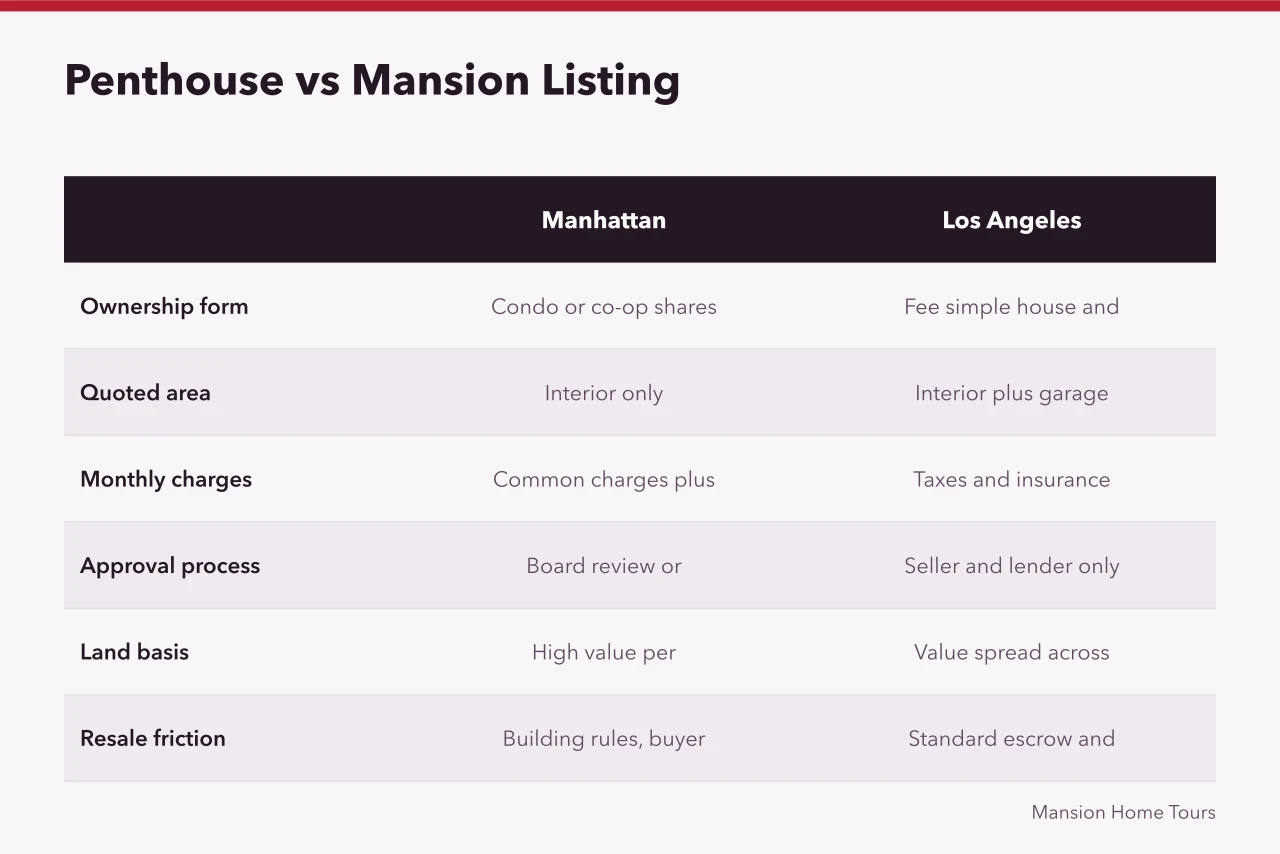
| Item | Manhattan penthouse | Los Angeles mansion |
|---|---|---|
| Ownership form | Condo or co-op shares | Fee simple house and lot |
| Quoted area | Interior only, often building records | Interior plus garage and covered areas |
| Monthly charges | Common charges plus taxes | Taxes and insurance only |
| Approval process | Condo board review or co-op board interview | Seller and lender only |
| Land basis | High value per buildable square foot | Value spread across a larger lot |
| Resale friction | Building rules, buyer review, financing caps | Standard escrow and lender rules |
| Data source | New York City property records, MLS fields | County records, MLS fields |
The first column tells you the penthouse's price per square foot is computed on a smaller base and carries a monthly charge the mansion does not. The second column shows more square footage counted and fewer recurring fees.
Now run the numbers. Suppose the penthouse lists at a price that works out to a high per-foot figure, and the mansion lists at a lower per-foot figure for more space. That does not make the mansion cheaper to own.
Add five years of common charges to the penthouse, plus projected assessment risk from a thin reserve. Add five years of property taxes, insurance and maintenance to the mansion, including roof, HVAC and landscaping.
The comparison changes once carrying costs enter. A lower per-foot price with higher annual ownership costs can end up more expensive than a higher per-foot price with predictable monthly charges.
Here is the sequence to follow before you make an offer on either property:
- Confirm the ownership form and read the governing documents, including the proprietary lease for a co-op or the declaration and bylaws for a condo.
- Pull the recorded documents and assessment history from the relevant public records system.
- Request the last three years of common charges or HOA dues, plus the reserve balance and any pending assessment.
- Check how the square footage was measured and what the MLS field includes in each market.
- Build a five-year total cost of ownership for both properties and compare that number, not the asking price.
A checklist for the penthouse side:
- Ownership form confirmed: co-op, condo or condop
- Board rules read: sublet, financing cap, pet policy, renovation windows
- Common charges and real estate taxes for the current year
- Reserve fund balance and reserve study reviewed
- Pending or recent special assessments disclosed
- Recorded deed, mortgage and assessment history pulled
- Square footage source identified and field definition checked
A checklist for the Los Angeles side:
- Lot size, zoning and any overlay or historic designation confirmed
- Property taxes at the current assessed value, plus any pending reassessment
- Insurance quote for the structure and any wildfire or flood exposure
- Deferred maintenance items identified by a qualified inspector
- Any HOA dues, if the house sits in a planned development
- Recent comparable sales reviewed with the same measurement standard
Both lists end at the same place: total cost of ownership over a defined holding period. The price per square foot is an input, not an answer.
If you are weighing the two markets, read the layout and light questions that decide a New York apartment alongside the cost analysis. Those are covered under New York homes interiors and under the daylight arguments behind a New York homes plan.
On the West Coast, the equivalent groundwork is covered under los angeles homes and in the pricing pointers on los angeles homes prices.
The gap between Manhattan penthouses and Los Angeles mansions comes down to land, legal form and carrying costs. Manhattan prices reflect scarce land and shared buildings. Los Angeles prices reflect larger lots and individual ownership. Both are readable, but only if you read the right documents.
Common questions
Why is price per square foot higher in Manhattan than in Los Angeles? Manhattan has less land per household, so land value per buildable square foot is higher, and the quoted area usually counts interior space only. Los Angeles spreads value across larger lots and counts more of the structure.
Do coop board rules really change the price? Yes. Board review narrows the buyer pool and slows resale, and financing caps can exclude buyers who need larger mortgages. That friction shows up as a discount relative to comparable condos.
What do condo charges cover that a Los Angeles mansion's costs do not? Common charges fund shared building systems: staff, elevators, lobby, common-area insurance and repairs. A mansion owner pays for those items directly and separately, with no association fee.
Where can I check land value and ownership history? New York City property records hold deeds, mortgages and assessment rolls that separate land from improvements. Los Angeles County records serve the same purpose on the West Coast.
Does NAR publish a national price per square foot? NAR publishes residential sales data, median prices and market statistics, and it maintains the MLS policy framework. Price per square foot is a local metric built from local data fields, so methods vary by market.
Is a Manhattan penthouse always more expensive to own? Not always. Monthly common charges and assessment risk push Manhattan costs up, but a Los Angeles mansion carries taxes, insurance and maintenance on a larger structure and lot. Compare five-year total cost of ownership.