Costs
Nevada versus Florida taxes on a celebrity mansion purchase
A mansion home purchase in Nevada or Florida turns on income tax, property tax caps and capital gains treatment. Here is how the two states compare.
What to take away
- A mansion home purchase in Nevada or Florida is shaped less by the sticker price than by state income tax, property tax caps and capital gains treatment.
- Nevada has no state income tax, so a Las Vegas closing avoids the state-level hit a Florida buyer can face on certain investment income.
- Florida also has no state income tax on wages, but its property tax caps and assessment rules differ from Nevada's statutes in ways that matter at eight figures.
- Federal rules under IRS Publication 523 and Publication 530 apply in both states and can decide net proceeds more than any state line item.
- State revenue figures show how each state funds itself, which is the quiet reason the two tax codes diverge.
How Nevada and Florida treat state income tax on a mansion purchase
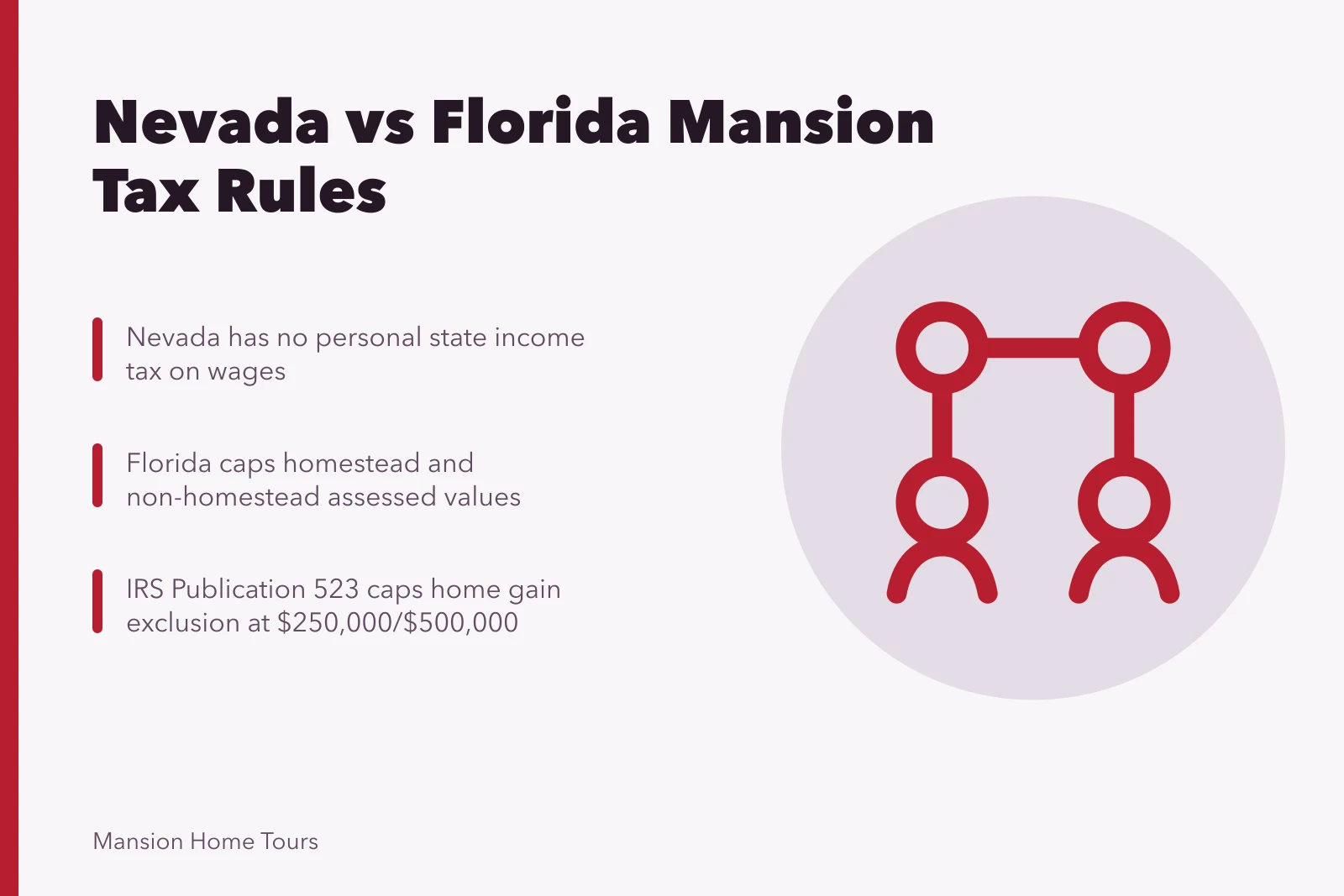
Start with the obvious: neither Nevada nor Florida levies a personal state income tax on wages. That single fact draws a large share of high net worth buyers to Las Vegas and Miami, and it is the first line in most comparisons.
The difference sits underneath. Nevada's constitution limits how the legislature can tax individuals, and the state funds itself through consumption and gaming taxes instead. Florida does the same through sales tax and a corporate income tax that does not reach most individuals.
For a celebrity buyer, the practical question is not the salary. It is whether the state reaches capital gains, carried interest, royalties or deferred compensation tied to the purchase. Neither state taxes those as ordinary personal income.
That is why the income tax line on a mansion home purchase in either state is often zero. The real cost shows up later, in property tax and in how the sale is structured.
Where the states part ways is residency. A buyer who keeps a Nevada home and a Florida home can trigger a domicile fight, and the losing state can assess back tax. Keep records of where you actually live, vote and register vehicles.
One more wrinkle: if the mansion is bought through an entity, the analysis shifts. A celebrity home llc purchase can change which state taxes the gain and when.
Property tax caps: Nevada statutes against Florida's framework
Nevada and Florida both cap property tax growth, but they cap different things. Nevada's statutes limit the taxable value used for the local property tax rate, while Florida's framework limits the assessed value for homestead and non-homestead property separately.
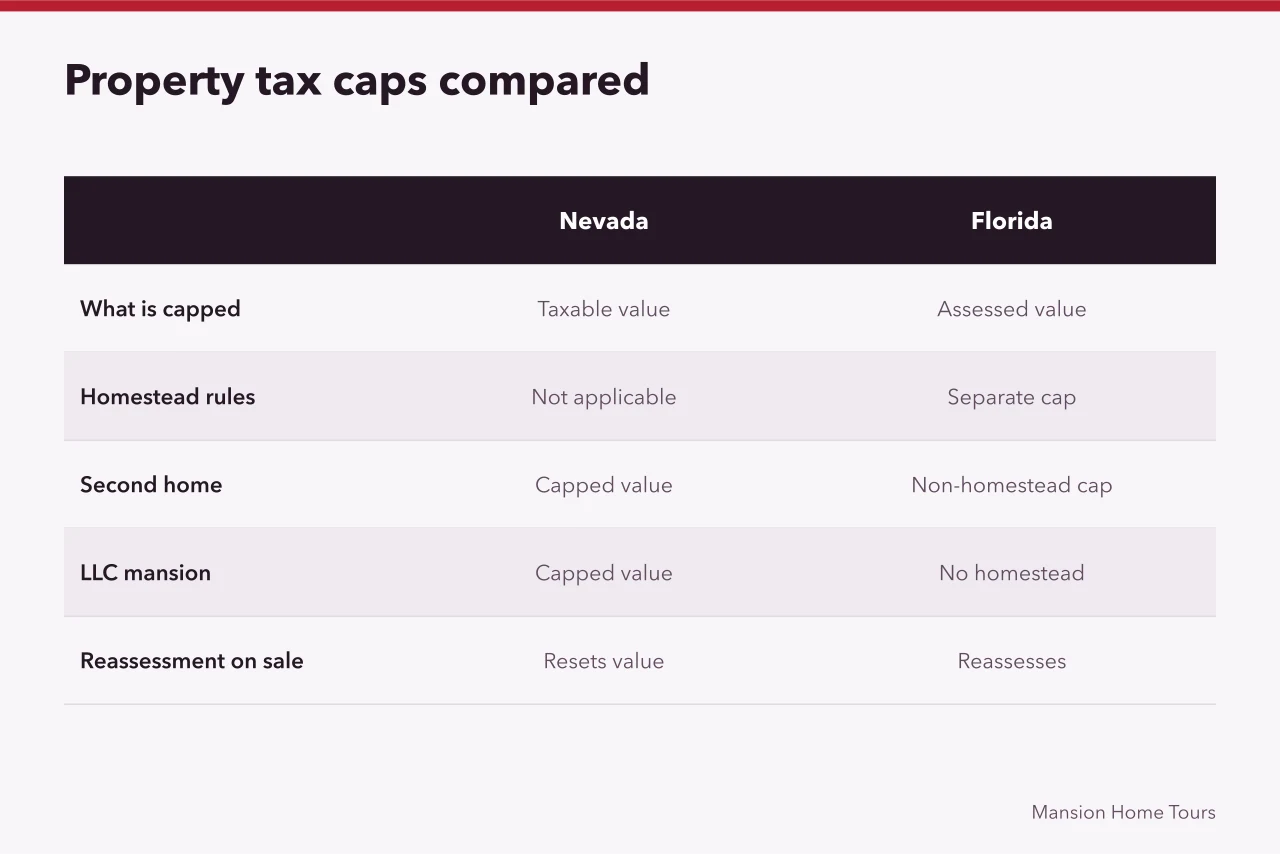
Nevada's cap applies to the assessed value of the property, not the market value. The county assessor still tracks market value, but the tax bill is computed on a capped figure that can rise only so much each year.
Florida's non-homestead cap limits annual increases in assessed value for most non-residential and non-homestead property. A mansion held as a second home falls under that cap, not the homestead rules.
That distinction is the one buyers miss. Homestead protection in Florida is powerful, but a celebrity mansion used as a vacation home or held in an LLC usually does not qualify.
Nevada's statutes are published by the Department of Taxation, and the property tax provisions sit alongside the state's other levies. The Nevada tax statutes and regulations set the framework, and the Nevada tax types page lists the property-related taxes a buyer will actually see on a closing statement.
Both states reassess on sale in some form. Nevada resets the taxable value when ownership changes, which can produce a jump in the first full tax year. Florida's assessment also resets toward market value when a property changes hands, subject to the cap going forward.
For a buyer comparing a $15 million Las Vegas estate with a $15 million Miami Beach estate, the first-year tax bill can look similar. The ten-year bill can diverge sharply because of how each cap compounds.
The US homes by city prices picture matters here, because assessed values track local markets, and the two metro areas have moved differently.
What each cap actually limits
| Feature | Nevada | Florida |
|---|---|---|
| Cap applies to | Taxable assessed value | Assessed value, homestead and non-homestead separately |
| Homestead benefit | Limited abatement for owner-occupied | Strong exemption and cap for primary residence |
| Second home or LLC | Cap still applies to assessed value | Non-homestead cap applies |
| Reset on sale | Yes, taxable value resets | Yes, assessment moves toward market |
| Administering body | County assessor under state statutes | County property appraiser under state law |
Capital gains treatment and federal overlay from the IRS
Neither Nevada nor Florida taxes long-term capital gains as personal income. That is the headline, and it is accurate for individuals who are residents of either state.
What differs is everything around the gain. Nevada has no personal income tax at all, so there is no state return to file for a personal gain. Florida has a corporate income tax, and an entity that sells the mansion may owe Florida tax on the gain even though an individual would not.
That is the trap for a celebrity buyer holding property through an LLC or a trust. The state income tax comparison flips depending on the entity, not the person.
Federal tax applies either way. A gain on the sale of a mansion is a capital gain for federal purposes, taxed at federal rates plus the net investment income tax where it applies. The state line is often zero; the federal line is not.
For a non-U.S. buyer, the overlay is different again. A non-resident tax celebrity homes analysis applies, including withholding on the gross sales price under federal rules.
Nevada's return filing system matters for anyone with Nevada-source income. The state's returns, payments, credits and refunds process is where an entity would report and pay anything owed.
Where the gain is taxed
- Determine residency for the year of sale, since that decides which state, if any, taxes the gain.
- Identify the owner: individual, LLC, trust or corporation, because entity type changes the Florida result.
- Compute the federal gain first, since federal rules apply regardless of state.
- Apply the state rule, which in Nevada is generally no personal income tax and in Florida depends on entity status.
- Check withholding rules if the seller is a non-resident alien.
What IRS Publication 523 means for net proceeds
The federal government taxes the gain on a mansion sale under the same rules it applies to a starter home, with one exception: the exclusion is capped. Publication 523 explains the exclusion of gain on the sale of a main home, and the cap is the part that matters at this price point.
A single filer can exclude up to $250,000 of gain, and a married couple filing jointly can exclude up to $500,000, provided the ownership and use tests are met. On a $15 million mansion sold at a large gain, that exclusion covers a small fraction of the profit.
So the net proceeds calculation is mostly a federal calculation. State tax is zero in both Nevada and Florida for an individual, and the federal bill is where the money goes.
Publication 523 also covers what counts as a main home, how to report the sale, and what happens when part of the property was used for business or rental. A celebrity mansion with a home office, a guest house rented out, or a production use may not be entirely eligible for the exclusion.
Publication 530 covers the other side of ownership. Publication 530 sets out the federal homeowner rules on property tax and mortgage interest deductions, including the limits that apply to large mortgages.
Those limits are why the after-tax cost of a mansion is not simply the purchase price plus property tax. The deduction for mortgage interest is capped on acquisition debt, and the state and local tax deduction is capped as well.
For a buyer comparing Nevada and Florida, the federal overlay is identical. That is the point: the federal rules do not favor one state, so the state comparison has to stand on its own.
Comparing the two states on a worked mansion example
Take a $15 million mansion, bought as a second home, held for five years, sold for $19 million. The owner is a U.S. citizen, files jointly, and has no business use of the property.
The federal gain is $4 million before selling costs. The couple meets the ownership and use tests, so $500,000 is excluded under Publication 523. The remaining $3.5 million is taxed at federal capital gains rates plus the net investment income tax where applicable.
State tax on the gain: zero in Nevada for an individual, and zero in Florida for an individual. The state income tax comparison is a tie at the personal level.
Property tax over five years is where they separate. Assume both start near a 1 percent effective rate on assessed value, with Nevada's cap and Florida's non-homestead cap each limiting growth. Small differences in the cap mechanics compound into six figures over five years.
Closing costs differ too. Nevada and Florida both charge documentary stamp or transfer taxes, and Florida's is assessed on the consideration paid. On a $15 million sale that is a real line item, and it is why the beverly hills vs bel air homes comparison needs to be modeled net, not gross.
Five-year cost sketch
| Item | Nevada | Florida |
|---|---|---|
| State income tax on gain | 0 | 0 for individuals |
| Property tax, year one | On capped assessed value | On assessed value, non-homestead cap |
| Property tax, year five | Capped growth | Capped growth |
| Transfer tax on sale | State and county rates | Documentary stamp tax on consideration |
| Federal gain tax | Same | Same |
Where state revenue figures change the answer
States do not tax for sport. They tax to fund a budget, and the mix of taxes tells you what a state will do when revenue is short.
Nevada relies heavily on sales, gaming and other consumption taxes, and it has no personal income tax. That structure means the state has less reason to chase a mansion owner for personal income, but it also means property and transfer taxes carry weight.
Florida relies on sales tax and a corporate income tax, with property tax funding local government and schools. When Florida needs revenue, the property tax base is the lever, and non-homestead property is the easiest target.
That is the forward-looking risk for a mansion buyer. A state with no income tax can still raise effective property tax rates, and a cap limits growth per parcel but not the rate itself.
Nevada's revenue mix also depends on tourism, which is volatile. A bad year for visitation can push the legislature to look at property and transfer taxes, and the statutes are where that would show up first.
For a buyer weighing Las Vegas against Miami, the answer is not which state has no income tax. Both do. The answer is which state's revenue base makes your property the likely target in a downturn.
The canadian celebrity home privacy laws data shows how second-home markets in both states have behaved, and that is the context for any long hold.
Questions to ask before you close
- Which state will you claim as domicile, and can you document it?
- Will the mansion be held personally, in an LLC or in a trust?
- Does the property qualify for homestead treatment in Florida, or is it non-homestead?
- What is the first-year property tax bill on the reset assessed value?
- What transfer tax applies on the eventual sale?
- Have you modeled the federal gain under Publication 523?
- If you are a non-U.S. buyer, what withholding applies on sale?
Common questions
Does Nevada have a state income tax on a mansion purchase? No. Nevada has no personal income tax, so an individual buying or selling a mansion in Las Vegas owes no state income tax on the gain. Entity owners should check the state's tax types before closing.
Does Florida tax capital gains on a mansion sale? Not for individuals. Florida has no personal income tax, so an individual resident pays no state tax on the gain. A corporation selling the property may owe Florida corporate income tax.
Do property tax caps apply to a celebrity mansion in Florida? Only in part. Florida's strong homestead cap applies to a primary residence. A mansion held as a second home or in an LLC falls under the non-homestead cap, which limits growth but starts from a higher assessed value.
How much gain can be excluded under IRS Publication 523? Up to $250,000 for a single filer and up to $500,000 for a married couple filing jointly, if the ownership and use tests are met. On a large mansion gain, the exclusion covers only a small part.
Which state is cheaper for a mansion purchase, Nevada or Florida? On state income tax, they tie for individuals. The difference is in property tax caps, transfer taxes and how each state's revenue base might change. Model both over a ten-year hold, not one year.
Can I avoid state tax by buying through an LLC? Sometimes, but not reliably. An entity can change which state taxes the gain, and Florida's corporate income tax may apply where an individual would owe nothing. Structure the purchase before closing, not after.