Features
Part of Purchases and sales records: a deed, a roll and a permit compared
A working brief on purchases and sales prices for 2027
Purchases and sales records: what the declared value on a building permit really is, and why the inspection chain is the useful part of the file.
A working brief on purchases and sales prices for 2027 starts with the number that appears on almost every building permit: the declared value of the work. It is a declaration an applicant files so a building department can set the review level and charge a fee.
That figure is not what the job cost. Definitions differ by city, so one jurisdiction's declared value is not comparable with another's, or with the price the property later sold for. Sale prices live on recorded deeds. Permit values live on application forms.
What to take away
- A declared value on a permit is an administrative input, not a record of expenditure.
- The useful content of a permit file is the description of the work, the sequence of inspections, and the dates.
- A permit file read in date order is one of the best histories of a building available anywhere.
- For 2027, the price paid sits on the deed at the county recorder, and the free indexes to check it against include NAR, FHFA and S&P CoreLogic Case-Shiller.
What the declared value is for, and who sets it
Departments need a way to scale their own process: how much review a job gets, which fee schedule applies, whether extra requirements attach. A declared value is a proxy for the size of the work, and a rough one.
Its definition is administrative because it is a proxy. Some jurisdictions ask for the contract value. Others use a published schedule keyed to floor area and construction type, so a formula generates the number rather than an applicant reporting it. Some count materials and labor but exclude land or design fees.
New York City's Department of Buildings collects an estimated cost of construction on new building and alteration filings and converts it into a filing fee through a published fee schedule. Chicago asks for a cost of construction on the permit application and tiers its fees on that number.
San Francisco ties plan review and permit fees to a valuation defined in the Building Code, charged per $1,000 of value. Los Angeles uses the valuation table in its building code, which follows the International Code Council's cost data.
Seattle's SDCI bases fees on a valuation that covers all construction work, including finish work and permanent equipment. Austin's Development Services Department publishes a valuation-based fee schedule in the Land Development Code.
Base permit fees in US cities typically run $5 to $30 per $1,000 of declared valuation, with minimums near $50 to $150 and plan review billed separately. Permit and plan review together commonly land between roughly 0.5% and 2% of the declared figure.
The International Code Council's Building Valuation Data table is revised twice a year and lists cost per square foot by occupancy group and construction type. Recent editions put common residential occupancies around $150 to $300 per square foot.
A declaration made under one definition is not comparable with one made under another, so comparing declared values between jurisdictions produces noise. Note the field and move past it.
What a permit file establishes, element by element
What a permit file establishes
| Element of the file | What it establishes |
|---|---|
| Scope description | What work was proposed, in the department's own vocabulary |
| Declared value | The applicant's stated cost of the work, used for fees and review level, never reconciled to final accounts |
| Filing date | Which edition of the code applied to the job |
| Plan examination and objections | What the department questioned, which is often revealing |
| Approval | That the proposal was authorized as described |
| Inspection records | That specific stages were observed, which is closer to evidence of what exists |
| Final sign-off, or its absence | Whether the work was completed to the department's satisfaction |
| Deed and transfer tax record | The price actually paid, held by the county recorder, a separate file from the permit |
Read in order, across decades, this is a building's construction history. A run of permits shows when the roof was replaced, when the kitchen moved, when a wing was added, and when services were renewed.
Permit File Chain
- Scope description: proposed work
- Filing date: code edition
- Plan examination: objections raised
- Approval: authorized as described
- Inspection records: stages observed
- Final sign-off: completion confirmed
Where a designation report exists, it usually drew on exactly this material. The way that record is organized is set out at the National Register database and how to search it.
Where 2027 purchase and sale prices are recorded
The price paid for a house appears on the deed, which the buyer records with the county recorder or registry of deeds. Transfer taxes are computed from it, so the figure is usually visible in tax stamps even when the deed scan is hard to read.
Florida's documentary stamp tax is $0.70 per $100 of price, with an added surtax in Miami-Dade County. New York State charges $2 per $500. New York City adds 1% below $500,000, 1.425% at $500,000 and above, and a mansion tax starting at 1% on $1 million and up.
Washington State's graduated real estate excise tax reaches 3% on the highest slice of a price, and the Department of Revenue resets the brackets each year. Recording a deed typically costs $10 to $50.
For market context, the National Association of Realtors gives a monthly national median existing-home price, recently in the low $400,000s, and FHFA publishes a quarterly repeat-sales House Price Index by state and metro. S&P CoreLogic Case-Shiller averages 20 cities over three months, and the Census Bureau and HUD report median new home prices.
Zillow's Home Value Index and the Redfin Data Center publish monthly tables down to ZIP code level.
Financing sets what buyers can pay. Freddie Mac's weekly survey has recently put the 30-year fixed rate in the 6% to 7% band. The FHFA conforming loan limit is announced each November for the following year, and stood at $806,500 for a single-family home in 2025.
Assessed values are not sale prices. Illinois assesses residential property at 33.33% of market value outside Cook County and 10% inside it. California keeps a base year value under Proposition 13 with annual increases capped at 2%, and Texas uses market value with a 10% homestead cap.
For tax year 2027, the valuation date is January 1 in most states and notices go out in the spring and summer. Sale prices lag the market, and repeat-sales indexes treat a gutted house the same as an untouched one.
Scopes of work, and why they read oddly
A permit scope is written for a plan examiner, not for a reader. It uses the code's categories: alteration, addition, repair, change of use, and technical terms with defined meanings. Two consequences follow.
First, an ambitious project can be described in flat administrative language, while a small job can carry a long scope because it touches several regulated systems. The length of the description is not a measure of the work.
Second, the categories carry consequences. Whether something counts as a repair or an alteration can change which requirements attach, which is why the classification is sometimes argued. That argument, where it appears in the file, is usually the most informative page in it.
The model documents from which most of these categories come are described at the International Code Council's code library, and the locally adopted version is what governs, by the mechanism set out in how a rule becomes a requirement.
Using a permit file honestly
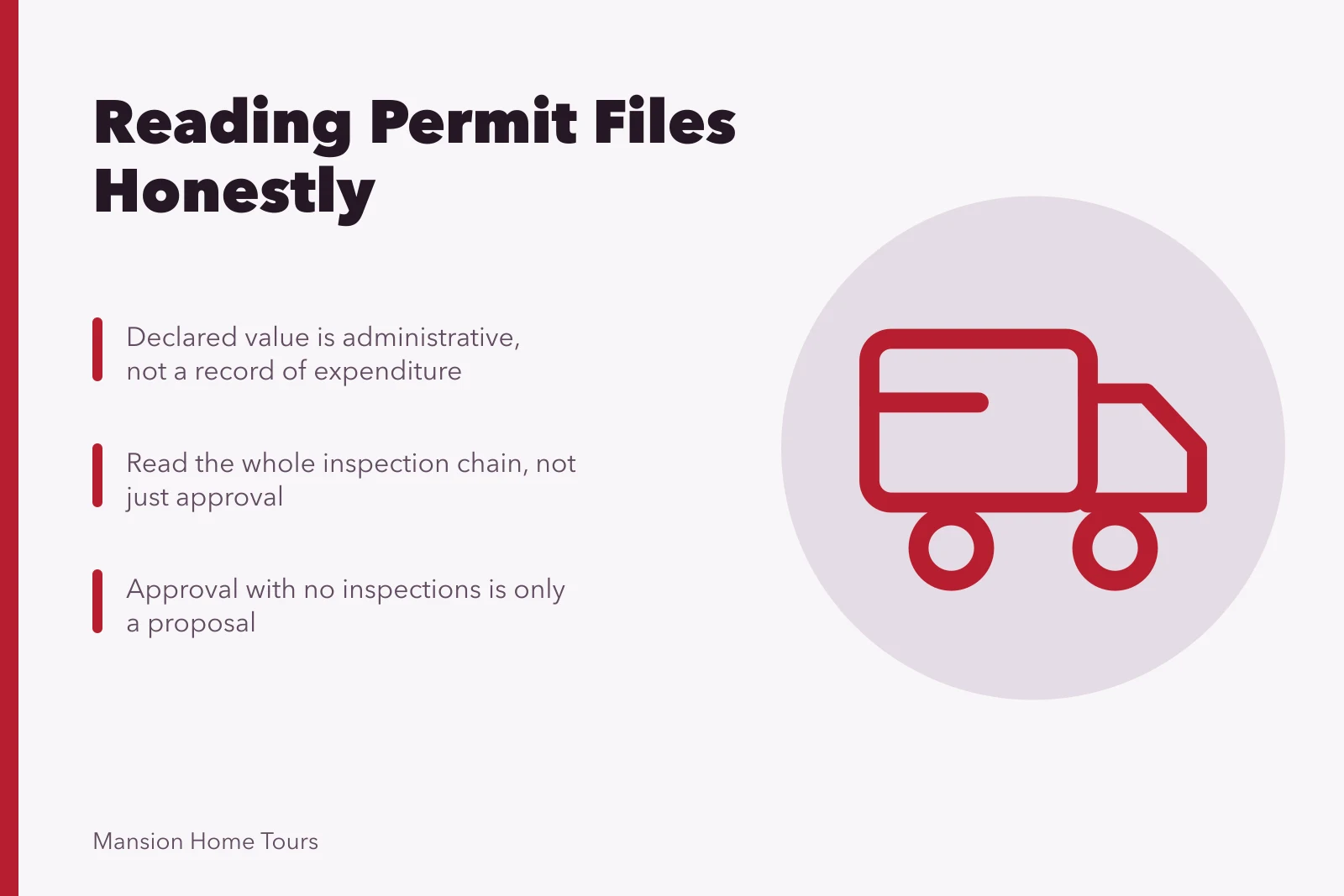
- Read the whole chain rather than the approval. An approval with no inspections is a proposal.
- Take dates from the file and put them beside the physical evidence, which is where the two kinds of research meet, as set out in reading interior phases.
- Treat the declared value as an administrative field and do not restate it as cost.
- Where a file is silent, say so. Work is done without permits, and a gap in the record is not evidence that nothing happened.
Why public records exist and what they are for in general is in how property records work, and how they differ office by office is in finding the right office. The recorder holds the price, the building department holds the permit, and neither office reconciles with the other.
Using Permit Files
- Read whole chain, not just approval
- Compare dates with physical evidence
- Treat declared value as administrative
- State gaps in the record
Common questions
Can I work out what a renovation cost from a permit?
No. The field is defined administratively and is not reconciled against actual expenditure. A recorded deed gives a sale price, and it says nothing about what a later renovation cost.
Why do some large projects have small declared values?
Because of what the definition includes. A figure excluding equipment, design fees or an owner-supplied element is a different figure from one including them, and both are correct returns under their own rules.
Is unpermitted work visible in the record?
Sometimes, through a later violation notice or a legalization permit. Often not at all. The absence of a permit is weak evidence, and the building is the better witness.
What is the most useful single document in a permit file?
The inspection record. An approval says what was allowed; an inspection says what somebody looked at.
Where do 2027 sale prices come from?
The deed at the county recorder, plus transfer tax filings that show the price paid. Check it against NAR's monthly existing-home report, FHFA's quarterly House Price Index and Case-Shiller's 20-city composite.